| |

|
|

Tempel1-ZZ-ZJ-Stardust_1024-PIA13860-PCF-LXTT.jpgComet Tempel-1 from Stardust NeXT Spacecraft (Natural Colors; credits for the additional process. and color.: Dr Paolo C. Fienga - Lunexit Team) 128 visiteCaption NASA:"This image mosaic shows 4 different views of comet Tempel-1 as seen by NASA's Stardust Spacecraft as it flew by it on February 14, 2011.
The images progress in time beginning at upper left, moving to upper right, then proceeding from lower left to lower right. When the Spacecraft first approached, it got a clear look at the same Surface that was imaged previously by NASA's Deep Impact Spacecraft in 2005. Deep Impact sent a projectile into the Comet, creating a crater that is located in the upper left image, but is difficult to see at this particular contrast level.
As Stardust flew closer to the Comet, it began to see New Territory that had not been imaged before. The New Territory appears on the left side of the upper right image. The Deep Impact Crater is also located in this view, on the right side.
Both the upper right and lower left images are the Closest Approach images for Stardust, taken at 3" before, and 3" after it. The images were taken from a distance of about 185 Km (approx. 115 miles). In the lower left image, the vast majority of Terrain pictured had not been seen until now. The fourth image, at lower right, shows Stardust's view as the Spacecraft was on the way out.
The image at upper left was taken 15" before the Encounter (or Closest Approach) from a distance of approx. 244 Km (about 152 miles); the image at lower right was taken 15" after the Encounter, from a distance of approx. 245 Km (about 152 miles)".MareKromium
|
|

Tempel1-ZZ-ZJ-Stardust_1024-PIA13867.jpgComet Tempel-1 from Stardust NeXT Spacecraft (Natural Colors; credits for the additional process. and color.: Dr Paolo C. Fienga - Lunexit Team) 135 visiteCaption NASA:"At the time of the encounter, comet Tempel-1 was approx. 335 MKM (about 208 MMs) away from Earth.
Tempel-1 is oblong in shape and has an average diameter of about 6 Km (approx. 4 miles). Stardust-NExT is an extended mission for the comet chaser, which previously flew past comet Wild 2 and returned some samples from its Coma to Earth.
During this latest encounter, the Spacecraft took images of the Comet's Surface and observed changes that occurred since a NASA Spacecraft last visited it (NASA's Deep Impact Spacecraft had an encounter with Tempel-1 in July 2005).
Stardust-NExT is a low-cost mission that is expanding the investigation of comet Tempel-1 initiated by the Deep Impact Spacecraft.
The mission is managed by the Jet Propulsion Laboratory, a division of the California Institute of Technology, Pasadena, Calif., for NASA's Science Mission Directorate in Washington. Lockheed Martin Space Systems in Denver built the Spacecraft and manages day-to-day mission operations".MareKromium
|
|

Tempel1-ZZ-ZL-PIA02132_fig1.jpgThe "Sunny Side" of Comet Tempel-180 visiteCaption originale:"This image composite shows comet Tempel 1 in visible (left) and infrared (right) light. The infrared picture highlights the warm, or sunlit, side of the comet, exactly where NASA's Deep Impact probe hit. These data were acquired about six minutes before impact.
The visible image was taken by the medium-resolution camera on the mission's flyby spacecraft, and the infrared data were acquired by the flyby craft's infrared spectrometer".
|
|

Tempel1-q.jpg13 MKM from Comet Tempel 169 visiteDa "NASA - Picture of the Day" del 29 Giugno 2005:"The Deep Impact spacecraft continues to close on Comet Tempel 1, a comet roughly the size of Manhattan. Early on July 3 (EDT), the Deep Impact spacecraft will separate in to 2 individual robotic spaceships, one called Flyby and the other called Impactor. During the next 24 hours, both Flyby and Impactor will fire rockets and undergo complex maneuvers in preparation for Impactor's planned collision with Comet Tempel 1. On July 4 (1:52 am EDT) if everything goes as scheduled, the 370-Kg Impactor will strike Tempel 1's surface at over 14.000 Km p.h.. Impactor will attempt to photograph the oncoming comet right up to the time of collision, while Flyby photographs the result from nearby. The above image was taken on 19 June from about 13 MKM out and used to help identify the central nucleus of the comet inside the diffuse coma. Telescopes around the Earth, including the HST, will also be closely watching the distant silent space bullet".
|
|

Tempel1-r-ImpactConfirmation.jpgDeep-impact...69 visiteTime of Impact: July 4, 05:52:15.0 +/- 17 sec UT as seen from Earth (1-sigma uncertainty)
Impact successfully occurred on July 4 at 05:52:24 UT as seen from Earth
|
|

Tenth_Planet-00.jpgThe 10th Planet? (1)73 visiteDa "NASA - Picture of the Day", del 31 Luglio 2005:"Is that a Tenth Planet? A faint, slowly moving dot discovered by computer shows clear signs of being a deep Solar System object at least as large as Pluto. The object, designated 2003 UB313, is currently situated nearly 100 times the Earth-Sun distance - over twice the average Pluto-Sun distance. That far out, the only way a single round object could be as bright as 2003 UB313 would be if it is at least as large as Pluto and completely reflective.
Since 2003 UB313 is surely not completely reflective, it could be substantially larger. One of the discovery frames is shown above digitally expanded and artificially brightened. 2003 UB313 was identified initially on frames taken by the automated 1.2-meter Samuel Oschin Telescope at Palomar Observatory in California, USA".
|
|

Tenth_Planet-01.jpgThe 10th Planet? (2)68 visitePerchè escludere a priori, come fa la NASA, che il Decimo Pianeta abbia una superficie TOTALMENTE RIFLETTENTE?
Scusateci la provocazione, ma sarebbe sufficiente ipotizzare - per assurdo, se volete - che questo ipotetico Decimo Pianeta sia:
1) una sfera costituita prevalentemente di ghiaccio (un'eventualità tutt'altro che remota);
2) un corpo capace di emanare luce propria (una piccola stella?);
3) una sfera metallica (ossìa, per esempio, una gigantesca astronave che si trova "parcheggiata" ai confini del Sistema Solare).
Stupidaggini "Cosmiche"? Fantascienza di basso livello? Forse.
Ma se ci pensate (e se conoscete almeno un poco la storia del Sistema Solare e delle meccaniche - per lo più teoriche - che ci hanno permesso di stimarne le dimensioni complessive), l'ipotesi più improbabile (molto in voga negli anni '60/'70 ma poi ritenuta inverosimile ed abbandonata) è proprio quella che immagina il Decimo Pianeta come un corpo roccioso di dimensioni medio-grandi!
|
|

Tenth_Planet-03.jpgThe 10th Planet? (3)69 visiteDa "NASA - Picture of the Day", del 1mo Agosto 2005:"Has a tenth planet been discovered? A newly discovered object, designated 2003 UB313 and located more than twice the distance of Pluto, is expected to be at least as large as Pluto and probably larger, given current measurements. 2003 UB313's dimness and highly tilted orbit (44°) prevented it from being discovered sooner. Many astronomers speculate that numerous other icy objects larger than Pluto likely exist in the Kuiper Belt of the far distant Solar System. If so, and if some are found closer in than 2003 UB313, it may be premature to call 2003 UB313 the tenth planet. Illustrated above is an artist's drawing showing what 2003 UB313 might look. The unusually bright star on the right is the Sun. Much of the world eagerly await the decision by the International Astronomical Union on whether 2003 UB313 will be designated a planet or given a name without subscripts".
|
|

Torifune_JAXA_1400.jpgDouble Asteroid "Torifune" (Credits: JAXA, U. of Tokyo, Chiba Tech, Tokyo U. of Science, AIST, Paris Obs., IAC)127 visiteWhy is this asteroid a double? Earlier this month the Japanese robotic spacecraft Hayabusa2 shot past asteroid 98943 Torifune and captured pictures. Although previous observations from distant Earth indicated that Torifune was oblong, Hayabusa2 found that Torifune actually has two joined lobes. With a length of about four soccer fields, this space rock frequently comes near the Earth as it orbits the Sun, although it is not a threat. Besides the two lobes, Torifune shows many large boulders, but, surprisingly, no obvious craters, likely because its surface is a pile of rubble. Like asteroid Arrokoth, it appears that each lobe formed separately before colliding and becoming stuck together. Hayabusa2 famously encountered asteroid Ryugu in 2018, and now heads for an encounter in 2031 with 1998 KY26, a smaller asteroid that rotates unusually fast and might have reservoirs of ice. Torifune translates literally to "bird boat" in Japanese. It primarily refers to Ame-no-torifune (Heavenly Bird Boat), a deity and his a deity and his magical vessel in Japanese mythology capable of traveling at high speeds with the steadiness of a rock.MareKromium
|
|
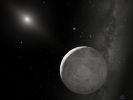
Xena.jpgXena: another "Tenth Planet"? (2003 UB313)69 visiteNASA's Hubble Space Telescope has resolved the Tenth Planet, now nicknamed Xena, for the first time and has found that it is only just a little larger than Pluto.
Though previous ground-based observations suggested that Xena was about 30% greater in diameter than Pluto, Hubble observations taken on Dec. 9 and 10, 2005, yield a diameter of 1.490 miles (with an uncertainty of 60 miles) for Xena. Pluto's diameter, as measured by Hubble, is 1.422 miles. Xena is the large object at the bottom of this artist's concept. A portion of its surface is lit by the Sun, located in the upper left corner of the image. Xena's companion, Gabrielle, is located just above and to the left of Xena.
|
|

ZZ-ZZ-ZZ-ZZ-ZZ-ZZ-ZZ-ZZ-Ultima_Thule_-_1.jpgUltima Thule (now "Arrokoth")109 visiteThe New Horizons team used the Hubble Space Telescope to search for its post-Pluto, Kuiper Belt flyby target. Using observations made with Hubble on June 26, 2014, the science team (led by co-investigator Marc Buie) discovered an object that New Horizons could reach with its available fuel. The object was subsequently designated 2014 MU69, given the minor planet number 485968 and, with public input, nicknamed "Ultima Thule" (which means "beyond the known world").
MU69 is located in the Kuiper Belt, beyond the orbit of Neptune. At 12:33 a.m. (EST) on January 1, 2019, New Horizons flew just 2,200 miles (3,500) kilometers from the object's surface, when it was about 4 billion miles (6.6 billion kilometers) from the Sun -- the most distant planetary flyby in history and the first close-up look at a solar system object of this type.
Ultima Thule is the first unquestionably primordial contact binary ever explored. Approach pictures hinted at a strange, snowman-like shape, but further analysis of images, taken near closest approach, uncovered just how unusual the KBO's shape really is. At 22 miles (35 kilometers) long, the binary consists of a large, flat lobe (nicknamed "Ultima") connected to a smaller, rounder lobe (nicknamed "Thule").
This strange shape was the biggest surprise of the flyby. Nothign like it has been anywhere in the solar system -- sending the planetary science community back to the drawing board to understand how planetesimals (the building blocks of the planets) form.
Because it is so well preserved, MU69 offered our clearest look back to the era of planetesimal accretion and the earliest stages of planetary formation. Apparently the two lobes once orbited each other, like many so-called binary worlds in the Kuiper Belt, until something brought them together in a "gentle" merger.
In color and composition, New Horizons data revealed that MU69 resembles many other objects found in its region of the Kuiper Belt. Consistent with pre-flyby observations from the Hubble Telescope, Ultima Thule is very red � redder even than Pluto, which New Horizons flew past on the inner edge of the Kuiper Belt in 2015 � and about the same color as many other so-called "cold classical" KBOs. ("Cold" referring not to temperature but to the circular, uninclined orbits of these objects; "classical" in that their orbits have changed little since forming, and represent a sample of the primordial Kuiper Belt.)
New Horizons scientists have also seen evidence for methanol, water ice and organic molecules on the surface -- a spectrum similar to some of the most extreme objects we've seen in the outer solar system.
Flyby data transmission continues, with all data expected on the ground by late summer 2020.MareKromium
|
|

ZZ-ZZ-ZZ-ZZ-ZZ-ZZ-ZZ-ZZ-Ultima_Thule_2-flyby.gifUltima Thule (Fly-By)83 visiteOriginal Caption:"Mission scientists created this "departure movie" from 14 different images taken by the New Horizons Long Range Reconnaissance Imager (LORRI) shortly after the spacecraft flew past the Kuiper Belt object nicknamed Ultima Thule (officially named 2014 MU69) on Jan. 1, 2019".MareKromium
|
|
| 289 immagini su 25 pagina(e) |
|
|
|
|
|
|
|
|
|
24 |
|
|
|








