|
|
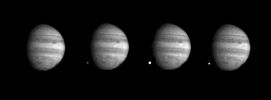
Shoemaker-Levy 9-1.jpgShoemaker-Levy 9: the W-impact (1)67 visiteThese four pictures, taken 2,3" apart, show the early meteor, or "bolide", stage of the impact of the last major fragment of Comet Shoemaker-Levy 9 into Jupiter's night side. In the first image (8:06:12 UTC), no impact is visible. In the second picture, a bright point of light appears superimposed on the dark side of Jupiter's Southern Hemisphere. In the third image, the impact has grown so bright that it saturates the CCD picture element at the center of the image of the impact flash. By remarkable coincidence, the HST took a picture of the W-impact, also in green light, within 1" of this image, providing a complementary view of very faint associated phenomena at very high altitudes in Jupiter's atmosphere, just above the planet's edge as seen from Earth. In the final Galileo image (8:06:19 UTC), the impact flash has faded appreciably.
These images are pictures 5 through 8 of a series of 56 placed on a single frame in time-lapse fashion. We interpret the rapid rise and fall of this initial peak over just 7 seconds to be the bolide phase of the W fragment's impact, analogous to the flash of light of meteors entering Earth's atmosphere. Images immediately following this show that the luminosity continues to fade over the next 15 seconds.
|
|

Shoemaker-Levy 9-2.jpgShoemaker-Levy 9: the W-impact (2)79 visiteThese four images of Jupiter and the luminous night-side impact of fragment W of Comet Shoemaker-Levy 9 are different versions of an average of 8 images taken by the Galileo spacecraft of July 22, 1994.
The frames that were averaged span about 30" near 8:06 UT.
These four "averaged" images show the scene without and with (top and bottom) spatial filtering and contrast enhancement, and without and with (left and right) a latitude/longitude grid. Grid spacing is 30 degrees, with 230° Longitude centered. The terminator is at about 265°. The impact location is about 43° South, as predicted, and at 280° Longitude. The dark spots to the right of the flash are from previous impacts.
|
|

ShootingStar.jpgShooting Star93 visiteDa "NASA - Picture of the Day" del giorno 15 Ottobre 2009:"The brilliant fireball meteor captured in this snapshot was a startling visitor to Tuesday evening's twilight skies over the city of Groningen (NL).
In fact, sightings of the meteor, as bright as the Full Moon, were widely reported throughout the Netherlands and Germany at approximately 17:00 UT. Accompanied by sonic booms and rumbling sounds, the meteor was seen to break up into bright fragments, eventually leaving a persistent smoke-like trail.
Even though there are bright fireball meteors in planet Earth's Atmosphere every day, sightings of them are relatively rare because they more often occur over oceans and uninhabited areas".MareKromium
|
|

Steins-0.jpg2867 Šteins137 visiteCaption NASA:"Cruising though space, sometimes you'll come across an unusual object. Such was the case on Friday for ESA's Rosetta Spacecraft on it's way to comet Churyumov-Gerasimenko. Robotic Rosetta buzzed right by the main belt asteroid 2867 Šteins, taking many pictures, some of which have been compiled into a short video.
At first glance, Steins looked like a 5-Km wide diamond, but as Rosetta shot by, craters and a more extended shape become evident. In the above sequence of 6 images, a notable chain of craters is evident vertically on the Asteroid's Surface, most probably caused by a chance collision with a stream of meteors. Space scientists will now study the data taken by Rosetta of asteroid Steins in an effort to better understand its composition, origin, and why the asteroid reflects light so well.
As the Earth-bound scientists toil, Rosetta itself will continue to zoom across our Solar System, next swooping again by the Earth in 2009 November, flying by asteroid 21 Lutetia in July 2010, and finally landing on Comet Churyumov-Gerasimenko in November 2014".
Nota Lunexit: un nuovo (ed eclatante) esempio di Asteroide il quale ci mostra, fra le diverse Surface Features che ne caratterizzano le fattezze, un gigantesco cratere (da impatto?!?) il quale - nonostante le usuali spiegazioni degli Scienziati Planetari NASA ed ESA - non potrebbe (nè dovrebbe) esistere.
Altri tre esempi di piccoli asteroidi che presentano un inspiegabile (per dimensioni e fattezze) "Mega-Cratere" sulla loro superficie: Annefrank; Mathilde e Dactyl (senza dimenticare Phobos, come ovvio, anche se Phobos - tecnicamente - non è un asteroide. O almeno: non lo è più...).MareKromium
|
|

Steins-1.JPG2867 Šteins (3D)66 visitenessun commentoMareKromium
|
|

Tempel 1-PIA07879.jpgComet "Tempel 1"69 visiteCaption NASA originale:"Sixty-nine days before it gets up-close-and-personal with a comet, NASA's Deep Impact spacecraft successfully photographed its quarry, comet Tempel 1, at a distance of 39,7 MMs. The image, taken on April 25, 2005, is the first of many comet portraits Deep Impact will take leading up to its historic comet encounter on July 4, 2005".
|
|

Tempel1-PIA07881.jpgTempel-1, from Kitt Peak (pseudo-colors)72 visiteCaption NASA originale:"The Kitt Peak National Observatory's 2,1-meter telescope observed comet Tempel 1 on April 11, 2005, when the comet was near its closest approach to the Earth. A pinkish dust jet is visible to the SouthWest, with the broader neutral gas coma surrounding it. North is up, East is to the left and the field of view is about 80.000 Km wide. The Sun was almost directly behind the observer at this time. The red, green and blue bars in the background are stars that moved between the individual images.
This pseudo-color picture was created by combining three black and white images obtained with different filters. The images were obtained with the HB Narrowband Comet Filters, using CN (3870 A - shown in blue), C2 (5140 A - shown in green) and RC (7128 A - shown in red).
The CN and C2 filters capture different gas species (along with the underlying dust) while the RC filter captures just the dust".
|
|

Tempel1-S-ImpactConfirmation.jpgTempel-1 from Kitt Peak National Obs.64 visiteOriginal caption:"The image was taken through an R band filter and has the smoothed dust light profile removed to enhance the jets. North is up, East to the left, the Sun at PA (Position Angle) 290 and the FOV is 2,5 arcmin (which is now 96.500 km at the comet)".
T. Farnham and Jianyang Li
(University of Maryland)
|
|

Tempel1-U-HST.jpgDeep-impact from HST78 visiteCaption NASA originale:"These 2 pictures of comet Tempel-1 were taken by NASA's HST. They show the comet before and after it ran over NASA's Deep Impact probe".
|
|

Tempel1-VV-nhvcaxf9000910-PIA02131.jpgImpact Time!67 visiteWhen NASA's Deep Impact probe collided with Tempel-1, a bright, small flash was created, which rapidly expanded above the surface of the comet. This flash lasted for more than a second and its overall brightness is close to that predicted by several models. After the initial flash, there was a pause before a bright plume quickly extended above the comet surface. The debris from the impact eventually cast a long shadow across the surface, indicating a narrow plume of ejected material, rather than a wide cone. The Deep Impact probe appears to have struck deep, before gases were heated and explosively released. The impact crater was observed to grow in size over time. A preliminary interpretation of these data indicate that the upper surface of the comet may be fluffy, or highly porous. The observed sequence of impact events is similar to laboratory experiments using highly porous targets, especially those that are rich in volatile substances. The duration of the hot, luminous gas phase, as well as the continued growth of the crater over time, all point to a model consistent with a large crater.
|
|

Tempel1-W.jpgDeep-impact...13 seconds after collision!80 visiteCaption NASA originale:"This image shows the initial ejecta that resulted when NASA's Deep Impact probe collided with comet Tempel-1 at 10:52 p.m. Pacific Time, July 3 (1:52 a.m. Eastern time, July 4). It was taken by the spacecraft's high-resolution camera 13 seconds after impact. The image has been digitally processed to better show the comet's nucleus".
|
|

Tempel1-X.jpgDeep-impact...16 seconds after collision!63 visiteCaption NASA originale:"This image shows the initial ejecta that resulted when NASA's Deep Impact probe collided with comet Tempel-1 at 10:52 p.m. Pacific time, July 3 (1:52 a.m. Eastern time, July 4) . It was taken by the spacecraft's medium-resolution camera 16 seconds after impact".
|
|
| 289 immagini su 25 pagina(e) |
 |
|
|
|
|
|
|
22 | |
|
|








