|
|

Lutetia-05-CTX-EDM-PCF-LXTT-IPF.jpgAsteroid 21-Lutetia (CTX Frame and EDM - Absolute Natural Colors; credits for the additional process. and color.: Dr Paolo C. Fienga - Lunexit Team)165 visite21 Lutetia is a relatively large Main-Belt Asteroid, measuring about 100 Km in diameter (approx. 120 km along its Major Axis). It was discovered in the AD 1852 by the French-German Astronomer Hermann Goldschmidt, and is named after Lutetia, such as the Latin name of the city that stood where Paris was later built. The Asteroid 21 Lutetia has an irregular shape and is heavily cratered, with the largest Impact Crater reaching about 45 Km in diameter.
The Surface of this Asteroid is geologically heterogeneous and it is intersected by a system of Grooves and Scarps, which are thought to be the external manifestation of deep, internal, Fractures; it also possess an high Average Density, which could have meant that is (likely) made of Iron and Nickel rich Rock (even though, as we shall better see later on, this - however logical - claim, is still unproven). The ESA - Rosetta Probe passed as close as about 3162 Km (approx. 1965 miles) from 21 Lutetia in July 2010 and, at the time of Rosetta's Fly-By, it was the largest Asteroid ever visited by a Spacecraft (that, until the NASA - Dawn Spaceraft arrived at 4 Vesta, in July 2011).
The composition of 21 Lutetia has puzzled astronomers for some time, and that is because, while classified among the M-type Asteroids, most of which are Metallic (better yet: rich of Metallic Minerals/Elements), 21 Lutetia must be one of the so-called Anomalous Members of this classification, since it does not display much evidence of Metallic Minerals on its Surface. As a matter of fact, after most part of the data received from the Rosetta Probe were analyzed, several indications of a NON-Metallic Surface of this Asteroid were found, like, for instance, a flat, Low Frequency Spectrum (similar to that of Carbonaceous Chondrites and C-type Asteroids - which is, of course, deeply different from the one of the so-called Metallic Meteorites, such as those Meteorites which are logically believed to derive from a Metallic - such as, we repeat, Iron and Nickel-rich - Celestial Body), a low Radar Albedo (unlike the high Albedoes of Strongly Metallic Asteroids, like 16 Psyche), evidence of Hydrated Materials on its Surface, abundant Silicates, and a thicker layer of Regolith than most of the other known (as far as their composition is concerned) Asteroids.MareKromium
|
|

MATHILDE_FLY-BY.gifMathilde (NEAR Probe Fly-By)80 visiteGuardate bene: osservate il "main crater" di Mathilde, così (enorme-mente) simile allo Stickney Crater di Phobos e poi, se volete, provate a pensare...Crateri troppo grandi, per mondi troppo piccoli!
Che ne dite?MareKromium
|
|

Man-Made_Nebula.gifMan-Made Nebula, such as: a warning sign of the Kessler Syndrome (GIF Movie)91 visiteCaption NASA:"What's that cloud drifting in space? It's not an astronomical nebula because...those appear to stay put.
Atmospheric clouds don't look like this.
The answer to last week's sky mystery turned out to be orbiting and expanding debris from the upper stage of a failed Russian rocket that exploded unexpectedly. The cloud became visible to unaided southern hemisphere observers, and its cause was initially unknown. The above time lapse movie shows the cloud drifting as seen from Australia. Streaks in and near the cloud are likely large pieces of debris. The debris cloud is more than an astronomical curiosity -- particles from this cloud and others could become projectiles damaging existing satellites. As the cloud disperses, many particles will fall to Earth, but many more may help make low Earth orbit an increasingly hostile environment".MareKromium
|
|

Mathilde-PIA02479.jpgMathilde82 visiteCaption NASA originale:"Two different views of asteroid 253 Mathilde were obtained by the NEAR spacecraft on June 27, 1997. The image at left was obtained as the spacecraft approached Mathilde with its camera pointed near the direction of the Sun; only a few of the prominent ridges on Mathilde are illuminated. The visible area at left is 29 Km (approx. 18 miles) high and the phase angle (the angle from Sun-Mathilde spacecraft) is 136°. As the spacecraft receded from Mathilde, it observed the asteroid (about 60 Km - or 38 miles across) almost fully lit by the Sun at a phase angle of 43° (right image). Mathilde's irregular shape results from a long history of severe collisions with smaller asteroids. The largest visible crater is about 30 Km (19 miles) in diameter".
|
|

Mathilde-PIA02494.jpgMathilde and Eros: C-Type and S-Type74 visiteCaption NASA originale:"In this montage, Mathilde (at left) and Eros (at right) are shown at the same scale, as they were imaged by NEAR Shoemaker from about 1.800 Km on June 27, 1997, and February 12, 2000, respectively. Mathilde is 56 Km across and Eros is 33 Km long and 13 Km wide. However, Mathilde's brightness is greatly exaggerated for viewing purposes - it's actually 6 times darker than Eros, with about the same reflectivity as soot! In a scheme that reflects how asteroids have historically been a topic for astronomy, not geology, they are classified into groups based on their colors as observed through telescopes. The 2 major classes of asteroids are called S-Types and C-Types. S-Types, whose colors are consistent with "stony" or rocky compositions, prevail among asteroids that orbit closer to the Sun than the mid-point of the asteroid belt. Eros and the 2 asteroids encountered briefly by the Galileo spacecraft on its way to Jupiter - Gaspra and Ida - are all S-Types. C-Types like Mathilde have a dark gray color consistent with a "carbonaceous" composition, rich in carbon compounds and other dark materials. They prevail in the outer part of the asteroid belt".
|
|
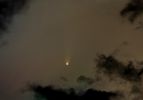
McNaught-00.jpgComet McNaught (1)65 visiteCaption NASA:"Early morning risers with a clear and unobstructed eastern horizon can enjoy the sight of Comet McNaught (C/2006 P1) in dawn skies over the next few days. Discovered in August by R. H. McNaught (Siding Spring Survey) the comet has grown bright enough to see with the unaided eye but will soon be lost in the glare of the Sun. Still, by January 11 sun-staring spacecraft SOHO should be able to offer web-based views as the comet heads toward a perihelion passage inside the orbit of Mercury. This image captures the new naked-eye comet at about 2nd magnitude in twilight skies near sunset on January 3rd. After rounding the Sun and emerging from the solar glare later this month, Comet McNaught could be even brighter".
|
|

McNaught-01.jpgComet McNaught (2)67 visiteCaption NASA:"The brightest comet in decades is unexpectedly now visible. The most optimistic predictions have Comet McNaught (C/2006 P1) shortly becoming one of the brightest comets of the past century. For the next few days, its short tail and bright coma can be spotted with the unaided eye close to the Sun and near the horizon in both evening and morning skies. This dramatic picture of the comet shining through cloudy skies was taken near sunset on January 7, 2007, from Bad Mergentheim, Germany".
|
|

McNaught-02.jpgComet McNaught (3)66 visiteCaption NASA:" Bright Comet McNaught (C/2006 P1) graced the twilight this week, seen by many and often described with superlatives. Watching the skies over Krakow, Poland, Andrzej Sawow recorded this view on Wednesday - with an ordinary handheld digital camera. He notes that "... astronomy is really for everyone who loves to look at the night sky. And fortunately (sometimes) the sky generously rewards its observer". Now very close to the Sun, Comet McNaught (along with Mercury) is visible in realtime images from the SOHO spacecraft. Otherwise, skywatchers will find the comet hard to see this weekend. But southern hemisphere observers could be rewarded next week as Comet McNaught begins to climb higher in southern skies".
|
|

McNaught-03.jpgComet McNaught (4)66 visiteCaption NASA:"This past weekend Comet McNaught peaked at a brightness that surpassed even Venus. Fascinated sky enthusiasts in the Earth's Northern Hemisphere were treated to an instantly visible comet head and a faint elongated tail near sunrise and sunset. Recent brightness estimates had Comet McNaught brighter than magnitude - 5 (minus five) over this past weekend, making it the brightest comet since Comet Ikeya-Seki in 1965, which was recorded at - 7 (minus seven). The Great Comet of 2007 reached its brightest as it rounded the Sun well inside the orbit of Mercury. Over the next week Comet McNaught will begin to fade as it moves south and away from the Sun. The unexpectedly bright comet should remain visible to observers in the Southern Hemisphere with unaided eyes for the rest of January.
The above image, vertically compressed, was taken at sunset last Friday from mountains above Catalonia, Spain".
|
|

McNaught-04.jpgComet McNaught (5)66 visiteCaption NASA:"The brightest comet of recent decades was a surprising first sight for a new camera in space.
The Sun Earth Connection Coronal and Heliospheric Investigation (SECCHI) instrument onboard the Solar TErrestrial RElations Observatory (STEREO) satellite had just opened up on January 11, 2007, when it snapped the above image of Comet McNaught. Visible was a spectacular view of the ion tail of Comet McNaught being swept away from the Sun by the solar wind in filamentary rays. The comet tail is seen to extend at least seven degrees across the above image, while the central coma is so bright it saturates. Comet McNaught is now reportedly so bright that it is visible even in broad daylight by blocking out the Sun with your hand.
Comet McNaught has rounded the Sun and will slowly fade away for observers in Earth's Southern Hemisphere as it recedes from the Sun".
|
|

McNaught-05.jpgComet McNaught (6)78 visiteCaption NASA:"After a remarkable performance in the Northern Hemisphere, the brightest comet in decades is now showing off in the South. Recorded during evening twilight on January 17, 2007, this view features the bright coma and gorgeous, sweeping tail of Comet McNaught (c/2006 P1) over Lake Horowhenua in Levin, a small town on New Zealand's North Island.
Astronomer Noel Munford reports that the five second long digital camera exposure comes close to capturing the visual appearance of the comet in a sky coloured by smoke from distant brush fires in Australia. Discovered last summer by R. H. McNaught (Siding Spring Survey), the comet grew impressively bright in early January and has even been sighted in full daylight.
In the coming days Comet McNaught will continue to move south, for now a spectacle in Southern Skies as it heads for the outer Solar System".
|
|
McNaught-06.jpgComet McNaught (7)79 visitenessun commento
|
|
| 289 immagini su 25 pagina(e) |
 |
|
|
|
|
20 | |
|
|
|
|








