|
|

LL-Itokawa.jpgTarget Marker located on Itokawa (1)70 visiteOn Nov. 26, spacecraft "Hayabusa" challenged the second trial to execute landing on and sampling from the asteroid Itokawa. Hayabusa team confirmed the whole process to have been implemented and it is sure that the team succeeded in sampling materials on the surface of an asteroid for the first time in World History. Detailed data to be sent from Hayabusa will further verify the sampling.
Hayabusa started its last descent phase from the altitude of 1 km above Itokawa by command from Earth around 10:00 p.m. Nov.25 (JST). It was followed by starting the vertical descent from around 6:00 a.m. Nov.26., and, around 6:25 a.m., Sagamihara Deep Space Control Room sent a command to continue the descent.
Hayabusa challenged landing and sampling operation after a hovering phase. Hayabusa team is now sure, through the analysis of telemetry data, that a series of sequence for sampling was successfully done. Hayabusa then flew up to several kilometers altitude with normal solar paddles power, spacecraft attitude, etc.
|
|
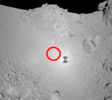
LLL-Itokawa.jpgTarget Marker located on Itokawa (2)68 visiteThe spacecraft shifted to safe-hold mode because of its attitude dispersion during ascent, and Sagamihara Deep Space Control Room is now carrying out the recovery operation to three-axis control mode.
It therefore takes a few more days to obtain detailed data relating the procedure. Instruments onboard are functioning very well so far.
Spacecraft Hayabusa could find, on the surface of Itokawa, the Target Marker dropped on Nov. 20 among the images taken during descent phase on Nov. 26.
On the Target Marker are etched 880.000 names from 149 Countries.
The previous images show the area named "MUSES Sea" and they were taken at 04:58 of Nov. 20, 2005 (left) and at 06:24 of Nov. 26, 2005 (right).
In this frame, the white light spot inside the red circle is the Target Marker with the 880.000 names!
|
|

LLM-Itokawa.jpg25143-Itokawa72 visiteA Japanese spacecraft has provided one of the best arguments yet in favor of a conception of asteroids which was pioneered by PSI (Planet Science Institute) scientists Don Davis and Clark Chapman in the late 70's. The evidence comes in startling closeup pictures of the tiny asteroid 25143-Itokawa, photographed by the Japanese Hayabusa spacecraft during a two-month encounter in late 2005. The asteroid illustrates the concept of a "Rubble-Pile" asteroid, which is composed of a mixture of boulders and dust gravitationally bound together.
The scientific results, recently highlighted in the journal Science, show that, unlike other asteroids recently imaged by spacecraft, which are mostly rounded and potato-like, dotted by craters, and with a few scattered boulders on the surface, Itokawa appears to be composed of massive splinter-like boulders protruding from a matrix of smaller fragments.
The largest boulders sticking out of the body appear to be some tens of meters across.
The Hayabusa science team includes PSI scientists Paul Abell and Bob Gaskell, and PSI affiliate scientists Hirdy Miyamoto and Faith Vilas.
|
|

LLN-Itokawa-ST_2506464135_v.pngApproaching Itokawa (1 - natural colors; elab. Lunexit)64 visitenessun commentoMareKromium
|
|

LLN-Itokawa-ST_2506540935_v.pngApproaching Itokawa (2 - natural colors; elab. Lunexit)65 visitenessun commentoMareKromium
|
|
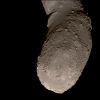
LLN-Itokawa-ST_2506694595_v.pngApproaching Itokawa (3 - natural colors; elab. Lunexit)66 visitenessun commentoMareKromium
|
|

LLN-Itokawa-ST_2506733028_v.pngApproaching Itokawa (4 - natural colors; elab. Lunexit)66 visitenessun commentoMareKromium
|
|

LLN-Itokawa-ST_2539429953_v.jpgThe unbelievable surface of 25143-Itokawa (HR - possible natural colors; elab. Lunexit)74 visiteIl piccolo Asteroide Itokawa si mostra ancora una volta per ciò che è: un piccolo mondo senza crateri e, apparentemente, senza polveri, la cui superficie - come questa splendida immagine HR ottenuta dalla Sonda JAXA "Hayabusa" - sembra risolversi in una serie di strati "a squame", tutti sensibilmente inclinati rispetto al piano dell'asteroide e, forse, piuttosto affilati (ci ricordano, in versione più grande, i "Razorblades" dei Crateri Endurance e Victoria (Marte).
Un piccolo mondo che, dopo un breve periodo di "fama", è ripiombato nell'oblìo collettivo, dopo che la Sonda JAXA "Hayabusa" ha malfunzionato (in circostanze e per cause ancora abbastanza oscure).
I Giapponesi, come ovvio, hanno preso molto male questo incidente, ma la coltre di silenzio che è caduta sulla Missione - la quale, come saprete, ha mostrato alla Terra il primo (ed unico?) Corpo Celeste PRIVO di crateri (un altro "schiaffo" per uno dei Maggiori Dogmi dell'Astronomia Convenzionale) - ha lasciato tutti molto perplessi.MareKromium
|
|

LLO-Itokawa-ST_25326292LL77_v.jpgThe unbelievable surface of 25143-Itokawa (HR1 - possible natural colors; elab. Lunexit)68 visitenessun commentoMareKromium
|
|

LLO-Itokawa-ST_2539423137_v.jpgThe unbelievable surface of 25143-Itokawa (HR3 - possible natural colors; elab. Lunexit)67 visitenessun commentoMareKromium
|
|

LLO-Itokawa-ST_25590030-68_v.jpgThe unbelievable surface of 25143-Itokawa (HR2 - possible natural colors; elab. Lunexit)79 visitenessun commentoMareKromium
|
|

LLO-Itokawa-ST_2563511720_v.jpgThe unbelievable surface of 25143-Itokawa (HR5 - possible natural colors; elab. Lunexit)81 visitenessun commentoMareKromium
|
|
| 288 immagini su 24 pagina(e) |
 |
|
|
|
|
18 | |
|
|
|
|





