|
|
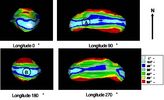
Itokawa-13.jpgGravity and Slope Map66 visiteThe purpose of the Rehearsal Descent is, first of all, to make sure that the proximity laser range finder works as intended, as its function has not been calibrated during cruise. The second purpose is to confirm whether the target marker image can be extracted against the asteroid surface, using onboard image processing that illuminates it using flash lamps onboard the spacecraft. The third purpose is to deploy and place the hopping robot MINERVA on the asteroid surface. Deploying MINERVA conflicts with the touch-down sequence, so it will be separated in advance of the sampling runs.
In conjunction with this very big challenge, JAXA is also starting a nation-wide campaign called ‘You Name the Landing Site’. The names assigned to the sites may not be officially registered by the IAU as the sites are very small. However, JAXA, as a finder, declares that the sites will be given those selected names.
|
|

Itokawa-2.jpgItokawa in natural colors66 visiteThis is the composite color image of Itokawa taken at September 12, 2005. This image composed of three images with different filters as red, green and blue. The irregular shape of this body is clearly seen and Hayabusa science observations started.
Hayabusa will approach Itokawa at a distance of 0,3 BKM from Earth. At this distance, even light takes about 17' to travel, so if Hayabusa needed an emergency instruction from Earth, it would not reach the probe in time. Therefore, Hayabusa is designed to pilot itself: to use the on-board camera and laser to read the asteroid's geography and judge when to approach it and where to land.
The exploration of small Solar System Bodies will contribute to improve our understanding of the Earth itself and it will also ead us to a more comprehensive interpretation of the constituents and potential resources that these celestial objects may have.
|
|

Itokawa-3.jpgItokawa and Hayabusa's shadow68 visiteDi asteroidi dalla forma bizzarra ne abbiamo visti davvero molti, ma mai così curiosi quanto Itokawa. Questa immagine, che peraltro possiede una definizione davvero ottima, ci mostra l'ombra della Sonda Hayabusa che si staglia, perfettamente definita, sul versante di Itokawa illuminato dal Sole.
Ed ora, qualche informazione su Hayabusa direttamente dall'Agenzia Spaziale Giapponese:"HAYABUSA's return trip from Earth to Itokawa is 2 billion kilometres long. Needless to say, such a long journey requires a large amount of fuel. HAYABUSA is the first long-distance interplanetary probe to use an ion engine as its main propulsion device.
Traditionally, propulsion occurs when gas is emitted at high speed. Until now, the main form of propulsion has consisted of super-heated gases created by burning fuel with an oxidant. An ion engine, in contrast, gets thrust from ionized gas accelerated by electricity. Therefore, it can accelerate much faster than by traditional propulsion, and only requires a tenth of the fuel.".
|
|

Itokawa.gifAsteroid "Itokawa": a new "shooting" against a Celestial Body66 visiteJapan's JAXA Space Agency launched the Hayabusa Mission to rendezvous with asteroid Itokawa. Last week, the small robotic Hayabusa spacecraft arrived at asteroid Itokawa and stationed only 20 Km away. Although a long term goal is to find out how much ice, rock and trace elements reside on the asteroid's surface, a shorter term goal is to determine the mass of the asteroid by measuring the attraction of the drifting Hayabusa spacecraft. During the next few months, Hayabusa will also image and map asteroid Itokawa. The above time-lapse image sequence was taken by Hayabusa upon final approach, showing the general oblong shape of the asteroid. In November, a small coffee-can sized robot dubbed MINERVA is scheduled for release and is expected to hop around the asteroid taking pictures. Also in November, Hayabusa will fire pellets into asteroid Itokawa and collect some of the debris in a return capsule. In December, Hayabusa will fire its rockets toward Earth and drop the return capsule in June 2007.
|
|

Itokawa.gifRevolving around Itokawa (a GIF-Movie by Dr Gianluigi Barca - Lunexit Team)80 visitenessun commentoMareKromium
|
|

Itokawa.jpgHayabusa's "shadow"!68 visiteWhat's that unusual looking spot on asteroid Itokawa? It's the shadow of the robot spacecraft Hayabusa that took the image. Japan's Hayabusa Mission arrived at the asteroid in early September and has been imaging and maneuvering around the floating space mountain ever since. The above picture was taken earlier this month (November 2005).
Asteroid Itokawa spans about 300 mt.
One scientific goal of the Hayabusa mission is to determine out how much ice, rock and trace elements reside on the asteroid's surface, which should give indications about how asteroids and planets formed in the early Solar System. A can-sized robot MINERVA that was scheduled to hop around the asteroid's surface has not, so far, functioned as hoped. Later this month, Hayabusa is scheduled to descend to asteroid Itokawa and collect surface samples in a return capsule. In December, Hayabusa will fire its rockets toward Earth and drop the return capsule down to Earth's Australian outback in 2007 June.
|
|

Itokawa~0.jpgClosing on Itokawa65 visiteItokawa: un asteroide che sembra contraddire tutto quanto viene dato per acquisito nel campo delle forme esteriori e dei rilievi superficiali dei corpi (teoricamente) esposti a pesantissimi azioni di impatto sin dagli albori della loro esistenza. Pensate a 433-Eros, oppure a Ceres, o Dactyl o a qualsiasi altro corpo similare che abbiamo avuto occasione di vedere da distanza ravvicinata. Forse il solo asteroide AnneFrank non sembra presentare una particolare craterizzazione (ma le immagini, di cattiva qualità, non possono essere considerate definitorie) e quindi si viene a porre nel novero delle rarità. Tuttavia, quello che vediamo adesso, è ben più che un'eccezione e molto di più di un'Anomalìa: Itokawa NON ha alcun cratere superficiale visibile e le sue forme, spigolose ed a tratti aguzze, costituiscono una novità assoluta per i Ricercatori e gli Studiosi di Scienze Planetarie.
Original caption:"Where are the craters on asteroid Itokawa? No one knows. The Japanese robot probe Hayabusa recently approached the Earth-crossing asteroid and is returning pictures showing a surface unlike any other Solar System body yet photographed -- a surface possibly devoid of craters. One possibility for the lack of common circular indentations is that asteroid Itokawa is a rubble pile -- a bunch of rocks and ice chunks only loosely held together by a small amount of gravity. If so, craters might be filled in whenever the asteroid gets jiggled by a passing planet -- Earth in this case. Alternatively, surface particles may become electrically charged by the Sun, levitate in the microgravity field, and move to fill in craters. Over the weekend, Hayabusa lowered itself to the surface of the strange asteroid in an effort to study the unusual body and collect surface samples that could be returned to Earth in 2007".
|
|

Iustitia.jpgIustitia (Imagination)104 visitenessun commentoMareKromium
|
|

KBO-1-Artist_Conception.jpgKuiper's Belt Object occulting a Star74 visiteThis is an artist's impression of a 0,5-mile-diameter Kuiper Belt Object (KBO) that was detected by NASA's Hubble Space Telescope. The icy relic from the early Solar System is too small for Hubble to photograph. The object was detected when it passed in front of a background star, temporarily disrupting the starlight.MareKromium
|
|

KBO-2-Artist_Conception.jpgKuiper's Belt Object occulting a Star77 visiteNASA's Hubble Space Telescope has discovered the smallest object ever seen in Visible Light in the Kuiper Belt, a vast ring of icy debris that is encircling the outer rim of the Solar System, just beyond Neptune.
The needle-in-a-haystack object found by Hubble is only 3200 feet across and a whopping 4,2 Billion Miles away. The smallest Kuiper Belt Object (KBO) seen previously in reflected light is roughly 30 miles across, or 50 times larger.
This is the first observational evidence for a population of comet-sized bodies in the Kuiper Belt that are being ground down through collisions. The Kuiper Belt is therefore collisionally evolving, meaning that the region's icy content has been modified over the past 4,5 BYs.
The object detected by Hubble is so faint — at 35th magnitude — it is 100 times dimmer than what Hubble can see directly.
So then how did the space telescope uncover such a small body?MareKromium
|
|

KBO-3-Artist_Conception.jpgKuiper's Belt Object occulting a Star66 visiteIn a paper published in the December 17th issue of the journal Nature, Hilke Schlichting of the California Institute of Technology in Pasadena, Calif., and her collaborators are reporting that the telltale signature of the small vagabond was extracted from Hubble's pointing data, not by direct imaging.
Hubble has three optical instruments called Fine Guidance Sensors (FGS). The FGSs provide high-precision navigational information to the space observatory's attitude control systems by looking at select guide stars for pointing. The sensors exploit the wavelike nature of light to make precise measurement of the location of stars.
Schlichting and her co-investigators determined that the FGS instruments are so good that they can see the effects of a small object passing in front of a star. This would cause a brief occultation and diffraction signature in the FGS data as the light from the background guide star was bent around the intervening foreground KBO.
They selected 4,5 years of FGS observations for analysis. Hubble spent a total of 12.000 hours during this period looking along a strip of sky within 20° of the Solar System's Ecliptic Plane, where the majority of KBOs should dwell. The team analyzed the FGS observations of 50.000 guide stars in total.
Scouring the huge database, Schlichting and her team found a single 0,3-second-long occultation event. This was only possible because the FGS instruments sample changes in starlight 40 times a second. The duration of the occultation was short largely because of the Earth's orbital motion around the Sun.
They assumed the KBO was in a circular orbit and inclined 14° to the Ecliptic. The KBO's distance was estimated from the duration of the occultation, and the amount of dimming was used to calculate the size of the object. "I was very thrilled to find this in the data", says Schlichting.
Hubble observations of nearby stars show that a number of them have Kuiper Belt–like disks of icy debris encircling them. These disks are the remnants of planetary formation. The prediction is that over billions of years the debris should collide, grinding the KBO-type objects down to ever smaller pieces that were not part of the original Kuiper Belt population.
The finding is a powerful illustration of the capability of archived Hubble data to produce important new discoveries. In an effort to uncover additional small KBOs, the team plans to analyze the remaining FGS data for nearly the full duration of Hubble operations since its launch in 1990.MareKromium
|
|

L-Itokawa.jpgThe Target Marker separated from Hayabusa (close-up)69 visiteThe Target Marker that separated from Hayabusa carried the names of 880.000 people who participated in the campaign from the World.
It was placed in the South-West area of the MUSES-Sea.
When it hit to the surface, the descent speed was about 9 cm/sec. The Target Marker was specifically designed and fabricated with an aluminum shell filled with polyimide balls (so to absorb kinetic energy through multi-collisions). This design is capable to dramatically suppress the bouncing of the probe and its function has been tested and verified via drop tower tests in a vacuum chamber on Earth.
The Target Marker (è il minuscolo punto luminoso - cerchiato in nero - che si vede accanto all'ombra di Hayabusa nel close-up di Sx) was illuminated by onboard flash lamps every 2' (...).
|
|
| 289 immagini su 25 pagina(e) |
 |
|
|
|
|
17 | |
|
|
|
|








