|
|

Comets-Halley-30155.jpgThe Halley Comet, from Giotto70 visiteCaption ESA originale:"A composite image of the nucleus of comet Halley. This image is composed of 68 images of varying resolution. The data at the brightest point on the nucleus is at the highest resolution (50 m).
The Sun comes from 30° above the horizontal to the left and is 17° behind the image plane (observation phase angle of 107°). The night side of the nucleus can be seen silhouetted against a background of bright dust in the far-field. Jets can be seen originating from 2 regions on the nucleus. Structure can be seen within the jets. A bright area is seen within the night side of the nucleus. We believe this to be a hill or mountain approximately 500 mt high. Other surface details can be seen in the illuminated region".
|
|
![Comets-Halley-Giotto-86hc145[1].jpg](albums/userpics/10008/small_Comets-Halley-Giotto-86hc145%5B1%5D.jpg "Nome del file=Comets-Halley-Giotto-86hc145[1].jpg
Dimensione del file=634KiB
Dimensioni=1756x1788
Aggiunta il=Set 17, 2006")
Comets-Halley-Giotto-86hc145[1].jpgThe "Halley Comet", from Giotto64 visitenessun commento
|
|

Comets-Halley-nucleus.jpgThe Nucleus of Halley79 visiteWhat does a Comet Nucleus look like?
Formed from the primordial stuff of the Solar System, Comet Nuclei were thought to resemble to very dirty icebergs. But ground-based telescopes revealed only the surrounding cloud of gas and dust of Active Comets nearing the Sun, clearly resolving only the Comet's Coma, and the characteristic cometary tails.
In 1986, however, the European Spacecraft "Giotto" became one of the first group of spacecrafts which encountered and photographed the Nucleus of a Comet, when it passed and imaged Halley's Nucleus as it approached the Sun.
Data from Giotto's camera were used to generate this enhanced image of the potato shaped Nucleus that measures roughly 15 Km across. Some Surface Features on the dark Nucleus are on the right, while gas and dust flowing into Halley's Coma are on the left.
Every 76 years Comet Halley returns to the Inner Solar System and each time the Nucleus sheds about a 6-meter deep layer of its ice and rock into space. This debris shed from Halley's Nucleus eventually disperses into an orbiting trail responsible for the Orionids Meteor Shower, which occurs in October of every year, and the Eta Aquariids Meteor Shower, that occurs in May.MareKromium
|
|

Comets-Hartley_2-PIA13626.gifSnowballs near Comet Hartley-2109 visiteCaption NASA:"This movie shows the motion of some Icy Particles in the Cloud around Comet Hartley 2, as seen by NASA's EPOXI mission Spacecraft. A star moving through the background is marked with red and moves in a particular direction and with a particular speed, while the Icy Particles move in random directions. The Icy Particles are marked in green, blue and light blue.
The images for the movie were obtained by the Medium-Resolution Imager on Nov. 4, 2010, the day the EPOXI mission Spacecraft made its closest approach to the Comet".MareKromium
|
|

Comets-Machholz___Meteor.jpgComet Machholz and a "corkscrew" meteor75 visiteCaption NASA originale:"Meteor trains (train--->trajectory) that twist noticeably are rare but have been noted before. The underlying reason for unusual meteors trains is that many meteors are markedly non-spherical in shape and non-uniform in composition. Meteors, usually sand sized grains that originate in comets, will disintegrate as they enter the Earth's atmosphere. Non-uniform meteors may evaporate more on one side than another. This may cause a rotating meteor to wobble slightly in its path, and also to spray fast moving debris in a nearly spiral path. The fast moving meteor debris ionizes molecules in the Earth's atmosphere that subsequently glow when they reacquire elections. Surely no meteor is perfectly uniform and spherical, so that a slight swagger that is below perceptibility is likely typical. Meteors may well have seeded Earth with the prebiotic molecules that allowed for the development of life".
|
|
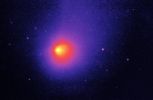
Comets-Schwassmann_Wachmann_1-00.jpgComet Schwassmann-Wachmann I and two asteroids73 visiteSchwassmann-Wachmann 1 (its nucleus is about 30 Km in diameter and is too small to be resolved by the SST while the micron-sized dust grains in the coma and tail stream out away from the Sun) is thought to be a member of a relatively new class of objects called "Centaurs," of which 45 objects are known. These are small icy bodies with orbits between those of Jupiter and Neptune. Astronomers believe that Centaurs are recent escapees from the Kuiper Belt, a zone of small bodies orbiting in a cloud at the distant reaches of the Solar System. Two asteroids, 1996 GM36 (left) and 5238 Naozane (right) were serendipitously captured in the comet image. Because they are closer to us than the comet and have faster orbital velocities, they appear to move relative to the comet and background stars, thereby producing a slight elongated appearance. The SST data have allowed astronomers to use thermal measurements, which reduce the uncertainties of visible-light albedo (reflectivity) measurements, to determine their size.
|
|

Comets-Schwassmann_Wachmann_1-01.jpgComet Schwassmann-Wachmann 3: incoming Space debris!63 visiteDa "NASA - Picture of the Day" del 26 Aprile 2006:"A crumbling comet will soon pass near the Earth. Comet 73P/Schwassmann-Wachmann 3 is brightening and may even be visible to the unaided eye when the fragmented comet zooms past Earth during the middle of next month. Still, the small comet poses no Earth hazard, since it will pass the Earth at about 25 times the distance of the Moon. Exactly how bright Comet Schwassman-Wachmann 3 will get is unknown. It is even possible, althought unlikely, that debris from the comet will have spread out enough to cause a notable meteor shower. Pictured above, Fragment B of Comet Schwassman-Wachmann 3 was photographed two nights ago by a 8.2-meter Very Large Telescope in Chile. Visible to the lower right of the large B Fragment are many mini-comets that have broken off and now orbit the Sun separately. Each mini-comet itself sheds gas and dust and so appears to have its own hazy coma.
The comet will pass closest to the Sun on June 7, 2006".
|
|

Comets-Schwassmann_Wachmann_1-02.jpgComet Schwassmann-Wachmann 3 from HST77 visiteHubble Space Telescope is providing astronomers with extraordinary views of Comet 73P/Schwassmann-Wachmann 3. The fragile comet is rapidly disintegrating as it approaches the Sun. Hubble images have uncovered many more fragments than have been reported by ground-based observers. These observations provide an unprecedented opportunity to study the demise of a comet nucleus. The comet is currently a chain of over three dozen separate fragments, named alphabetically, stretching across the sky by several times the angular diameter of the Moon. Hubble caught two of the fragments (B and G) shortly after large outbursts in activity.
HST shows several dozen of "mini-comets" trailing behind each main fragment and probably associated with the ejection of house-sized chunks of surface material.
|
|

Comets-Schwassmann_Wachmann_1-03.jpgComet Schwassmann-Wachmann 3: fragment "B"65 visitePeriodic comet 73P/Schwassmann-Wachmann 3 has fallen apart before. A cosmic souffle of ice and dust left over from the early Solar System, this comet was seen to split into several large pieces during the close-in part of its orbit in 1995. However, this time the comet seems to be rapidly disintegrating with over 3 dozen fragments, named alphabetically, now stretching several degrees across the sky. Since comets are relatively fragile, stresses from heat and gravity and outgassing, for example, could be responsible for their tendency to breakup in such a spectacular fashion. On April 18th, 2006, HST recorded this sharp view of prolific Fragment B, itself trailing dozens of smaller pieces, each with its own cometary coma and tail. The picture spans over 3000 Km at the comet's April 18 distance of 32 MKM from planet Earth. With its brightest fragment presently too faint to be seen with the naked eye, comet Schwassmann-Wachmann 3 will pass closest to Earth on May 13 at a distance of about 11 MKM.
|
|
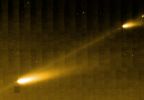
Comets-Schwassmann_Wachmann_1-04.jpgComet Schwassmann-Wachmann 3 from SST72 visiteThis image from NASA's Spitzer Space Telescope (SST) shows three of the many fragments making up Comet 73P/Schwassman-Wachmann 3. The infrared picture also provides the best look yet at the crumbling comet's trail of debris, seen here as a bridge connecting the larger fragments.
The comet circles around our Sun every 5,4 years.
In 1995, it splintered apart into four pieces, labeled "A" through "D", with "C" being the biggest. Since then, the comet has continued to fracture into dozens of additional pieces. This image is centered about midway between fragments "C" and "B"; fragment "G" can be seen in the upper right corner.
The comet's trail is made of dust, pebbles and rocks left in the comet's wake during its numerous journeys around the sun. Such debris can become the stuff of spectacular meteor showers on Earth.
This image was taken on April 1, 2006, by Spitzer's Multi-Band Imaging Photometer using the 24-micron wavelength channel.
|
|

Comets-Schwassmann_Wachmann_1-05.jpgComet Schwassmann-Wachmann 3, M 57 and IC 129670 visiteAs dawn approached on May 8, 2006, astronomer Stefan Seip carefully watched Fragment "C" of broken Comet 73P/Schwassmann-Wachmann 3 approach M 57 - the Ring Nebula, and faint spiral galaxy IC 1296.
Of course, even though the trio seemed to come close together in a truly cosmic photo opportunity, the comet is in the inner part of our Solar System, a mere 0,5 Light-Minutes (LM) or so from Seip's telescope located near Stuttgart, Germany, planet Earth.
The Ring Nebula (upper right) is more like 2000 LY distant, well within our own Milky Way Galaxy. At a distance of 200 MLY, IC 1296 (between the Comet and the Ring Nebula) is beyond even the Milky Way's boundaries. Because the Comet is so close, it appears to move relatively rapidly against the distant stars. This dramatic telescopic view was composited from two sets of images; one compensating for the Comet's apparent motion and one recording the background stars and nebulae.
|
|

Comets-Schwassmann_Wachmann_1-06.jpgComet Schwassmann-Wachmann 3 and M 5766 visiteMoving rapidly through planet Earth's night sky, Fragment "C" of crumbling comet 73P/Schwassmann-Wachmann 3 passed almost directly in front of M 57 - the "Ring Nebula" - and faint spiral galaxy IC 1296 on May 8, 2006. In fact, in this gorgeous view, the bright head of mentioned Fragment "C" is separated by only about 0,1° from M 57, with the tail apparently engulfing nebula and galaxy.
Recorded from Elizabeth, Illinois, USA, this picture corresponds to the cosmic scene only 30 minutes after yesterday's picture of the approaching alignment. The relative motion of the comet against the background stars and nebulae is easy to see when comparing the two images. This comet's fragments will be near their closest approach in the coming days, about 10 MKM away, and none pose any danger to our fair planet.
|
|
| 288 immagini su 24 pagina(e) |
 |
|
|
|
|
10 | |
|
|
|
|





