Before the Moon and Walking on the Moon (partially edited)
|
|
|

17-Mare Imbrium.jpgAlpine Valley and Mare Imbrium84 visiteCaption NASA originale:"Obique view looking west of Alpine Valley and Mare Imbrium on the Moon taken by Lunar Orbiter 5. Alpine Valley is a sinuous rille, about 150 Km long and 8 Km wide running vertically through the center of the image. Mare Imbrium is the dark, flat feature at the top. North is at 4:00 (Lunar Orbiter 5, frame M-102)".
Location & Time Information
Date/Time (UT): 1967-08-14 T 09:38:23
Distance/Range (km): 302
Central Latitude/Longitude (deg): +48.22/001.08
|
|

18-Rima Hadley.jpgHadley Rille100 visiteCaption NASA originale:"Lunar Orbiter 5 view of Hadley Rille and the surrounding region on the Moon. Hadley Rille is the sinuous depression running from the top to the bottom of the image. To the right are the 1 to 2 Km high Apennine mountains. Apollo 15 landed near the very rightmost extension of the rille, near the top of the image. The large crater in the center of the image is the 30 Km diameter Hadley C.
A HR image of the rille is available as L05-H105. North is up (Lunar Orbiter 5, frame M-105)".
Location & Time Information
Date/Time (UT): 1967-08-14 T 12:41
Distance/Range (km): 132
Central Latitude/Longitude (deg): +25.09/002.95
|
|

19-Oceanus Procellarum.jpgNorthern Oceanus Procellarum74 visiteCaption NASA originale:"Lunar Orbiter 5 view of a chain of elongated craters and low mounds in northern Oceanus Procellarum on the Moon. The chain continues to the south (down) of this image as a mare ridge. The chain may have been formed by upwelling of material along a line of weakness resulting in extension to form mounds and collapse to from the elongated craters. The crater at the upper left is about 7 Km in diameter (Lunar Orbiter 5, frame M-183)".
Location & Time Information
Date/Time (UT): 1967-08-17 T 23:29:55
Distance/Range (km): 170
Central Latitude/Longitude (deg): +35.43/318.55
|
|

20-Aristarchus Crater.jpgAristarchus Crater95 visiteCaption NASA originale:"Lunar Orbiter 5 view of Aristarchus Crater. Aristarchus is approximately 40 Km in diameter and 3,6 Km in depth from rim to floor. Note the hummocky ejecta blanket surrounding the crater and the concentric and radial valleys along the Crater walls, resulting from mass gravity wasting. North is up (Lunar Orbiter 5, frame M-197)".
Location & Time Information
Date/Time (UT): 1967-08-18 T 08:59
Distance/Range (km): 130
Central Latitude/Longitude (deg): +23.06/312.58
|
|
![22-Dawes Crater-lo5_m70[1].jpg](albums/userpics/10008/small_22-Dawes%20Crater-lo5_m70%5B1%5D.jpg "Nome del file=22-Dawes Crater-lo5_m70[1].jpg
Dimensione del file=224KiB
Dimensioni=938x1121
Aggiunta il=Gen 23, 2005")
22-Dawes Crater-lo5_m70[1].jpgDawes Crater93 visiteCaption NASA originale:"Lunar Orbiter 5 image of Dawes Crater. Dawes Crater is 18 Km in diameter and appears to be a relatively young Lunar Lrater. The Crater is about 600 m deep. North is up (Lunar Orbiter 5, frame M-70)".
Nota: questo frame, sebbene molto suggestivo, è pesantemente intaccato dalla presenza di artefatti fotografici.
Attenzione, quindi, allorchè operate analisi ed interpretazioni.
Location & Time Information
Date/Time (UT): 1967-08-12 T 16:03:49
Distance/Range (km): 116
Central Latitude/Longitude (deg): +17.30/026.33
|
|

23-Farside-Luna3.jpgThe Moon from "Luna 3"70 visiteCaption NASA originale:"The Luna 3 spacecraft returned the first views ever of the far side of the Moon. The first image was taken at 03:30 UT on 7 October 1959 at a distance of 63.500 Km after Luna 3 had passed the Moon and looked back at the sunlit far side. The last image was taken 40 minutes later from 66.700 Km. A total of 29 photographs were taken, covering 70% of the far side. The photographs were very noisy and of low resolution, but many features could be recognized. This close up view taken with the narrow angle camera shows the far side has fewer maria (the dark areas) than the near side. The image is centered at 20° N, 95° E and the dark area to the left and just below center is Mare Marginus and below that Mare Smythii, just at the boundary between the near and far sides. The left half of the image shows the near side of the Moon, including the circular Mare Crisium at far left (Luna 3-26)".
|
|
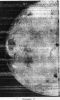
24-Farside-Luna3.jpgThe Far-Side of the Moon from "Luna 3"65 visiteCaption NASA originale:"The Luna 3 spacecraft returned the first views ever of the far side of the Moon. The first image was taken at 03:30 UT on 7 October at a distance of 63,500 km after Luna 3 had passed the Moon and looked back at the sunlit far side. The last image was taken 40 minutes later from 66,700 km. A total of 29 photographs were taken, covering 70% of the far side. The photographs were very noisy and of low resolution, but many features could be recognized. This close up view taken with the narrow angle camera shows the far side has fewer maria (the dark areas) than the near side. The image is centered at 20 N, 95 E and the dark area to the left and just below center is Mare Marginus and below that Mare Smythii, just at the boundary between the near and far sides. The left half of the image shows the near side of the Moon, including the circular Mare Crisium at far left. The Moon is 3475 km in diameter and north is up (Luna 3-27)".
|
|

25-Farside-Luna3.jpgThe Far-Side of the Moon from "Luna 3"74 visiteCaption NASA originale:"This is the second image returned by Luna 3, taken by the wide-angle lens, it showed the far side of the Moon was very different from the near side, most noticeably in its lack of lunar maria (the dark areas). The right three-quarters of the disk are the far side. The dark spot at upper right is Mare Moscoviense, the dark area at lower left is Mare Smythii. The small dark circle at lower right with the white dot in the center is the crater Tsiolkovskiy and its central peak. The Moon is 3475 Km in diameter and north is up in this image (Luna 3-2)".
|
|

26-Farside-Luna3.jpgThe first - noisy - close-up of the Moon from "Luna 3"66 visiteCaption NASA originale:"This is the first close-up view of the Moon returned, taken with the narrow angle camera. This image is centered at 20° N, 105° E, the dark region below and left of center is Mare Smythii, the bright crater above and left of center is Giordano Bruno. North is up. (Luna 3-3)".
|
|

27-Farside-Luna3.jpgThe first - noisy - close-up of the Far-Side of the Moon from "Luna 3"66 visiteCaption NASA originale:"This close up view taken with the narrow angle camera shows the far side has fewer maria (the dark areas) than the near side. This image is centered at 17° N, 110° E, the dark region below and left of center is Mare Smythii, the bright crater above and left of center is Giordano Bruno. North is up. (Luna 3-6)".
|
|

27-Farside-Luna3~0.jpgThe first - noisy - close-up of the Far-Side of the Moon from "Luna 3"68 visiteCaption NASA originale:"This close up view taken with the narrow angle camera shows the far side has fewer maria (the dark areas) than the near side. This image is centered at 17° N, 110° E, the dark region below and left of center is Mare Smythii, the bright crater above and left of center is Giordano Bruno. North is up (Luna 3-6)".
|
|

28-Farside-Luna3.jpgThe Far-Side of the Moon from "Luna 3"68 visiteCaption NASA originale:"This wide-angle view shows the far side of the Moon, comprising most of the image, with the near side making up about one-quarter of the disk at left. The dark patch at upper right is Mare Moscoviense and the dark areas at below and left of center are Mare Marginus and Mare Smythii. These are on the border between the near and far sides. The small dark circle at lower right is the crater Tsiolkovskiy. The image is centered at 15° N, 120° E; North is at 11:30 (Luna 3-phc6)".
|
|
| 143 immagini su 12 pagina(e) |
 |
3 | |
|
|
|
|
|
|
|
|





