Before the Moon and Walking on the Moon (partially edited)
|
|
|

00-The Moon.jpgThe Moon71 visiteMoon Facts and Data
Mass (kg) = 7.349e+22
Mass (Earth = 1) = 1.2298e-02
Equatorial radius = 1.737,4 Km
Equatorial radius (Earth = 1) = 2.7241e-01
Mean density (gm/cm^3) = 3.34
Mean distance from Earth = 384.400 Km
Rotational period (days) = 27,32166
Orbital period (days) = 27,32166
Average length of lunar day (days) = 29,53059
Mean orbital velocity (km/sec) = 1,03
Tilt of axis = 1,5424°
Orbital inclination = 5,1454°
Equatorial surface gravity (m/sec^2) = 1,62
Equatorial escape velocity (km/sec) = 2,38
Magnitude (Vo) = -12,74
Mean surface temperature (day) = 107°C
Mean surface temperature (night) = -153°C
Maximum surface temperature = 123°C
Minimum surface temperature = -233°C
|
|

01-Lunar Orbiter 1.jpgCrescent Earth from the Lunar Orbiter 1116 visiteCaption NASA originale:"Lunar Orbiter 1 new of the Moon and crescent Earth. This is the first good image of the Earth taken from the vicinity of the Moon, 380.000 km away. The Earth sunset terminator runs through Odessa, Istanbul and slightly west of Capetown. The center of the Lunar Surface corresponds to the location of the crater Pasteur, just on the eastern farside at 10° S,105° E, but the high sun angle makes it hard to see the craters. The horizon covers about 550 Km and north is to the right in this west facing image. (LO1 - frame 102; H1, H2, H3)".
Location & Time Information
Date/Time (UT): 1966-08-23 T 16:36:23
Distance/Range (km): 1476
Central Latitude/Longitude (deg): -14.68/104.34
|
|
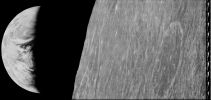
01-Lunar_Orbiter_1_-_The_Moon_and_Earth.jpgCrescent Earth from the Lunar Orbiter 1 (credits: NASA/LOIRP)92 visiteCaption NASA:"Pictured above is the first image ever taken of the Earth from the Moon. The image was taken in 1966 by Lunar Orbiter 1 and heralded by then-journalists as the Image of the Century. It was taken about two years before the Apollo 8 crew snapped its more famous color cousin. Recently, modern technology has allowed the recovery of Higher Resolution images from old data sources such as Lunar Orbiter tapes than ever before. Specifically, recovery of the above image was initiated 20 years ago by Nancy Evans, and completed recently by Dennis Wingo and Keith Cowing who lead the Lunar Orbiter Image Recovery Project.
Images like this one carry more than aesthetic value -- i.e.: by making a comparison to recent High Definition images of the Moon enables investigations into how the Moon has been changing".MareKromium
|
|

02-Taruntius Crater.jpgTaruntius Crater form Lunar Orbiter 1106 visiteCaption NASA originale:"Lunar Orbiter 1 image of Taruntius crater on the Moon. The crater at the top of the image is 56 km in diameter. Note the central peak and internal concentric ridges and rilles. North is up. (Lunar Orbiter 1, frame M-31)".
Location & Time Information
Date/Time (UT): 1966-08-20 T 13:46:59
Distance/Range (km): 247
Central Latitude/Longitude (deg): +02.54/047.96
|
|

03-Korolev Basin.jpgThe "far side" of the Moon: Korolev Basin from Lunar Orbiter 190 visiteCaption NASA originale:"Lunar Orbiter 1 view of the Korolev Basin on the far side of the Moon. The basin is located at 3° S, 158° W and is about 440 Km in diameter, the largest crater in the image, to the left and slightly above the center. Adjacent to Korolev, at about 5:00, is the crater Galois and at 6:30 is the smaller Doppler crater. The rim of the South Pole - Aitken Basin - is faintly visible running just below these craters. North is up (Lunar Orbiter 1, frame M-40)".
Location & Time Information
Date/Time (UT): 1966-08-22 T 14:58
Distance/Range (km): 1466
Central Latitude/Longitude (deg): -06.44/211.26
|
|

04-Copernicus Crater.jpgOblique view of Copernicus Crater from Lunar Orbiter 2132 visiteCaption NASA originale:"Lunar Orbiter 2 oblique northward view of the interior of the 100 Km diameter Copernicus Crater on the Moon. The central peaks are in the middle of the image, rising about 400 m above the crater floor and stretching for about 15 Km. The northern wall of the crater is in the background. This is the top frame of a set of 3 adjoining HR frames, which are available in image lo2_h162_123 (Lunar Orbiter 2, frame 162-H3)".
Location & Time Information
Date/Time (UT): 1966-11-24 T 00:05:43
Distance/Range (km): 130
Central Latitude/Longitude (deg): +05.48/340.00
|
|

05-Copernicus Crater.jpgOblique view of Copernicus Crater from Lunar Orbiter 2109 visiteCaption NASA originale:"Lunar Orbiter 2 northword - looking oblique view of Copernicus Crater on the Moon. Copernicus crater extends across the background of the picture, about 100 Km in diameter. Note the radial ridges, mounds and cones around the crater. The keyhole shaped Fauth crater sits atop one of the ridges 60 Km south of Copernicus (Lunar Orbiter 2, frame M-162)".
Location & Time Information
Date/Time (UT): 1966-11-24 T 00:05:43
Distance/Range (km): 130
Central Latitude/Longitude (deg): +05.48/340.00
|
|

06-Oceanus Procellarum.jpgOceanus Procellarum73 visiteCaption NASA originale:"Northward oblique view of the Marius Hills and Oceanus Procellarun on the Moon taken by LO 2. The hills are named after the 41 Km diameter crater Marius, at the upper right at 11,8°N, 50,8° W and are thought to be volcanic domes, plugs and cones. Note the wrinkle ridges which also stretch across the image (Lunar Orbiter 2, frame M-213)".
Location & Time Information
Date/Time (UT): 1966-11-25 T 14:16
Distance/Range (km): 139
Central Latitude/Longitude (deg): +07.96/307.23
|
|

07-Kepler Crater.jpgKepler Crater from Lunar Orbiter 3113 visiteCaption NASA originale:"Lunar Orbiter 3 oblique image of Kepler crater on the Moon. The crater is 32 km in diameter and is located near the outer rim of the Imbrium Basin. Kepler is located at 8° N, 38° W, southwest of Mare Imbrium. North is at 11:00 (Lunar Orbiter 3, frame M-162)".
Location & Time Information
Date/Time (UT): 1967-02-21 T 05:02
Distance/Range (km): 156
Central Latitude/Longitude (deg): +06.91/321.90
|
|

08-Sinus Medii.jpgBruce Crater and Sinus Medii90 visiteCaption NASA originale:"Lunar Orbiter 3 oblique view of Bruce Crater in the foreground and the Sinus Medii Mare plain on the Moon. Bruce crater is 7 Km in diameter and 800 mt deep. Note the wrinkle ridges near the center of the image and the higher highland ridges in the background. The view is looking westward (Lunar Orbiter 3, frame M-84)".
Location & Time Information
Date/Time (UT): 1967-02-18 T 00:35:14
Distance/Range (km): 122 km
Central Latitude/Longitude (deg): +0.80/358.96
|
|

09-Murchison and Ukert.jpgOblique view of Murchison and Ukert Crater140 visiteCaption NASA originale:"Lunar Orbiter 3 oblique view of Murchison Crater (foreground), 58 Km across, and Ukert Crater (back right-center) on the Moon. The southern edge of Mare Vaporum is visible in the background. Note the irregular features and rilles on the floor of Murchison. North is at 10:30 (Lunar Orbiter 3, frame M-85)".
Location & Time Information
Date/Time (UT): 1967-02-18 T 04:03
Distance/Range (km): 90.4
Central Latitude/Longitude (deg): +04.94/359.66
|
|

1-AA-Surveyor 5.jpgSurveyor 5 - September 1967242 visiteDal "NASA - Picture of the Day" di Sabato 23 Ottobre 2004:
"Safe!" In September 1967, during regular season play, the Surveyor 5 lander actually slid several feet while making a successful soft landing on the Moon's Mare Tranquillitatis. Equipped with television cameras and soil sampling experiments, the US Surveyor spacecraft were intended to determine if the lunar surface at chosen locations was safe for the planned Apollo landings. Surveyor 5 touched down on the inside edge of a small crater inclined at about 20°. Its footpad slipped and dug the trench visible in the picture. Covered with dusty lunar soil, the footpad is about half a meter in diameter".
Sembra essere passato un secolo (o anche di più) da quel Settembre del '67. Erano i giorni gloriosi della "Moon Race" fra USA ed URSS: il Mondo aveva tantissimi problemi (più o meno come oggi...), sparsi tra il Biafra, il VietNam e la Cold War, ma quando si guardava alla Luna l'Umanità, in fondo, era unita.
O così, almeno, mi sembra di ricordare...
|
|
| 143 immagini su 12 pagina(e) |
1 |
 |
|
|
|
|
|
|
|
|
|





