A Tribute To Mars Global Surveyor
|
|
|

Volcanoes-Olympus-Viking-MGS.gifAs Time Goes By... (a GIF-Movie by Dr Paolo C. Fienga - Lunexit Team)234 visitenessun commentoMareKromium
|
|

Volcanoes-Olympus_Mons-MGS-2003_09-PCF-LXTT-00.jpgOlympus Mons (Absolute Natural Colors; credits for the additional process. and color: Dr Paolo C. Fienga - Lunexit Team)280 visiteCaption originale: "This is a red camera wide angle view of the Giant Martian Volcano, Olympus Mons, acquired by the Mars Global Surveyor (MGS) Mars Orbiter Camera (MOC). The Volcano is large enough to cover much of the state of New Mexico. This view was taken looking West toward the Sunward Limb of the Planet. The limb is the horizon to the left; the dark band is outer space. Sunlight illuminates this scene from the lower left". MareKromium
|
|

Volcanoes-Olympus_Mons-MGS-2003_09-PCF-LXTT-01.jpgOlympus Mons (Natural Colors; credits for the additional process. and color: Dr Paolo C. Fienga - Lunexit Team)240 visite...Alla NASA, Marte in generale, ed Olympus Mons in particolare, piacciono così...MareKromium
|
|

Volcanoes-Olympus_Mons-MGS.jpgOlympus Mons (Natural Colors; NASA/JPL/MSSS)367 visitenessun commento
|
|

Volcanoes-Olympus_Mons-PCF-LXTT-2.jpgOlympus Mons, from MGS (Natural Colors; credits: NASA & Lunar Explorer Italia)147 visitenessun commentoMareKromium
|
|

Volcanoes-Olympus_Mons.jpgOlympus Mons (Natural Colors; NASA/JPL/MSSS)72 visitenessun commento
|
|

Volcanoes-Olympus_Mons_and_Tharsis_Region.jpgTharsis Region (Natural Colors; credits: NASA/MGS/MSSS)146 visite"Mars Global Surveyor's camera, MOC, provided this hemispheric view of the northern Tharsis region on June 1, 1998. This picture shows the giant volcano, Olympus Mons, and one of the Tharsis Montes volcanoes, Ascraeus Mons. Another volcano, Alba Patera, is lurking under the haze and clouds at the top of the image. Olympus Mons is about 550 Km wide.
The Terminator - such as the line that divides night and day - was located west of Olympus Mons (left part of the image). It is Winter in the northern hemisphere of Mars and the high latitudes (i.e.: north of Olympus Mons in this picture) exhibit clouds and haze. These clouds most likely contain water ice".
Non possiamo non notare l'enfasi che viene spesso posta, in sede di commento originale alle immagini, sul fatto che le nuvole Marziane "MOLTO PROBABILMENTE" (ossia "QUASI CERTAMENTE") contengono ACQUA.
E allora noi rivolgiamo alla NASA - ancora - la stessa domanda: ma siamo certi che su Marte non piove da qualche milione di anni?
Risposta? Silenzio totale
|
|

Volcanoes-Pavonis_Mons-PCF-LXTT.jpgPavonis Mons (Enhanced and Saturated Natural Colors; credits for the additional process. and color.: Dr Paolo C. Fienga - Lunexit Team)99 visiteCaption NASA originale:"This Mars Global Surveyor (MGS) Mars Orbiter Camera (MOC) wide angle color composite image, obtained in December 2003, shows the middle of the three Tharsis Montes, Pavonis Mons.
This is a broad shield volcano - similar to the volcanoes of Hawaii - located on the Martian Equator at approx. 113° West.
The Volcano Summit is near 14 Km (~8,7 mi) above the Martian Datum (such as 0 elevation); the central caldera (crater near center of image) is about 45 Km (~28 mi.) across and about 4,5 Km (~2.8 mi.) deep. Sunlight illuminates the scene from the lower left".MareKromium
|
|

Volcanoes-Pavonis_Mons.jpgPavonis Mons (Darkened Natural Colors; credits: NASA/MGS/MSSS)93 visiteCaption NASA originale:"This Mars Global Surveyor (MGS) Mars Orbiter Camera (MOC) wide angle color composite image, obtained in December 2003, shows the middle of the three Tharsis Montes, Pavonis Mons.
This is a broad shield volcano -similar to the volcanoes of Hawaii - located on the Martian equator at 113° W.
The volcano summit is near 14 Km (~8.7 mi) above the Martian Datum (0 elevation); the central caldera (crater near center of image) is about 45 Km (~28 mi.) across and about 4.5 Km (~2.8 mi.) deep.
Sunlight illuminates the scene from the lower left".
|
|

Volcanoes-Small_Volcano_in_Jovis_Fpssae-1-2005_07.jpgLost in the Dust: a small Volcano in Jovis Fossae (Original NASA/MGS/MSSS b/w Frame)69 visiteCaption NASA originale:"This MGS-MOC image shows a small, dust-covered, volcano in the Jovis Fossae region of Mars.
While Mars is known for its extremely large volcanoes, such as Olympus Mons, many small volcanoes also occur on the Red Planet, particularly in the Tharsis Region. This small volcano is a good example of those.
It was originally found by members of the MGS Mars Orbiter Laser Altimeter (MOLA) team during the MGS primary mission.
The volcano is old and cratered. Its surface is mantled by dust and its caldera (summit depression) has some dust-covered wind ripples on its floor".
Location near: 20,7° North and 111,3° West
Image width: ~3 Km (~1,9 mi)
Illumination from: lower left
Season: Northern Autumn
|
|
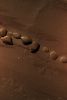
Volcanoes-Tharsis_Tholus-MGS.jpgPit-chain near Tharsis Tolus (MULTISPECTRUM; credits: Lunexit)66 visitenessun commentoMareKromium
|
|

Volcanoes-The_FootPrint_Volcano-A-MGS-PCF-LXTT-IPF.jpgThe "Footprint" Volcano (Absolute Natural Colors; credits for the additional process. and color.: Drr Don P. Mitchell and Paolo C. Fienga - Lunexit Team)96 visiteThis NASA - Mars Global Surveyor (MGS) - Mars Orbiter Camera (MOC) High Resolution image, acquired on the date of July, 13, 2003, shows a small, Dust-covered and so far - officially - Unnamed Volcano (note: the nickname "Footprint" has been given to this Surface Feature by the Researchers of the Italian Planetary Foundation) that is located on the Volcanic Plains to the East of the Giant Martian Volcano, Pavonis Mons.
It is interesting to notice that the Floor of the Caldera - such as the elliptical depression visible at the Summit of the Volcano - has a few windblown Ripples on it. The Ripples and the extremely thick Dust Mantle, together with a number of small Impact Craters located on its Surface, are signs which indicate that the "Footprint" Volcano erupted a VERY long time ago, and that there has been no more activity in (geologically speaking) recent times. In addition to the above, we also wish to underline that, while the Surface surrounding the Footprint Volcano has kept, despite the eons of volcanic idleness, a dark gray color (such as the typical colors of Lava, once is cooled off, and Volcanic Ashes), the Land that is farther away from the Volcano has maintained (or maybe re-gained?) the typical brown-orange color which characterizes most of the Equatorial and Peri-Equatorial Surface of Mars. This image covers an area approx. 3 by 6,8 Km wide (such as approx. 1,9 by 4,2 miles). The Footprint Volcano is located near 1,6° South Lat. and 105,7° West Long.; the Sunlight illuminates the scene from the South.
The frame has been colorized in Absolute Natural Colors (such as the colors that a human eye would actually perceive if someone were onboard the NASA - Mars Global Surveyor Orbiter and then looked down, towards the Surface of Mars), by using an original technique created - and, in time, dramatically improved - by the Lunar Explorer Italia Team.MareKromium
|
|
| 512 immagini su 43 pagina(e) |
 |
|
|
|
|
|
|
|
|
42 |
|








