A Tribute To Mars Global Surveyor
|
|
|

South_Polar_Regions-M0903484-03.jpgFeatures of the South Polar Regions (EDM - Absolute Natural Colors; credits for the additional process. and color.: Dr Paolo C. Fienga - Lunexit Team) 192 visitenessun commentoMareKromium
|
|

South_Polar_Regions-PIA03007.jpgDefrosting South Polar Region (Absolute Natural Colors; credits for the additional process. and color.: Dr Paolo C. Fienga - Lunexit Team)120 visiteDefrosting Southern Regions
Original caption:"This MGS-MOC image shows a second view of varied Springtime defrosting patterns formed in a dune field and surrounding polygon-patterned ground in the South Polar Region of Mars. (...) The feature sporting an outline of dark spots and an interior of smaller, closely-spaced dark spots and dark-outlined polygons is a patch of windblown or wind-eroded sand that was covered by carbon dioxide frost during the previous Autumn and Winter. The fainter, larger polygon pattern on either side of the patch of defrosting sand is formed in the substrate upon which the sand patch is sitting. Polygonal forms such as these might indicate the presence of ice below the surface".
Location near: 79,9°S; 125,9°W
Image width: width: ~3 Km (~1,9 mi)
Illumination from: upper left
Season: Southern SpringMareKromium
|
|
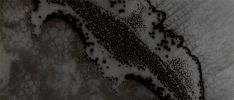
South_Polar_Regions-PIA04162.jpgDefrosting South Polar Region (Absolute Natural Colors; credits for the additional process. and color.: Dr Paolo C. Fienga - Lunexit Team)125 visiteOriginal caption:"This MGS-MOC image shows varied springtime patterns formed in defrosting, seasonal carbon dioxide frost in the South Polar Region of Mars. The feature sporting an outline of dark spots and an interior of smaller, closely-spaced dark spots and dark-outlined polygons is a patch of windblown or wind-eroded sand that was covered by carbon dioxide frost during the previous autumn and winter. The fainter, larger polygon pattern on either side of the patch of defrosting sand is formed in the substrate upon which the sand patch is sitting. Polygonal forms such as these might indicate the presence of ice below the surface".
Location near: 79,6°S; 125,0°W
Image width: width: ~3 Km (~1,9 mi)
Illumination from: upper left
Season: Southern SpringMareKromium
|
|

South_Polar_Regions-Polygons-PIA05951.jpgThe "Martian Polygons" (Original NASA-MGS-MSSS b/w frame)166 visiteThis Mars Global Surveyor (MGS) Mars Orbiter Camera (MOC) image shows "polygons" patterned ground in the South Polar region near 82.0°S, 90.8°W. Polygons are fairly common at high latitudes in both Martian hemispheres, but they do not occur everywhere. On Earth, features such as these would be good indicators of the presence and freeze-thaw cycles of ground ice. On Mars, the same might (emphasis on "might") also be true. This image covers an area approximately 3 Km across and is illuminated by sunlight from the upper left. Seasonal frost enhances the contrast in the scene; the darkest areas have advanced the farthest in the springtime defrosting process.
|
|
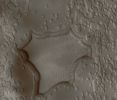
South_Polar_Regions-SPRC.jpgSublimation at the South Polar Residual Cap (Absolute Natural Colors; credits: Dr Paolo C. Fienga - Lunexit Team)120 visiteCaption NASA:"This MGS-MOC image shows a portion of the South Polar Residual Cap where the effects of Sublimation are apparent.
Over extended periods of time, Sublimation "eats" away at the smoother appearing material (largely composed of frozen CO2), darkening the Scarps and creating the irregularly shaped depressions that are present throughout much of the scene".
Location near: 87,1° South Lat. and 69,3° West Long.
Image width: ~3 Km (~1,9 miles)
Illumination from: upper left
Season: Southern SummerMareKromium
|
|
![South_Polar_Regions-South_Pole-MGS-mg90s000[1]-PCF-LXTT-1.jpg](albums/userpics/10060/small_South_Polar_Regions-South_Pole-MGS-mg90s000%5B1%5D-PCF-LXTT-1.jpg "Nome del file=South_Polar_Regions-South_Pole-MGS-mg90s000[1]-PCF-LXTT-1.jpg
Dimensione del file=48KiB
Dimensioni=1062x1000
Aggiunta il=Ago 09, 2009")
South_Polar_Regions-South_Pole-MGS-mg90s000[1]-PCF-LXTT-1.jpgMartian South Pole and South Polar Regions, from MGS (Darkened Natural Colors; credits for the additional process. and color.: Dr Paolo C. Fienga - Lunexit Team)64 visitenessun commentoMareKromium
|
|
![South_Polar_Regions-South_Pole-MGS-mg90s000[1]-PCF-LXTT-2.jpg](albums/userpics/10060/small_South_Polar_Regions-South_Pole-MGS-mg90s000%5B1%5D-PCF-LXTT-2.jpg "Nome del file=South_Polar_Regions-South_Pole-MGS-mg90s000[1]-PCF-LXTT-2.jpg
Dimensione del file=195KiB
Dimensioni=2000x2000
Aggiunta il=Giu 15, 2011")
South_Polar_Regions-South_Pole-MGS-mg90s000[1]-PCF-LXTT-2.jpgThe South Pole of Mars (Absolute Natural Colors; credits for the additional process. and color.: Dr Paolo C. Fienga - Lunexit Team)267 visitenessun commentoMareKromium
|
|

South_Polar_Regions-South_Pole.jpgThe South Pole of Mars (Natural Colors; credits: NASA/MGS/MSSS)210 visiteCaption NASA:"During Spring, the Ice Cap - predominantly formed by layers of frozen carbon dioxide (dry ice) plus some water ice - begins to shrink as the ices change directly from solid to gas (cosiddetta "sublimazione"). Hazy clouds of ice crystals and fog extend across the bottom of the picture and a darker, more defrosted area, is visible at the upper right, near the Red Planet's night side".
|
|

South_Polar_Storm-PIA11982.jpgSouth Polar Dust Storm74 visiteCaption NASA:"This nearly global mosaic of observations made by the Mars Color Imager on NASA's Mars Reconnaissance Orbiter on April 2, 2009, shows billowing clouds of dust being lifted into the Atmosphere by a storm near the edge of the Seasonal Polar Cap of Southern Mars.
The season on Southern Mars is late Spring. Late Southern Spring and early Southern Summer are a peak time of the Martian year for major Dust Storms.
Atmospheric haze due to suspended dust from recent storm activity is evident elsewhere on the Planet, including the Skies over Mars rovers Opportunity (MER-B) and Spirit (MER-A).
Black areas in the mosaic are the result of data drops or high angle roll maneuvers by the Orbiter that limit the camera's view of the Planet.
Equally-spaced blurry areas that run from South-to-North (bottom-to-top) result from the high off-nadir viewing geometry, a product of the spacecraft's low-orbit.
Malin Space Science Systems, San Diego, provided and operates the Mars Color Imager. NASA's Jet Propulsion Laboratory, a division of the California Institute of Technology in Pasadena, manages the Mars Reconnaissance Orbiter for NASA's Science Mission Directorate, Washington. Lockheed Martin Space Systems, Denver, is the prime contractor for the project and built the Spacecraft".MareKromium
|
|

Sysiphi_Planum-MGS-PCF-LXTT-01.jpgSeeps in Sysiphi Planum (Absolute Natural Colors; credits: Dr Paolo C. Fienga - Lunexit Team)740 visitenessun commentoMareKromium
|
|

Sysiphi_Planum-MGS-PCF-LXTT-02.JPGSysiphi Planum (Original NASA-MSSS RAW b/w Frame)65 visiteCaption NASA originale:"This MGS-MOC image shows a spine of material exposed in the Sisyphi Planum Region of Mars.
Gullies can be seen on the deeply-shadowed ridge slope.
Mass movement (landsliding - maybe?) has contributed to the erosion of this ridge and the creation of the apron of talus that surrounds it".
Location near: 70,7° South; 357,0° West
Image width: ~3 Km (~1,9 mi)
Illumination from: upper left
Season: Southern Summer
|
|

Terra_Cimmeria-Gullies-PIA02919-1.jpgGullies in Terra Cimmeria (Original RAW Frame)64 visiteCaption originale NASA:"This MGS-MOC image shows two suites of gullies within a single impact crater in the Terra Cimmeria Region. The gullies near the top of the image are located on the northern wall of the crater, while the lower suite resides on a lower bench in the crater's northern wall complex. Gully erosion has cut into the layered rock exposed on the crater wall. Water may have been involved in their formation".
Location near: 38,2° South; 190,6° West
Image width: ~3 Km (~1,9 mi)
Illumination from: upper left
Season: Southern Summer
|
|
| 512 immagini su 43 pagina(e) |
 |
|
|
|
|
35 | |
|
|
|
|








