A Tribute To Mars Global Surveyor
|
|
|

Phobos_from_MGS-003.jpgPhobos from Mars Global Surveyor (4 - HD)202 visitenessun commento
|
|

Phobos_from_MGS-004.jpgPhobos from Mars Global Surveyor (5)70 visitenessun commento
|
|

Phobos_from_Mgs-006-PIA01332.jpgPhobos from Mars Global Surveyor (6)234 visiteCaption NASA:"This image of Phobos, the inner and larger of the two moons of Mars, was taken by the Mars Global Surveyor on August 19, 1998. The Thermal Emission Spectrometer (TES) measured the brightness of thermal radiation at the same time the camera acquired this image. By analyzing the brightness, TES scientists could deduce the various fractions of the surface exposed to the Sun and their temperatures. This preliminary analysis shows that the surface temperature, dependent on slope and particle size, varies from a high of +25° F (-4° C) on the most illuminated slopes to -170° F (-112° C) in shadows. This large difference, and the fact that such differences can be found in close proximity, adds support to the notion that the surface of Phobos is covered by very small particles".
|
|
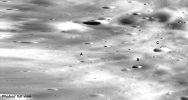
Phobos_from_Mgs-007.jpgPhobos, from MGS (Original NASA/MGS/MSSS Full Frame n. 1)63 visiteLett. A: grappolo di boulders a forma "colonnare" (si direbbe un gruppo di tre boulders allineati secondo un ordine dimensionale coerente ed un ulteriore rilievo, anch'esso di apparenza colonnare, posto nelle immediate vicinanze del primo gruppo).
Lett. B: rilievo anomalo, decisamente alto (a giudicare dall'ombra che proietta), posto sul versante interno di un cratere di modeste diomensioni, a circa mezza altezza della murata.
Lett. C: gruppo di rilievi anomali (si direbbe 3 o 4) - concettualmente molto simili al grappolo di boulders evidenziato sub lett. A - posti sul ciglio di un cratere di medie dimensioni.MareKromium
|
|
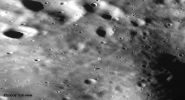
Phobos_from_Mgs-008.jpgPhobos, from MGS (Original NASA/MGS/MSSS Full Frame n. 2)63 visiteLett. D: il famoso "Monolito di Phobos"MareKromium
|
|
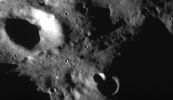
Phobos_from_Mgs-009.jpgPhobos, from MGS (Original NASA/MGS/MSSS Full Frame n. 3)65 visiteLett. E: il secondo (più piccolo, ma certo non meno inesplicabile) Monolito di Phobos.
Nota: nella parte superiore del frame sono visibili anche altri rilievi colonnari - riconoscibili a causa delle ombre assolutamente peculiari che proiettano in condizioni di illuminazione radente - ancora più piccoli.
Le "Colonne di Phobos" e le "Cuspidi di Blair": potrebbe esistere una connessione? Questi rilievi possono essere il frutto di processi geologici simili?
Che ne pensate?MareKromium
|
|

Phobos_from_Mgs-010.jpgPhobos, from MGS (Original NASA/MGS/MSSS Full Frame n. 4)63 visitenessun commentoMareKromium
|
|

Phobos_from_Mgs-011.jpgMartian Limb and Phobos (Natural Colors; credits: NASA/MGS/MSSS)145 visiteUna spettacolare veduta del bordo ("limb") di Marte e della sua luna "misteriosa", Phobos, la quale costituisce anche uno degli oggetti più "bui" dell'intero Sistema Solare. Ecco il commento originale a questa immagine:
"Phobos is one of the darkest objects in the Solar System. Thus, 4 wide angle images were obtained to make the picture of Phobos over the martian limb: a pair of red and blue wide angle images was acquired for the limb and a pair of separate images were required to see Phobos. The wide angle images illustrate the fact that Phobos is mostly colorless (dark gray); the faint orange/red hue in the wide angle picture is a combination of slight differences in the focal lengths of the blue and red cameras and the orange/red illumination provided by reflection of sunlight off Mars. To a person standing on Phobos, the Red Planet would fill most of the sky".
|
|
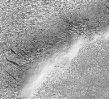
Seeps-MedusaeFossae.gifSeepage in Medusae Fossae (GIF-Movie; credits for the additional proecss.: Mars Unearthed)65 visitenessun commentoMareKromium
|
|

Slope_Streaks-MGS-PIA06846.jpgAs Time Goes By... (Original NASA/MGS/MSSS b/w Frame)105 visiteUn'interessantissimo frame che ci mostra "come passa il tempo" (e come cambiano le cose...) su Marte. La stessa zona (Memnonia region - 5,9° South Lat. and 162,2° West Long.) a distanza di quasi 5 anni. Noi vediamo delle differenze palesi del paesaggio ed altre, per così dire, un pò "più sottili", che richiedono una certa attenzione per essere individuate (ma che sono individuabili!). Provateci anche Voi a trovarle!...
|
|

Souhern_Emisphere.jpgThe Southern Hemisphere of Mars (Natural Colors; credits: NASA/MGS/MSSS)123 visiteCaption NASA:"The wide angle camera view of Mars shown here was obtained by the Mars Global Surveyor Mars Orbiter Camera in late July 1999, about 1 week before the start of southern Spring. The frosty, retreating south polar cap (white) is seen in the lower quarter of the image and wisps of dust storm clouds (grayish-orange in this view) occur just above the cap at the lower left. The southernmost of the large Tharsis volcanoes, Arsia Mons, is seen at the upper left. Arsia Mons is about 350 Km across".
|
|
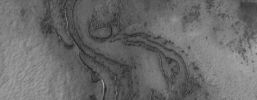
South_Polar_Features-00.JPGSouth Polar "River-like" Surface Features? (NASA-MGS/MOC RAW b/w frame)83 visiteCaption originale:"This MGS-MOC image shows layering in terrain at the high Southern Latitudes of Mars.
South Polar layers are commonly assumed to consist of varying amounts of dust and ice but there is an an alternative explanation saying that they may be exposures of ancient sedimentary rock".
Location near: 78,9° S; 10,1° W
Image width: ~3 Km (~1,9 mi)
Illumination from: upper left
Season: Southern Summer
|
|
| 512 immagini su 43 pagina(e) |
 |
|
|
|
|
31 | |
|
|
|
|








