A Tribute To Mars Global Surveyor
|
|
|

North_Polar_Features-Dunes-MGS-06.jpgNorth Polar Dunes (Natural Colors; credits for the additional process. and color.: Dr Paolo C. Fienga - Lunexit Team)74 visiteCaption NASA originale:"This MGS-MOC image shows dunes in the North Polar Region of Mars. In this scene, the dunes and the plain on which the dunes reside, are at least in part covered by a bright CO2 frost.
Dark spots indicate areas where the frost has begun to change, either by subliming away to expose dark sand, changing to a coarser particle size, or both.
The winds responsible for the formation of these dunes blew from the South-West toward the North-East.
Location near: 76,3° North; 261,2° West
Image width: ~3 Km (~1,9 mi)
Illumination from: lower left
Season: Northern SpringMareKromium
|
|

North_Polar_Features-Dunes-MGS-07.jpgNorth Polar Dunes (Original NASA/MGS/MSSS b/w Frame)68 visiteCaption NASA originale:"This MGS-MOC image shows dunes in the Martian North Polar Region. The dunes are composed of dark,
coarse (--> ruvido, di tessitura grossolana) sand.
The white areas around the dunes are the last remaining areas of seasonal CO2 frost cover.
The solid CO2 accumulates during the Autumn and Winter and sublimes (goes from solid to gas) away in the Spring.
This image was taken near the end of the Northern Spring".
Location near: 78,0° North; 244,5° West
Image width: ~3 Km (~1,9 mi)
Illumination from: lower left
Season: Northern Spring
|
|

North_Polar_Features-Dunes-MGS-08.jpgNorth Polar Dunes (Natural Colors; credits for the additional process. and color.: Dr Paolo C. Fienga - Lunexit Team)71 visiteCaption NASA originale:"This MGS-MOC image shows dunes in the Martian North Polar Region. The dunes are composed of dark,
coarse (--> ruvido, di tessitura grossolana) sand.
The white areas around the dunes are the last remaining areas of seasonal CO2 frost cover.
The solid CO2 accumulates during the Autumn and Winter and sublimes (goes from solid to gas) away in the Spring.
This image was taken near the end of the Northern Spring".
Location near: 78,0° North; 244,5° West
Image width: ~3 Km (~1,9 mi)
Illumination from: lower left
Season: Northern SpringMareKromium
|
|

North_Polar_Features-Dunes-MGS-09.jpgNorth Polar Dunes (Natural Colors; credits for the additional process. and color.: Dr Paolo C. Fienga - Lunexit Team)68 visiteCaption NASA:"What causes the black dots on dunes on Mars? As spring dawned on the Northern Hemisphere of Mars in 2004, dunes of sand near the Poles begin to defrost. Thinner regions of ice typically thaw first revealing sand whose darkness soaks in sunlight and accelerates the thaw.
The process might involve sandy jets exploding through the thinning ice. By Summer, the spots expanded to encompass the entire dunes that were then completely thawed and dark. The carbon dioxide and water ice actually sublime in the thin atmosphere directly to gas. Taken in mid-July, the above image shows a field of spotted polar dunes spanning about 3 Km near the Martian North Pole.
Today, the future of Mars Rovers Spirit and Opportunity remains unknown windy dust storms continue to starve them of needed sunlight".MareKromium
|
|

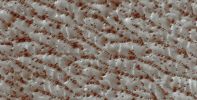
North_Polar_Features-Dunes-MGS-10.jpgDefrosting North Polar Dunes (Original NASA/MGS/MSSS b/w Frame)68 visiteCaption NASA originale:"This MGS-MOC image shows a portion of a sand dune field in the North Polar Region of Mars. The dunes are covered with frozen CO2, which accumulated over the Autumn and Winter months in the Northern Hemisphere.
During the Spring, the time at which this image was acquired, the CO2 begins to sublime away, going directly from solid to gas, just as dry ice does here on Earth.
The dark spots, streaked by blowing winds, may be places where the frost has been removed (exposing underlying dark sand), places where the grain size or roughness of the frost has increased (increasing shadowing due to the change in texture), or both".
Location near: 79,7° North Lat. and 148,3° West Long.
Image width: ~3 Km (~1,9 mi)
Illumination from: lower left
Season: Northern Spring
|
|
North_Polar_Features-Dunes-MGS-11.jpgDefrosting North Polar Dunes (Natural Colors; credits for the additional process. and color.: Dr Paolo C. Fienga - Lunexit Team)72 visitenessun commentoMareKromium
|
|
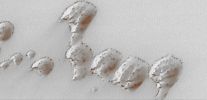
North_Polar_Features-Dunes-PCF-LXTT.jpgThe Frozen Dunes of the North in early Spring (Natural Colors; credits for the additional process. and color.: Dr Paolo C. Fienga - Lunexit Team)71 visiteCaption NASA originale:"This MGS-MOC image shows a group of sand dunes, covered by seasonal Carbon Dioxide frost, in the Martian North Polar Region. Over the course of Northern Hemisphere Spring, the CO2 frost sublimes away, slowly revealing the dark sand that makes up the dunes.
The dark spots in this image may be patches of freshly-exposed sand, or they could be places where the CO2 frost has changed, either becoming rougher, coarser-grained (larger crystals), or both.
A rougher or coarser-grained surface will appear darker because of an increase in shadowing of the surface by the small-scale roughness elements".
Location near: 75,2° North Lat.and 51,3° West Long.
Image width: ~3 Km (~1,9 mi)
Illumination from: lower left
Season: Northern SpringMareKromium
|
|

North_Polar_Features-Frosted_Dunes-Plumage-MGS.JPGNorth Polar "Frosted Dunes" (Original NASA/MGS/MSSS b/w Frame)71 visiteCaption NASA originale:"This MGS-MOC image shows Dunes in the North Polar Region of Mars.
The Dunes in this scene are covered by a layer of Carbon Dioxide Frost that accumulated during the Winter in 2005.
Dark spots indicate areas where Frost has begun to sublime away. In Summer, the Dunefield will be dark, as all of the Frost will be gone and the Iron- and Magnesium-bearing Silicate Sands will be exposed".
Location near: 81,9° North Lat. and 226,1° West Long.
Image width: ~3 Km (~1,9 mi)
Illumination from: lower left
Season: Northern Spring
|
|

North_Polar_Features-Layers-MGS-1-PCF-LXTT.jpgNorth Polar Layers (Natural Colors; credits for the additional process. and color.: Dr Paolo C. Fienga - Lunexit Team)422 visiteCaption NASA originale:"The middle portion of the Northern Summer Season is the ideal time of year to capture relatively dust- and haze-free views of Martian North Polar Terrain.
This year, much more of the North Polar Cap has sublimed away than has been evident in previous Northern Summers going back to 1999, when MGS began the Mapping Phase of the mission. This MGS-MOC image shows a nearly ice-free view of Layers exposed by erosion in the North Polar Region. The light-toned patches are remnants of water ice frost.
The Layers are generally considered by the Mars scientific community to be record of past depositions of ice and dust. This picture is located near 82,5° North, 118,6° West and covers an area about 3 by 10 Km (approx. 1,9 by 6,2 miles). Sunlight illuminates the scene from the upper left; the image was acquired on September, 22, 2006".MareKromium
|
|

North_Polar_Features-Layers-MGS-2-PCF-LXTT.jpgNorth Polar Layers (Enhanced Natural Colors; credits for the additional process. and color.: Dr Paolo C. Fienga - Lunexit Team)238 visitenessun commentoMareKromium
|
|

North_Polar_Features-North_Polar_Cap-MGS.jpgAnnular Clouds over the North Pole (Natural Colors; credits: NASA/JPL/MSSS)69 visiteCaption NASA:"Two annular (---> somewhat circular) clouds are seen in the upper left corner of this mosaic of MOC wide angle camera daily global mapping images. To the right of the picture's center is the Martian North Polar Cap. The image has a scale of about 7,5 Km (about 4,7 miles) per pixel. Annular clouds are common in mid-Northern Summer in the North Polar Region and may result from eddy currents in the lower atmosphere. The appearance of such clouds happens every year; this year they came like clockwork within a two-week forecasted period, based on the previous 4 Martian Years of experience gained from MGS MOC daily global imaging.
Despite their superficial resemblance to Earth-orbiting satellite views of hurricanes, these cloud features are not the result of strong winds and they typically dissipate later in the day. The pictures used to make this mosaic were acquired less than 2 days before the MOC was turned off for MGS's 5th Mars-Earth Solar Conjunction period. During Conjunction, Mars was on the other side of the Sun, relative to Earth, and thus MGS could not transmit data (through the Sun) during the second half of October".
|
|

North_Polar_Features-North_Polar_Margin-Chasma_Boreale-PIA07052-PCF-LXTT.jpgNorth Polar "Scarp" (Absolute Natural Colors; credits for the additional process. and color.: Dr Paolo C. Fienga - Lunexit Team)259 visiteCaption NASA:"This 1,6 meters (~5 feet) per pixel Mars Global Surveyor (MGS) Mars Orbiter Camera (MOC) image shows a typical North Polar Scarp and associated dark windblown Sand Dunes. Layers of material -- possibly Dust and Ice -- are exposed by the Scarp. The small white patches in the image are remnants of seasonal Frost. When this North Polar image was acquired in late September 2004, most of the Polar Frost had sublimed away. This image is located near 85,1° North Lat. and 210,8°West Longitude. The scene covers an area of approximately 3 Km (about 1,9 mi) across, and is illuminated by sunlight from the lower left.MareKromium
|
|
| 512 immagini su 43 pagina(e) |
 |
|
|
|
|
27 | |
|
|
|
|








