A Tribute To Mars Global Surveyor
|
|
|

Mars-02.jpgMars' Solar Longitude 145° (2) - Acidalia Region and Mare Erythraeum77 visitevedi il commento al frame precedente
|
|

Mars-03.jpgMars' Solar Longitude 145° (3) - Mare Cimmerium and Mare Elysium80 visitenessun commento
|
|

Marte_Vallis-MGS-PCF-LXTT.jpgThe alleged "Frozen Ocean" of Marte Vallis (Natural Colors; credits for the additonal process. and color.: Dr Paolo C. Fienga - Lunexit Team)103 visitenessun commentoMareKromium
|
|

Martian_Eclipse-moc2_msss_3shadow100-00.jpgMOC Views of Martian Solar Eclipses (Original NASA/MGS/MSSS b/w Frame)117 visiteThe shadow of the martian moon, Phobos, has been captured in many recent wide angle camera views of the red planet obtained by the Mars Global Surveyor (MGS) Mars Orbiter Camera (MOC). Designed to monitor changes in weather and surface conditions, the wide angle cameras are also proving to be a good way to spot the frequent solar eclipses caused by the passage of Phobos between Mars and the Sun.This picture shows three samples of MOC's global image swaths, each in this case with a shadow of Phobos visible (arrow). The first scene (left) was taken on September 1, 1999 and shows the shadow of Phobos cast upon southern Elysium Planitia. The large crater with dark markings on its floor at the lower right corner is Herschel Basin. The second scene shows the shadow of Phobos cast upon northern Lunae Planum on September 8, 1999. Kasei Valles dominates the upper right and the deep chasms of Valles Marineris dominate the lower third of the September 8 image. The picture on the right shows the shadow of Phobos near the giant volcano, Olympus Mons (upper left), on September 25, 1999. Three other major volcanoes are visible from lower-center (Arsia Mons) and right-center (Pavonis Mons) to upper-middle-right (Ascraeus Mons).
|
|
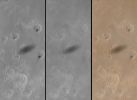
Martian_Eclipse-moc2_msss_3shadow100-01.jpgMOC Views of Martian Solar Eclipses (Original NASA/MGS/MSSS - Natural Color Frame)148 visiteThis picture shows wide angle red (left), blue (middle) and color composite (right) views of the shadow of Phobos (elliptical feature at center of each frame) as it was cast upon western Xanthe Terra on August 26, 1999, at about 2 p.m. local time on Mars. The image covers an area about 250 Km (155 miles) across and is illuminated from the left. The meandering Nanedi Valles is visible in the lower right corner of the scene. Note the dark spots on three crater floors - these appear dark in the red camera image (left) but are barely distingished in the blue image (middle), while the shadow is dark in both images. The spots on the crater floors are probably small fields of dark sand dunes.
|
|

Martian_Limb-MGS-E23-00100_limb-00.jpgMartian Limb and Outer Space (Original NASA/MGS/MSSS b/w Frame)181 visitecaption originale: "The Mars Global Surveyor (MGS) Mars Orbiter Camera (MOC) red and blue wide angle cameras provide daily coverage of the Red Planet "from Limb to Limb." The "Limbs" are the edges of the Planet as seen to the West and East of the spacecraft. Depending on weather conditions, Clouds or Haze can sometimes be seen above the Limb. This picture was taken by the blue camera in December 2002. It is an oblique view looking Westward across heavily Cratered Terrain at High Southern Latitudes. A thin line of Haze, high in the Martian Atmosphere, can be seen above the Planet's Surface. The view of Craters in the foreground is enhanced by the presence of bright, winter-time CO2 Frost. The darkness above the Limb is outer space".
|
|

Martian_Limb-MGS-E23-00100_limb-01.jpgMartian Limb, Clouds, Haze and Outer Space (Original NASA/MGS/MSSS b/w Frame)139 visiteCaption originale:"Mars Global Surveyor orbits the Red Planet 12 times each day. Half of each orbit is spent on the day side of Mars, which is where most Mars Orbiter Camera images are obtained because sunlight is required to illuminate the Surfaces being observed. However, on the night side of Mars, the wide angle cameras can see clouds and hazes above the sunward Martian Limb. This blue wide angle camera image, obtained on the night side of Mars on May 15, 2003, shows Clouds picking up the first sunlight before dawn near 55° North Latitude. The scene is illuminated by sunlight from the right. The Sun is actually on the other side of the Planet and has not yet risen over this Region. The dark area on the left side of the picture is the Martian Surface at night. The dark band on the right side is Outer Space. The bright features just right of center are the Clouds hanging above the Martian Limb over Mars' Northern Plains. North is up and the Spacecraft was moving Southward when the image was acquired".
|
|

Martian_Mountains-MGS-00.jpgCharitum Montes (Natural Colors; credits: NASA/MGS/MSSS)218 visiteWhat causes the unusual white color on some Martian Mountains? The answer can be guessed by noticing that the bright areas disappear as springtime takes hold in the South of Mars: dry ice. Dry CO2 ice sublimates directly to gas from its frozen state. The frosty mountains, named "Charitum Montes", have been covered with CO2 ice over the Martian Winter. The serene scene pictured above is not a photograph, but rather a computationally constructed digital illusion resulting from the fusion of two color images from the Mars Orbital Camera and topographic data from the Mars Orbiter Laser Altimeter. Both instruments operate from the Mars Global Surveyor robot spacecraft currently orbiting Mars.
|
|

Martian_Mountains-MGS-01.jpgCharitum Montes (Natural Colors; credits: NASA/MGS/MSSS)146 visiteCaption originale: "This is a perspective view of the Charitum Montes, the Mountain Range that bounds Southern Argyre Planitia, created by combining red and blue Mars Global Surveyor (MGS) Mars Orbiter Camera (MOC) wide angle images with topography from the MGS Mars Orbiter Laser Altimeter (MOLA). Carbon dioxide frost coats some of the hills, craters, and mountainsides in this southern springtime image. The picture is located near 57° South Lat. and 43°West Long. North is toward the top, South toward the bottom. Sunlight illuminates the scene from the upper left. The area shown is about 355 Km. A smaller portion of this image was previously released in July 2003 as "Frosty Mountains."
|
|

Martian_Mountains-MGS-02.jpgCharitum Montes (Natural Colors; credits: NASA/MGS/MSSS)165 visitenessun commento
|
|

Meridiani_Planum-Tepe-2005_09.jpg"Tepe" in Sinus Meridiani (Original NASA/MGS/MSSS b/w Frame)74 visiteOriginal caption:"This MGS-MOC image shows a lonely, light-toned Butte (----> collina "a ceppo") composed of Sedimentary Rock in Northern Sinus Meridiani. The dark landscape that surrounds the Butte was once covered by the same rocks that make up this lonely remnant".
Location near: 2,5° North Lat. and 4,2° West Long.
Image width: ~3 Km (~1,9 mi)
Illumination from: lower left
Season: Northern Autumn
|
|

Meridiani_Planum_Region-PIA03650~0.jpgUnusual Landform in Meridiani Planum (Original NASA/MGS/MSSS b/w Frame)64 visiteOriginal caption:"This MGS-MOC image shows exposures of light-toned, layered, Sedimentary Rock among dark-surfaced plains in Northern Sinus Meridiani. The circular feature in the South-East (lower right) corner of the image is a wedding-cake-like tower of Sedimentary Rocks".
Location near: 2,9° North Lat. and 359,9° West Long.
Image width: width: ~3 Km (~1,9 mi)
Illumination from: lower left
Season: Northern Winter
Nota: una "torre", piuttosto regolare nelle forme e presumibilmente costituita da rocce sedimentarie stratificate ed erose dal vento (e se ci pensate solo un attimo non Vi sarà difficile realizzare quanto rara possa essere una simile configurazione) viene liquidata come "torre-tipo-torta-matrimoniale". Non fraintendeteci: lo sappiamo che la banalizzazione fa parte del più recente stile NASA ma, alle volte, dopo gli assurdi nomi dati alle rocce Marziane, dopo la Hamburger-Nebula e dopo la torre a torta, ci domandiamo quali sìano mai le reali idee ed impressioni dei Signori che si occupano di questa Materia.
|
|
| 512 immagini su 43 pagina(e) |
 |
|
|
|
|
24 | |
|
|
|
|








