A Tribute To Mars Global Surveyor
|
|
|

Craters-Lyot_Crater-PCF-LXTT.jpgFretted Terrain and Lyot Crater (Absolute Natural Colors; credits for the additional process. and color.: Dr Paolo C. Fienga - Lunexit Team) 150 visiteCaption NASA:"Martian "fretted (--->corrugato/increspato) terrain" occurs in Regions of "Buttes" (--->colline "a ceppo") and "Mesas" (--->altopiani) that stand at the erosional margin where Northern low-lying Plains meet the higher-standing Cratered Uplands. Found mostly in the Mid-Northern Latitudes, some of the best examples of "Fretted Terrain" occur in the Deuteronilus Mensae Region. Here, the interaction of the process that creates the Mesas and Buttes, the processes that modify these surfaces after they form, and the relationship of both of these processes with the near-instantaneous event that formed the large Crater Lyot, provide us places to look to decipher this small but important piece of Martian Geological History.MareKromium
|
|

Craters-Newton_Crater-00-39S_166W_30.jpgGullies inside Newton Crater - Terra Sirenum (Natural Colors; credits: NASA/MGS/MSSS)112 visiteCaption NASA originale:"Both pictures show gullies (gully--->plur.: gullies: "gole" o "crepacci scoscesi") on the walls of two different meteor impact craters that occur in Newton Basin in Sirenum Terra, Mars. This picture, showing gullies in a crater at 42.4°S, 158.2°W, exhibits patches (patch-->geol.: "placche" o "macchie") of wintertime frost on the crater wall and dark-toned sand dunes on the floor. Its resolution is 1,5 meters (5 feet) per pixel - objects the size of school buses can be resolved in the full size image. The gullies in these craters originate at a specific layer and may have formed by release of groundwater to the martian surface in geologically recent times".
|
|

Craters-Newton_Crater-01-42S_158W_30.jpgGullies inside Newton Crater - Terra Sirenum (Natural Colors; credits: NASA/MGS/MSSS)119 visiteCaption NASA originale:"This picture shows gullies in a crater at 39.0°S, 166.1°W and it is one of the highest-resolution images ever obtained from Mars. Also in this case the resolution is 1,5 meters (5 feet) per pixel".
|
|

Craters-Newton_Crater-03.jpgNewton Crater's Gullies (Original NASA/MGS/MSSS b/w Frame)206 visiteDa "NASA - Picture of the Day" del 26.6.2000:"...Inside a small crater that lies inside large Newton Crater on Mars, numerous narrow channels run from the top down to the crater floor. The above picture covers a region spanning about 3000 meters across. These and other gullies have been found on Mars in recent HR pictures taken by the orbiting Mars Global Surveyor robot spacecraft. Similar channels on Earth are formed by flowing water, but on Mars the temperature is normally too cold and the atmosphere too thin to sustain liquid water. Nevertheless, many scientists now hypothesize that liquid water did burst out here from underground Mars, eroded the gullies and pooled at the bottom as it froze and evaporated. If so, life-sustaining ice and water might exist even today below the Martian surface (...)". L'idea che ci sia acqua allo stato liquido sotto la superficie di Marte non è nuova, anzi: la NASA stessa lo ipotizzava 4 anni fa. Oggi, dopo mesi di esplorazione "in loco", tutto tace. Forse un ripensamento?
|
|

Craters-Newton_Crater-PCF-LXTT-04.jpgNewton Crater's Gullies (Absolute Natural Colors; credits for the additional process. and color.: Dr Paolo C. Fienga - Lunexit Team)269 visitenessun commentoMareKromium
|
|

Craters-Pollack_Crater-00.jpgThe "White Rock" inside Pollack Crater (NASA/JPL/MSSS)98 visiteCaption NASA originale:"White Rock" is a ridged mound that was first seen and informally named "White Rock" in pictures from the Mariner 9 orbiter in 1972. In black-and-white photos, the feature appears much brighter than its surrounding terrain, giving the impression that the material is white. Later analyses of Mariner 9, Viking and MGS data showed that the feature isn't actually white: it is somewhat red and reflects only about 20-25% of the sunlight that falls upon it (a white surface would reflect 100%). Located in Pollack Crater, a 95 Km wide impact basin at 7.9°S, 334.7°W, White Rock is the light-red/orange feature with the rectangular white box drawn on it in the context view. The light-toned material that gives White Rock its name forms steep cliffs with valleys between them covered by dark, windblown, rippled sand".
|
|

Craters-Pollack_Crater-01.jpgThe "White Rock" inside Pollack Crater93 visiteCaption NASA originale:"The layering in White Rock suggests that the material is sediment deposited at some time in the distant past within Pollack Crater. The fact that the material erodes to form steep cliffs suggests that it is hard like rock. Thus, White Rock is interpreted to be an outcrop of sedimentary rock. It is probably a small remnant of a larger body of rock that may have once covered the entire floor of Pollack Crater; this view is supported by the observation that more extensive layered rocks are seen in other craters across the surface of the Red Planet (e.g., the crater at 8°N, 7°W)".
|
|
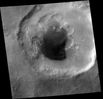
Craters-Rabe_Crater-I-M0203079-00.jpgThe "Pitted" West Floor of Rabe Crater - The Area (1) - (Original NASA/MGS/MSSS b/w Frame)75 visiteImage ID (picno): M02-03078
Image start time: 1999-06-22 - T04:56:09.09 SCET
Image width: 1024 pixels
Image height: 3200 pixels
Line integration time: 0,7231 millisec
Pixel aspect ratio: 1,60
Compression type: MOC-PRED-X-5
Longitude of image center: 326,11°W
Latitude of image center: 44,24°S
Scaled pixel width: 2,77 mt
Scaled image width: 2,85 Km
Scaled image height: 14,4 Km
Solar Longitude (Ls): 158,39°
Local True Solar Time: 14,80 decimal hours (such as--->14:48 MLT)
Emission angle: 0,26°
Incidence angle: 65,43°
Phase angle: 65,36°
North azimuth: 94,16°
Sun azimuth: 47,45°
Spacecraft altitude: 371,30 Km
Slant (--->inclinazione) distance: 371,30 Km
|
|
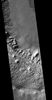
Craters-Rabe_Crater-I-M0203079-01.jpgThe "Pitted" West Floor of Rabe Crater (2) - (Original NASA/MGS/MSSS b/w Frame)69 visitenessun commento
|
|

Craters-Rabe_Crater-I-M0203079-02.jpgThe "Pitted" West Floor of Rabe Crater (3) - EDM (Original NASA/MGS/MSSS b/w Frame)77 visitenessun commento
|
|

Craters-Rabe_Crater-PCF-LXTT.jpgOn the Floor of Rabe Crater (Absolute Natural Colors; credits for the additional process. and color: Dr Paolo C. Fienga - Lunexit Team)240 visiteCaption NASA originale:"This MGS-MOC image shows remnants — Buttes and Knobs — of light-toned rock, perhaps sedimentary in origin, on the Floor of Rabe Crater. The Buttes and Knobs are surrounded by dark, windblown Sands which have been criss-crossed by Dust Devil Tracks".
Location near: 44,0° South; 325,9° West
Image width: ~3 Km (~1,9 mi)
Illumination from: upper left
Season: Southern SummerMareKromium
|
|

Craters-Schiaparelli_Crater-Layers-01.jpgLayers in Schiaparelli Crater (Natural Colors; credits: Lunexit)67 visitenessun commentoMareKromium
|
|
| 512 immagini su 43 pagina(e) |
 |
|
|
|
|
13 | |
|
|
|
|








