|
|

The_Saddest_Truth.jpgDedicated to me...Just for a little laugh!338 visitePer i non "Anglofili": "Vedo Alieni e Mondi lontani" risposta "Ragazzino fortunato! Io vedo solo stronzi e cretini!...". Estratta da un oramai vecchio film che, penso, conosciate tutti.MareKromium
|
|
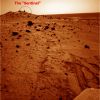
The_Sentinel-SOL1041-2N218780542EFFAS81P0700L0M1.jpgImagination: the Sentinel - Sol 104185 visitenessun commento
|
|

The_Teapot.jpgDo you see?!?100 visiteSure, you can see the 2D rectangle of colours, but can you see deeper? Counting colour patches in the featured image, you might estimate that the most information that this 2D digital image can hold is about 60 (horizontal) x 50(vertical) x 256 (possible colours) = 768,000 bits. However, the yet-unproven Holographic Principle states that, counter-intuitively, the information in a 2D panel can include all of the information in a 3D room that can be enclosed by the panel. The principle derives from the idea that the Planck length, the length scale where quantum mechanics begins to dominate classical gravity, is one side of an area that can hold only about one bit of information. The limit was first postulated by physicist Gerard 't Hooft in 1993. It can arise from generalizations from seemingly distant speculation that the information held by a black hole is determined not by its enclosed volume but by the surface area of its event horizon. The term "holographic" arises from a hologram analogy where three-dimension images are created by projecting light through a flat screen. Beware, some people staring at the featured image may not think it encodes just 768,000 bits - nor even 2563,000 bit permutations - rather they might claim it encodes a three-dimensional teapot. MareKromium
|
|

Time.jpgIs the Future worth twice the Past?196 visiteYes, it is. And a very simple (and "stupid", of course...) pseudo-mathematical "game" proves it. Please read the comment if you want to see the "formula" and the reasoning.
Si, il Futuro vale due volte il Passato. £d un semplicissimo (e sciocco, naturalmente...) "gioco" pseudo matematico lo prova. Leggere, per favore, il commento per la Formula ed il ragionamento retrostante.MareKromium
|
|

Titan-Malaska.jpgTitan's Fly-Over (by Mike Malaska)106 visiteQuesta "Visione" di Titano, da circa 150 Km di altitudine, per quanto è bella e suggestiva, tanto è - purtroppo e concettualmente - sbagliata. A nostro parere.
Perchè? Da quale punto di vista?
Dal "solito": quello dell'illuminazione.
Questa "veduta", infatti, può essere ragionevolissima per la Terra (chessò, pensiamo al Mojave Desert, oppure alla Monument Valley); può essere ragionevole per Marte (e qui diremmo che si può pensare ed immaginare la Regione Equatoriale della Vallis Marineris Canyon System), ma per Titano, ad oltre un miliardo di Km dal Sole...
Peccato. Bel Lavoro Mike, ma hai cercato di "gratificare" troppo la NASA (solo "loro", infatti, ci propongono Titano con illuminazione simil-Terrestre) e, come sempre accade in questi casi, il risultato finale è tanto bello, quanto irrealistico.
Try again!MareKromium
|
|

Titan-PIA11626-02.jpgA Floating Probe in Kraken Mare89 visitenessun commentoMareKromium
|
|
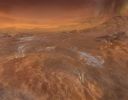
Titan-PIA11838.jpgRainy Day at Hotei Arcus74 visiteA short but fierce "gullywasher" rainstorm of Methane falls on the mountains surrounding the intriguing flows of Titan's Hotei Arcus in this artist's concept, based upon radar mapping data from the Cassini Spacecraft in orbit around Saturn.
Radar data show that the arc of Hotei is the boundary between rugged mountains to the South and East and a broad valley. Emerging from the mountains are several radar-bright channels that are likely now dry riverbeds that were carved by flowing Methane due to rainfall. Within the valley, the channels end near lobate (blobby) flows some 100 to 200 meters (300 to 600 feet) thick, which some scientists think could be slushy ice lava from cryovolcanoes.
These flows are portrayed here as the rough and elevated lighter tan areas in the foreground. It is possible that such phenomena could release Methane from beneath the surface, helping to explain how Titan's Atmosphere sustains its supply of Methane.
The area depicted is located at approximately 28° South Latitude and 78° West Longitude.MareKromium
|
|

Titan-PIA16634-Fantasy.jpgOn the Surface of Titan...108 visiteCaption NASA:"This artist's concept envisions what Hydrocarbon Ice forming on a liquid Hydrocarbon Sea of Saturn's moon Titan might look like. A new model from scientists on NASA's Cassini mission suggests that clumps of Methane-and-Ethane-rich ice -- shown here as the lighter-colored clusters -- could float under some conditions".MareKromium
|
|

Titanian_Rainstorm-David_A__Hardy.jpgRainy Day on Titan (a Fantasy Frame by David A. Hardy - AstroArt) 305 visiteUn Lavoro davvero BELLISSIMO dell'Artista David A. Hardy che abbiamo tuttavia LEGGERMENTE modificato in accordo a quelle che noi, come Lunexit Team, riteniamo essere le condizioni effettive di luminosità esistenti al Datum di Titano (il quadro di Dave Hardy, a nostro parere, pecca - come d'altronde la NASA "insegna" e "suggerisce" - di una luminosità davvero eccessiva - verificate Voi stessi l'original painting di Dave Hardy, pubblicato sulla Rubrica "NASA - Picture of the Day" del giorno 1mo Aprile 2011 per rendervene conto).
Ci scusiamo, ovviamente, con il Maestro David A. Hardy per la modifica effettuata sul Suo - comunque SPLENDIDO - quadro, ma questa modifica la ritenevamo e riteniamo dovuta ai Lettori di Lunar Explorer Italia.MareKromium
|
|

Titanian_Sunset.JPGSunset on Titan89 visiteUna "Fantasia" su Titano, certo molto suggestiva, ma intrinsecamente errata: Titano, infatti, a dispetto di quanto mostrato in questo frame e nella stragrande maggioranza delle ricostruzioni di fantasia "Made by NASA", è un mondo immerso nel silenzio più assoluto ed in una perenne (e, riteniamo, pesante) semi-oscurità.
Un Mondo in cui il Sole - lontanissimo - se e quando riesce a farsi spazio tra le nebbie giallastre che lo avvolgono, dovrebbe apparire simile ad una stella, certo un pò più brillante delle altre, ma la cui luminosità sarebbe comunque insufficiente dal creare un "effetto giorno" (in termini simil-terrestri o simil-marziani) e quindi ben lungi dal poter rischiarare la sua gelida superficie nel modo in cui viene qui - davvero assai immaginificamente - ipotizzato.
Forse, come potrete leggere nell'articolo di prossima pubblicazione su TruePlanets - ed intitolato "Beyond the Fog" -, la maggiore (se non unica) sorgente di illuminazione discreta per Titano dovrebbe essere il SaturnShine, o "Chiaro di Saturno", quando esso, letteralmente, "splende" - in fase piena - nel suo Cielo cupo e nebbioso...MareKromium
|
|

Triton-Atmosphere-Fantasy.jpgA View from Triton131 visitenessun commentoMareKromium
|
|

Un-Sunset.jpgUn-Sunset (by Dr Gianluigi Barca)140 visitenessun commentoMareKromium
|
|
| 93 immagini su 8 pagina(e) |
 |
|
|
|
|
7 |
|








