| |

The Universe in Super Definition
|
|
|
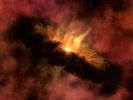
NGC-1333-PIA09967.jpgNGC 133368 visiteNASA's Spitzer Space Telescope observed a fledgling Solar System like the one depicted in this artist's concept, and discovered deep within it enough water vapor to fill the oceans on Earth five times. This water vapor starts out in the form of ice in a cloudy cocoon (not pictured) that surrounds the embryonic star, called NGC 1333-IRAS 4B (buried in center of image).
Material from the cocoon, including ice, falls toward the center of the cloud. The ice then smacks down onto a dusty pre-planetary disk circling the stellar embryo (doughnut-shaped cloud) and vaporizes.
Eventually, this water might make its way into developing planets.MareKromium
|
|
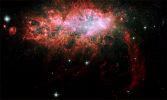
NGC-1569.jpgStarburst Galaxy NGC 156972 visiteThis image taken by NASA's Hubble Space Telescope showcases the brilliant core of one of the most active galaxies in our local neighborhood. The entire core is 5,000 light-years wide.
The galaxy, called NGC 1569, sparkles with the light from millions of newly formed young stars. NGC 1569 is pumping out stars at a rate that is 100 times faster than the rate observed in our Milky Way Galaxy. This frenzied pace has been almost continuous for the past 100 million years.
The core's centerpiece is a grouping of three giant star clusters, each containing more than a million stars. (Two of the clusters are so close they appear as one grouping.) The clusters reside in a large, central cavity. The gas in the cavity has been blown out by the multitude of massive, young stars that already exploded as supernovae. These explosions also triggered a violent flow of gas and particles that is sculpting giant gaseous structures. The sculpted structure at lower right is about 3,700 light-years long.
Huge bubbles of gas, such as the two at left, appear like floating islands. The largest bubble is about 378 light-years wide and the smallest 119 light-years wide. They are being illuminated by the radiation from the bright, young stars within them. Some of those stars are peaking through their gaseous cocoons.
The biggest and brightest objects surrounding the core are stars scattered throughout our Milky Way Galaxy. In contrast, the thousands of tiny white dots in the image are stars in the halo of NGC 1569. The galaxy is 11 million light-years from Earth.
A new analysis of NGC 1569 shows that it is one and a half times farther from Earth than astronomers previously thought. The extra distance places the galaxy in the middle of a group of about 10 galaxies centered on the spiral galaxy IC 342. Gravitational interactions among the group's galaxies may be compressing gas in NGC 1569 and igniting the star-birthing frenzy.
MareKromium
|
|
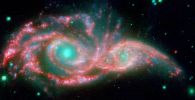
NGC-2207-PIA08097.jpgNGC 2207 and IC 2163: Colliding Galaxies71 visiteThese shape-shifting galaxies have taken on the form of a giant mask. The icy blue eyes are actually the cores of two merging galaxies, called NGC 2207 and IC 2163, and the mask is their spiral arms. The false-colored image consists of infrared data from NASA's Spitzer Space Telescope (red) and visible data from NASA's Hubble Space Telescope (blue/green).
NGC 2207 and IC 2163 met and began a sort of gravitational tango about 40 million years ago. The two galaxies are tugging at each other, stimulating new stars to form. Eventually, this cosmic ball will come to an end, when the galaxies meld into one. The dancing duo is located 140 million light-years away in the Canis Major constellation.
The infrared data from Spitzer highlight the galaxies' dusty regions, while the visible data from Hubble indicates starlight. In the Hubble-only image (not pictured here), the dusty regions appear as dark lanes.
The Hubble data correspond to light with wavelengths of .44 and .55 microns (blue and green, respectively). The Spitzer data represent light of 8 microns.
|
|

NGC-2237-PIA09267.jpgNGC 2237 - The "Rosette Nebula", and Globular Star Cluster NGC 224467 visiteThis infrared image from NASA's Spitzer Space Telescope shows the Rosette nebula, a pretty star-forming region more than 5,000 light-years away in the constellation Monoceros. In optical light, the nebula looks like a rosebud, or the "rosette" adornments that date back to antiquity.
But lurking inside this delicate cosmic rosebud are so-called planetary "danger zones" (see spheres illustrations in figure 1). These zones surround super hot stars, called O-stars (blue stars inside spheres), which give off intense winds and radiation. Young, cooler stars that just happen to reside within one of these zones are in danger of having their dusty planet-forming materials stripped away.
While O-star danger zones were known about before, their parameters were not. Astronomers used Spitzer's infrared vision to survey the extent of the five danger zones shown here. The results showed that young stars lying beyond 1.6 light-years, or 10 trillion miles, of any O-stars are safe, while young stars within this zone are likely to have their potential planets blasted into space.
Radiation and winds from the super hot stars have collectively blown layers of dust (green) and gas away, revealing the cavity of cooler dust (red). The largest two blue stars in this picture are in the foreground, and not in the nebula itself.
This image shows infrared light captured by Spitzer's infrared array camera. Light with wavelengths of 24 microns is red; light of 8 microns is green; and light of 4.5 microns is blue.
MareKromium
|
|

NGC-2237_and_NGC-2244-SST.jpgThe "O" Stars inside the Rosette Nebula119 visiteIn this sub-frame are highlighted 5 dangerous hot stars that can be found inside the Rosette Nebula; these stars are classified as "O" Stars (meaning stars with a surface temperatures of 25.000 Kelvins - such as 24.726,85° Celsius - or higher).
Astronomers calculate that cool stars wandering within about 1,6 Light-Years of the Rosette's "O" Stars are in danger of having their planet forming disks destroyed.
MareKromium
|
|
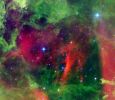
NGC-2237_and_NGC-2244.jpgHot Stars in the Rosette Nebula69 visiteWinds and radiation from massive hot stars in the Rosette Nebula have cleared the natal gas and dust from the center of the nearby star-forming region. They also pose a danger to planet forming disks around young, cooler stars in the neighborhood. This Spitzer Space Telescope (SST) infrared image of dust clouds near the Rosette's central region, shows the cleared-out cavity.
The view spans about 45 LY at the the nebula's estimated distance of 5.200 LY. MareKromium
|
|
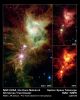
NGC-2264.jpgNGC 2264 - The "Snowflake Cluster" versus the "Cone Nebula"72 visiteCaption NASA:"Strange shapes and textures can be found in the neighborhood of the Cone Nebula.
These patterns result from the tumultuous unrest that accompanies the formation of the open cluster of stars known as NGC 2264, the Snowflake Cluster. To better understand this process, a detailed image of this Region was taken in two colors of infrared light by the orbiting Spitzer Space Telescope (SST). Bright stars from the Snowflake cluster dot the field. These stars soon heat up and destroy the gas and dust mountains in which they formed. One such dust mountain is the famous Cone Nebula, visible in the above image on the left, pointing toward a bright star near the center of the field.
The entire NGC 2264 Region is located about 2500 LY away toward the constellation of the Unicorn (Monoceros)".MareKromium
|
|
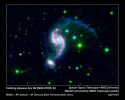
NGC-2535-PIA09106.jpgNGC 2535 and NGC 2536 (alias Arp 82)69 visiteA pair of interacting galaxies might be experiencing the galactic equivalent of a mid-life crisis. For some reason, the pair, called Arp 82, didn't make their stars early on as is typical of most galaxies. Instead, they got a second wind later in life -- about 2 billion years ago -- and started pumping out waves of new stars as if they were young again.
Arp 82 is an interacting pair of galaxies with a strong bridge and a long tail. NGC 2535 is the big galaxy and NGC 2536 is its smaller companion. The disk of the main galaxy looks like an eye, with a bright "pupil" in the center and oval-shaped "eyelids." Dramatic "beads on a string" features are visible as chains of evenly spaced star-formation complexes along the eyelids. These are presumably the result of large-scale gaseous shocks from a grazing encounter. The colors of this galaxy indicate that the observed stars are young to intermediate in age, around 2 million to 2 billion years old, much less than the age of the universe (13.7 billion years).
The puzzle is: why didn't Arp 82 form many stars earlier, like most galaxies of that mass range? Scientifically, it is an oddball and provides a relatively nearby lab for studying the age of intermediate-mass galaxies.
This picture is a composite captured by Spitzer's infrared array camera with light at wavelength 8 microns shown in red, NASA's Galaxy Evolution Explorer combined 1530 and 2310 Angstroms shown in blue, and the Southeastern Association for Research in Astronomy Observatory light at 6940 Angstroms shown in green.
|
|

NGC-2683.jpgNGC 2683 - Spiral Edge-On Galaxy116 visitenessun commentoMareKromium
|
|

NGC-2808-0.jpgNGC 2808 - Globular Star Cluster69 visiteAstronomers have long thought that globular star clusters had a single "baby boom" of stars early in their lives and then settled into a quiet existence.
New observations by NASA's Hubble Space Telescope, however, are showing that this idea may be too simple. The Hubble analysis of the massive globular cluster NGC 2808 provides evidence that star birth went "boom, boom, boom," with three generations of stars forming very early in the cluster's life.
"We had never imagined that anything like this could happen," said Giampaolo Piotto of the University of Padova in Italy and leader of the team that made the discovery. "This is a complete shock."
Globular clusters are the homesteaders of our Milky Way Galaxy, born during our galaxy's formation. They are compact swarms of typically hundreds of thousands of stars held together by gravity.
"The standard picture of a globular cluster is that all of its stars formed at the same time, in the same place, and from the same material, and they have co-evolved for billions of years," said team member Luigi Bedin of the European Space Agency, the European Organization for Astronomical Research in the Southern Hemisphere (ESO), in Garching, Germany, and the Space Telescope Science Institute in Baltimore, Md. "This is the cornerstone on which much of the study of stellar populations has been built. So we were very surprised to find several distinct populations of stars in NGC 2808. All of the stars were born within 200 million years very early in the life of the 12.5-billion-year-old massive cluster."
Finding multiple stellar populations in a globular cluster so close to home has deep cosmological implications, the researchers said.
"We need to do our best to solve the enigma of these multiple generations of stars found in these Hubble observations so that we can understand how stars formed in distant galaxies in our early universe," Piotto explained.
The astronomers used Hubble's Advanced Camera for Surveys to measure the brightness and color of the cluster stars. Hubble's exquisite resolution allowed the astronomers to sort out the different stellar populations. The Hubble measurements showed three distinct populations, with each successive generation appearing slightly bluer. This color difference suggests that successive generations contain a slightly different mix of some chemical elements.
"One assumption, although we have no direct proof," said team member Ivan King of the University of Washington in Seattle, "is that the successively bluer color of the stellar populations indicates that the amount of helium increases with each generation of stars. Perhaps massive star clusters like NGC 2808 hold onto enough gas to ignite a rapid succession of stars."
The star birth would be driven by shock waves from supernovae and stellar winds from giant stars, which compress the gas and make new stars, King explained. The gas would be increasingly enriched in helium from previous generations of stars more massive than the Sun.
Astronomers commonly assume that globular clusters produce only one stellar generation, because the energy radiating from the first batch of stars would clear out most of the residual gas needed to make more stars. But a hefty cluster like NGC 2808, which is two to three times more massive than a typical globular cluster, may have enough gravity to hang onto that gas, which has been enriched by helium from the first stars. Of the about 150 known globular clusters in our Milky Way Galaxy, NGC 2808 is one of the most massive, containing more than 1 million stars.
Another possible explanation for the multiple stellar populations is that NGC 2808 may only be masquerading as a globular cluster. The stellar grouping may have been a dwarf galaxy that was stripped of most of its material due to gravitational capture by our galaxy.
Omega Centauri, the only other stellar system Piotto's group found to have multiple generations of stars, is suspected to be the remnant core of a dwarf galaxy, Bedin said.
Although the astronomers' search is only in its infancy, they say multiple stellar populations may be a typical occurrence in other massive clusters.
"No one would make the radical step of suggesting that previous work on other clusters is no longer valid," King said. "But this discovery shows that the study of stellar populations in globular clusters now opens up in a new direction."
The team plans to use ESO's Very Large Telescope in Chile to make spectroscopic observations of the chemical abundances in NGC 2808, which may offer further evidence that the stars were born at different times and yield clues to how they formed. They also will use Hubble to hunt for multiple generations of stars in about 10 more hefty globular clusters.
The team's results have been accepted for publication in the Astrophysical Journal Letters.
MareKromium
|
|
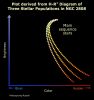
NGC-2808-2.jpgTriple Stellar Evolution Epochs in NGC 280870 visiteLike a simplified version of the Hertzsprung-Russell (HR) Diagram and by using the original HST data, this graph schematically plots the brightness of the stars in Globular Cluster NGC 2808 (along the vertical axis) against stellar color and temperature (along the horizontal axis).
The cooler a star is, the redder it appears, and it diminishes in brightness.
The bluer stars are to the left; redder stars are to the right.
The brightest stars are near the top.
The 3 curves represent the 3 different populations of stars that are present in NGC 2808.MareKromium
|
|
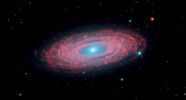
NGC-2841-PIA12001.jpgNGC 2841 - Spiral Galaxy70 visiteThis image from NASA's Spitzer Space Telescope shows the Spiral Galaxy NGC 2841, located about 46 MLY from Earth in the constellation Ursa Major. The galaxy is helping astronomers solve one of the oldest puzzles in astronomy: Why do galaxies look so smooth, with stars sprinkled evenly throughout?
An international team of astronomers has discovered that rivers of young stars flow from their hot, dense stellar nurseries, dispersing out to form large, smooth distributions.
This image is a composite of three different wavelengths from Spitzer's InfraRed Array Camera. The shortest wavelengths are displayed in blue, and mostly show the older stars in NGC 2841, as well as foreground stars in our own Milky Way galaxy. The cooler areas are highlighted in red, and show the dusty, gaseous regions of the galaxy.
Blue shows InfraRed Light of 3,6 microns, green represents 4,5-micron light and red, 8,0-micron light. The contribution from starlight measured at 3,6 microns has been subtracted from the 8,0-micron data to enhance the visibility of the dust features. The shortest wavelengths are displayed in blue, and mostly show the older stars in NGC 2841, as well as foreground stars in our own Milky Way Galaxy.MareKromium
|
|
| 157 immagini su 14 pagina(e) |
|
|
|
|
|
9 | |
|
|
|
|
|
|








