| |

The Universe in Super Definition
|
|
|

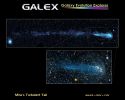
Mira-PIA09958-0.jpgMira soars through the Sky!69 visiteNew ultraviolet images from NASA's Galaxy Evolution Explorer shows a speeding star that is leaving an enormous trail of "seeds" for new solar systems. The star, named Mira (pronounced my-rah) after the latin word for "wonderful," is shedding material that will be recycled into new stars, planets and possibly even life as it hurls through our galaxy.
In figure 1, the upper panel shows Mira's full, comet-like tail as seen only in shorter, or "far" ultraviolet wavelengths, while the lower panel is a combined view showing both far and longer, or "near" ultraviolet wavelengths. The close-up picture at bottom gives a better look at Mira itself, which appears as a pinkish dot, and is moving from left to right in this view. Shed material appears in light blue. The dots in the picture are stars and distant galaxies. The large blue dot on the left side of the upper panel, and the large yellow dot in the lower panel, are both stars that are closer to us than Mira.
The Galaxy Evolution Explorer discovered the strange tail during part of its routine survey of the entire sky at ultraviolet wavelengths. When astronomers first saw the picture, they were shocked because Mira has been studied for over 400 years yet nothing like this has ever been documented before.
Mira's comet-like tail stretches a startling 13 light-years across the sky. For comparison, the nearest star to our sun, Proxima Centauri, is only about 4 light-years away. Mira's tail also tells a tale of its history -- the material making it up has been slowly blown off over time, with the oldest material at the end of the tail being released about 30,000 years ago (figure 2).
Mira is a highly evolved, "red giant" star near the end of its life. Technically, it is called an asymptotic giant branch star. It is red in color and bloated; for example, if a red giant were to replace our sun, it would engulf everything out to the orbit of Mars. Our sun will mature into a red giant in about 5 billion years.
Like other red giants, Mira will lose a large fraction of its mass in the form of gas and dust. In fact, Mira ejects the equivalent of the Earth's mass every 10 years. It has released enough material over the past 30,000 years to seed at least 3,000 Earth-sized planets or 9 Jupiter-sized ones.
While most stars travel along together around the disk of our Milky Way, Mira is charging through it. Because Mira is not moving with the "pack," it is moving much faster relative to the ambient gas in our section of the Milky Way. It is zipping along at 130 kilometers per second, or 291,000 miles per hour, relative to this gas.
Mira's breakneck speed together with its outflow of material are responsible for its unique glowing tail. Images from the Galaxy Evolution Explorer show a large build-up of gas, or bow shock, in front of the star, similar to water piling up in front of a speeding boat. Scientists now know that hot gas in this bow shock mixes with the cooler, hydrogen gas being shed from Mira, causing it to heat up as it swirls back into a turbulent wake. As the hydrogen gas loses energy, it fluoresces with ultraviolet light, which the Galaxy Evolution Explorer can detect.
Mira, also known as Mira A, is not alone in its travels through space. It has a distant companion star called Mira B that is thought to be the burnt-out, dead core of a star, called a white dwarf. Mira A and B circle around each other slowly, making one orbit about every 500 years. Astronomers believe that Mira B has no effect on Mira's tail.
Mira is also what's called a pulsating variable star. It dims and brightens by a factor of 1,500 every 332 days, and will become bright enough to see with the naked eye in mid-November 2007. Because it was the first variable star with a regular period ever discovered, other stars of this type are often referred to as "Miras."
Mira is located 350 light-years from Earth in the constellation Cetus, otherwise known as the whale. Coincidentally, Mira and its "whale of a tail" can be found in the tail of the whale constellation.
These images were between November 18 and December 15, 2006.
MareKromium
|
|
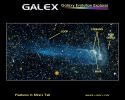
Mira-PIA09958-1.jpgMira: anatomy of a "Celestial Shooting Star"...68 visiteA close-up view of a star racing through space faster than a speeding bullet can be seen in this image from NASA's Galaxy Evolution Explorer. The star, called Mira (pronounced My-rah), is traveling at 130 kilometers per second, or 291,000 miles per hour. As it hurls along, it sheds material that will be recycled into new stars, planets and possibly even life.
In this image, Mira is moving from left to right. It is visible as the pinkish dot in the bulb shape at right. The yellow dot below is a foreground star. Mira is traveling so fast that it's creating a bow shock, or build-up of gas, in front of it, as can be seen here at right.
Like a boat traveling through water, a bow shock forms ahead of the star in the direction of its motion. Gas in the bow shock is heated and then mixes with the cool hydrogen gas in the wind that is blowing off Mira. This heated hydrogen gas then flows around behind the star, forming a wake.
Why is the wake of material glowing? When the hydrogen gas is heated, it transitions into a higher-energy state, which then loses energy by emitting ultraviolet light - a process called fluorescence. The Galaxy Evolution Explorer has special instruments that can detect this ultraviolet light.
A similar fluorescence process is responsible for the Northern Lights -- a glowing, green aurora that can be seen from northern latitudes. However, in that case nitrogen and oxygen gas are fluorescing with visible light.
Streams and a loop of material can also be seen coming off Mira. Astronomers are still investigating what these streams are, but they suspect that they are denser parts of Mira's wind perhaps flowing out of the star's poles.
This image consists of data captured by both the far- and near-ultraviolet detectors on the Galaxy Evolution Explorer between November 18 and December 15, 2006. It has a total exposure time of about 3 hours.
MareKromium
|
|
Mira-PIA09959.jpgMira: anatomy of a "Celestial Shooting Star"...70 visiteA close-up view of a star racing through space faster than a speeding bullet can be seen in this image from NASA's Galaxy Evolution Explorer. The star, called Mira (pronounced My-rah), is traveling at 130 kilometers per second, or 291,000 miles per hour. As it hurls along, it sheds material that will be recycled into new stars, planets and possibly even life.
In this image, Mira is moving from left to right. It is visible as the pinkish dot in the bulb shape at right. The yellow dot below is a foreground star. Mira is traveling so fast that it's creating a bow shock, or build-up of gas, in front of it, as can be seen here at right.
Like a boat traveling through water, a bow shock forms ahead of the star in the direction of its motion. Gas in the bow shock is heated and then mixes with the cool hydrogen gas in the wind that is blowing off Mira. This heated hydrogen gas then flows around behind the star, forming a wake.
Why is the wake of material glowing? When the hydrogen gas is heated, it transitions into a higher-energy state, which then loses energy by emitting ultraviolet light - a process called fluorescence. The Galaxy Evolution Explorer has special instruments that can detect this ultraviolet light.
A similar fluorescence process is responsible for the Northern Lights -- a glowing, green aurora that can be seen from northern latitudes. However, in that case nitrogen and oxygen gas are fluorescing with visible light.
Streams and a loop of material can also be seen coming off Mira. Astronomers are still investigating what these streams are, but they suspect that they are denser parts of Mira's wind perhaps flowing out of the star's poles.
This image consists of data captured by both the far- and near-ultraviolet detectors on the Galaxy Evolution Explorer between November 18 and December 15, 2006. It has a total exposure time of about 3 hours.
MareKromium
|
|
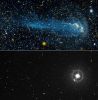
Mira-PIA09961.jpgMira's Tail70 visiteCaption NASA:"NASA's Galaxy Evolution Explorer discovered an exceptionally long comet-like tail of material trailing behind Mira -- a star that has been studied thoroughly for about 400 years.
So, why had this tail gone unnoticed for so long? The answer is that nobody had scanned the extended region around Mira in ultraviolet light until now.
As this composite demonstrates, the tail is only visible in ultraviolet light (top), and does not show up in visible light (bottom). Incidentally, Mira is much brighter in visible than ultraviolet light due to its low surface temperature of about 3000 Kelvin (about 5000° Fahrenheit)".MareKromium
|
|
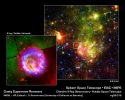
N76-PIA08516-2.jpgThe "N 76 Nebula"65 visiteThe supernova remnant1E0102.2-7219 sits next to the Nebula N76 in a bright, Star-Forming Region of the Small Magellanic Cloud, a satellite galaxy to our Milky Way galaxy located about 200.000 LY from Earth. A Supernova Remnant is made up of the messy bits and pieces of a massive star that exploded, or went Supernova. This image shows glowing dust grains in three wavelengths of infrared radiation: 24 microns (red) measured by the Multiband Imaging Photometer aboard NASA's Spitzer Space Telescope; and 8.0 microns (green) and 3.6 microns (blue) measured by Spitzer's infrared array camera. The red bubble is a dust envelope around the supernova remnant E0102, which is being heated by the shock wave created in the explosion of the remnant's massive progenitor star some 1,000 years ago. Most of the blue stars are in the Small Magellanic Cloud, though some are in our own galaxy.
|
|
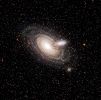
NGC-0253-HST.jpgCosmic Alignment! (2MASX J00482185-2507365)71 visiteNASA's Hubble Space Telescope has captured a rare alignment between two spiral galaxies. The outer rim of a small, foreground galaxy is silhouetted in front of a larger background galaxy. Skeletal tentacles of dust can be seen extending beyond the small galaxy's disk of starlight.
Such outer dark dusty structures, which appear to be devoid of stars, like barren branches, are rarely so visible in a galaxy because there is usually nothing behind them to illuminate them. Astronomers have never seen dust this far beyond the visible edge of a galaxy. They do not know if these dusty structures are common features in galaxies.
Understanding a galaxy's color and how dust affects and dims that color are crucial to measuring a galaxy's true brightness. By knowing the true brightness, astronomers can calculate the galaxy's distance from Earth.
Astronomers calculated that the background galaxy is 780 MLY away. They have not as yet calculated the distance between the two galaxies, although they think the two are relatively close, but not close enough to interact. The background galaxy is about the size of the Milky Way Galaxy and is about 10 times larger than the foreground galaxy.
Most of the stars speckled across this image belong to the nearby spiral galaxy NGC 253, which is out of view to the right. Astronomers used Hubble's Advanced Camera for Surveys to snap images of NGC 253 when they spied the two galaxies in the background. From ground-based telescopes, the two galaxies look like a single blob. But the Advanced Camera's sharp "eye" distinguished the blob as two galaxies, cataloged as 2MASX J00482185-2507365. The images were taken on Sept. 19, 2006.
The results have been submitted for publication in The Astronomical Journal.
For additional information, contact:
Donna Weaver/Ray Villard
Space Telescope Science Institute, Baltimore, Md.
410-338-4493 / 410-338-4514
dweaver@stsci.edu / villard@stsci.edu
Benne Holwerda
Space Telescope Science Institute, Baltimore, Md.
/University of Cape Town, South Africa
holwerda@stsci.edu
Object Name: 2MASX J00482185-2507365
MareKromium
|
|
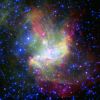
NGC-0346-PIA11227.jpgNGC 346 in the Small Magellanic Cloud72 visiteThis painterly portrait of a star-forming cloud, called NGC 346, is a combination of multiwavelength light from NASA's Spitzer Space Telescope (infrared), the European Southern Observatory's New Technology Telescope (visible), and the European Space Agency's XMM-Newton space telescope (X-ray).
The infrared observations highlight cold dust in red, visible data show glowing gas in green, and X-rays show very warm gas in blue. Ordinary stars appear as blue spots with white centers, while young stars enshrouded in dust appear as red spots with white centers.
The colorful picture demonstrates that stars in this region are being created by two different types of triggered star formation — one involving wind, and the other, radiation.
Triggered star formation occurs when massive stars spur new, smaller stars into existence. The first radiation-based mechanism is demonstrated near the center of the cloud. There, radiation from the massive stars is eating away at the surrounding dust cloud, creating shock waves that compress gas and dust into new stars. This compressed material appears as an arc-shaped orange-red filament, while the new stars within this filament are still blanketed with dust and cannot be seen.
The second wind-based mechanism is at play higher up in the cloud. The isolated, pinkish blob of stars at the upper left was triggered by winds from a massive star located to the left of it. This massive star blew up in a supernova explosion 50,000 years ago, but before it died, its winds pushed gas and dust together into new stars. While this massive star cannot be seen in the image, a bubble created when it exploded can be seen near the large, white spot with a blue halo at the upper left (this white spot is actually a collection of three stars).
NGC 346 is the brightest star-forming region in the Small Magellanic Cloud, an irregular dwarf galaxy that orbits our Milky Way galaxy, 210.000 LY away.MareKromium
|
|
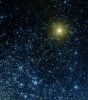
NGC-0362-PIA09653.jpgNGC 362 - Globular Star Cluster70 visiteThe Galaxy Evolution Explorer's ultraviolet eyes have captured a globular star cluster, called NGC 362, in our own Milky Way galaxy. In this new image, the cluster appears next to stars from a more distant neighboring galaxy, known as the Small Magellanic Cloud.
Globular clusters are densely packed bunches of old stars scattered in galaxies throughout the universe. NGC 362, located 30,000 light-years away, can be spotted as the dense collection of mostly yellow-tinted stars surrounding a large white-yellow spot toward the top-right of this image. The white spot is actually the core of the cluster, which is made up of stars so closely packed together that the Galaxy Evolution Explorer cannot see them individually.
The light blue dots surrounding the cluster core are called extreme horizontal branch stars. These stars used to be very similar to our sun and are nearing the end of their lives. They are very hot, with temperatures reaching up to about four times that of the surface of our sun (25,000 Kelvin or 45,500 degrees Fahrenheit).
A star like our sun spends most of its life fusing hydrogen atoms in its core into helium. When the star runs out of hydrogen in its core, its outer envelope will expand. The star then becomes a red giant, which burns hydrogen in a shell surrounding its inner core. Throughout its life as a red giant, the star loses a lot of mass, then begins to burn helium at its core. Some stars will have lost so much mass at the end of this process, up to 85 percent of their envelopes, that most of the envelope is gone. What is left is a very hot ultraviolet-bright core, or extreme horizontal branch star.
Blue dots scattered throughout the image are hot, young stars in the Small Magellanic Cloud, a satellite galaxy of the Milky Way located approximately 200,000 light-years away. The stars in this galaxy are much brighter intrinsically than extreme horizontal branch stars, but they appear just as bright because they are farther away. The blue stars in the Small Magellanic Cloud are only about a few tens of millions of years old, much younger than the approximately 10-million-year-old stars in NGC 362.
Because NGC 362 sits on the northern edge of the Small Magellanic Cloud galaxy, the blue stars are denser toward the south, or bottom, of the image.
Some of the yellow spots in this image are stars in the Milky Way galaxy that are along this line of sight. Astronomers believe that some of the other spots, particularly those closer to NGC 362, might actually be a relatively ultraviolet-dim family of stars called "blue stragglers." These stars are formed from collisions or close encounters between two closely orbiting stars in a globular cluster.
This image is a false-color composite, where light detected by the Galaxy Evolution Explorer's far-ultraviolet detector is colored blue, and light from the telescope's near-ultraviolet detector is red.
MareKromium
|
|
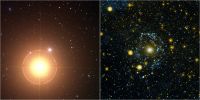
NGC-0404-PIA11393-1.jpgNGC 404 - The 'Ghost of Mirach' rears its Spooky Head78 visiteThe "Ghost of Mirach" Galaxy is shown in visible light on the left, and in UltraViolet as seen by NASA's Galaxy Evolution Explorer on the right. The fields of view are identical in both pictures, with the Ghost of Mirach — a galaxy also known as NGC 404 — seen as the whitish spot in the center of the images.
Mirach is a Red Giant star that looms large in visible light. Because NGC 404 is lost in the glare of this star, it was nicknamed the "Ghost of Mirach".
But when the galaxy is viewed in ultraviolet light, it comes to "life", revealing a never-before-seen ring. This ring, seen in blue in the picture on the right, contains new stars — a surprise considering that the galaxy was previously thought to be, essentially, dead.
The field of view spans 55.000 Light Years across. The Ghost of Mirach is located 11 MLY from Earth. The star Mirach is very close in comparison — since it is only 200 LY away and is visible with the naked eye.
The visible data come from the Digitized Sky Survey of the Space Telescope Science Institute in Baltimore, Md.MareKromium
|
|

NGC-1313.jpgNCG 1313 - Barred Spiral70 visite"...You have no idea how much nastier would be if I was not a Catholic.
Without "Supernatural Aid" I would hardly be a human being..."
Evelyn Waugh (1903 - 1966) - replying to Nancy Mitford who rebuked her for cruelty
|
|

NGC-1333-PIA09965.jpgWater Vapor inside NGC 133373 visiteThis plot of infrared data, called a Spectrum, shows the strong signature of water vapor deep within the core of an Embryonic Star System called NGC 1333-IRAS 4B.
The data were captured by NASA's SST using an instrument called Spectrograph.
A spectrograph collects light and sorts it according to color, or wavelength. In this case, infrared light from NGC 1333-IRAS 4B was broken up into the wavelengths listed on the horizontal axis of the plot. The sharp spikes, called spectral lines, occur at wavelengths at which the stellar object is particularly bright. The signature of water vapor is revealed in the pattern of wavelengths at which the spikes appear.
By comparing the observed data to a model (lower curve), astronomers can also determine the physical and chemical details of the region.
F.e.: Astronomers say these data suggest that ice in a cocoon surrounding the forming star is falling inward. The ice then smacks supersonically into a dusty planet-forming disk surrounding the stellar embryo, heats up and vaporizes quickly, releasing the infrared light that Spitzer collected.
MareKromium
|
|
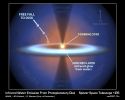
NGC-1333-PIA09966.jpgWater Vapor inside NGC 133369 visiteThis diagram illustrates the earliest journeys of water in a young, forming Star System. Stars are born out of icy cocoons of gas and dust. As the cocoon collapses under its own weight in an inside-out fashion, a stellar embryo forms at the center surrounded by a dense, dusty disk.
The stellar embryo "feeds" from the disk for a few million years, while material in the disk begins to clump together to form planets.
NASA's Spitzer Space Telescope was able to probe a crucial phase of this stellar evolution - a time when the cocoon is vigorously falling onto the pre-planetary disk. The infrared telescope detected water vapor as it smacks down on a disk circling a forming star called NGC 1333-IRAS 4B.
This vapor started out as ice in the outer envelope, but vaporized upon its arrival at the disk.
By analyzing the water in the system, astronomers were also able learn about other characteristics of the disk, such as its size, density and temperature.
How did Spitzer see the water vapor deep in the NGC 1333-IRAS 4B system?
This is most likely because the system is oriented in just the right way, such that its thicker disk is seen face-on from our Earthly perspective. In this "face-on" orientation, Spitzer can peer through a window carved by an outflow of material from the embryonic star. This system in this drawing is shown in the opposite "edge-on" configuration.MareKromium
|
|
| 157 immagini su 14 pagina(e) |
|
|
|
|
|
8 | |
|
|
|
|
|
|








