| |

The Universe in Super Definition
|
|
|

M-033-PIA11970.jpgM 33 - Spiral Galaxy62 visiteOne of our closest galactic neighbors shows its awesome beauty in this new image from NASA's Spitzer Space Telescope.
M 33, also known as the "Triangulum Galaxy", is a member of what's known as our Local Group of galaxies. Along with our own Milky Way, this group travels together in the universe, as they are gravitationally bound.
In fact, M 33 is one of the few galaxies that is moving toward the Milky Way despite the fact that space itself is expanding, causing most galaxies in the universe to grow farther and farther apart.
When viewed with Spitzer's InfraRed eyes, this elegant spiral galaxy sparkles with color and detail. Stars appear as glistening blue gems (many of which are actually foreground stars in our own galaxy), while dust in the spiral disk of the galaxy glows pink and red. But not only is this new image beautiful, it also shows M 33 to be surprising large —bigger than its Visible-Light appearance would suggest.
With its ability to detect cold, dark dust, Spitzer can see emission from cooler material well beyond the visible range of M 33's disk. Exactly how this cold material moved outward from the galaxy is still a mystery, but winds from giant stars or supernovas may be responsible.
M 33 is located about 2,9 MLY away in the constellation Triangulum. This composite image was taken by Spitzer's InfraRed Array Camera (a.k.a.: IRAC). The color blue indicates InfraRed Light of 3.6 microns, green shows 4.5-micron light, and red 8.0 microns.MareKromium
|
|
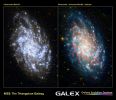
M-033-a.jpgM 33 - The "Triangulum" Spiral Galaxy (a.k.a. NGC 598)61 visiteNASA's Galaxy Evolution Explorer Mission celebrates its sixth anniversary studying galaxies beyond our Milky Way through its sensitive UltraViolet telescope, the only such far-UltraViolet detector in space.
The mission studies the shape, brightness, size and distance of distant galaxies across 10 BY of cosmic history, giving scientists a wealth of data to help us better understand the origins of the universe. One such object is pictured here, the galaxy NGC 598, more commonly known as M 33.
The image shows a map of the recent star formation history of M 33. The bright blue and white areas are where star formation has been extremely active over the past few million years. The patches of yellow and gold are regions where star formation was more active 100 MY ago.
In addition, the UltraViolet image shows the most massive young stars in M 33. These stars burn their large supply of Hydrogen fuel quickly, burning hot and bright while emitting most of their energy at UV wavelengths. Compared with low-mass stars like our Sun, which live for billions of years, these massive stars never reach old age, having a lifespan as short as a few million years.
The California Institute of Technology, in Pasadena, Calif., leads the Galaxy Evolution Explorer Mission and is responsible for science operations and data analysis. NASA's Jet Propulsion Laboratory, also in Pasadena, manages the mission and built the science instrument. The mission was developed under NASA's Explorers Program managed by the Goddard Space Flight Center, Greenbelt, Md. South Korea and France are the mission's international partners.MareKromium
|
|

M-042-PIA09411.jpgOut of Orion's Head (1)61 visiteThis image from NASA's SST shows infant stars "hatching" in the Head of the Hunter constellation, Orion. Astronomers suspect that shockwaves from a supernova explosion in Orion's head, nearly 3 MY ago, may have initiated this newfound birth
The Region featured in this Spitzer image is called Barnard 30.
It is located approx. 1,300 LY away and sits on the right side of Orion's "Head" just North of the massive star Lambda Orionis.
Wisps of green in the cloud are organic molecules called polycyclic aromatic hydrocarbons. These molecules are formed anytime carbon-based materials are burned incompletely. On Earth, they can be found in the sooty exhaust from automobile and airplane engines. They also coat the grills where charcoal-broiled meats are cooked.
Tints of orange-red in the cloud are dust particles warmed by the newly forming stars. The reddish-pink dots at the top of the cloud are very young stars embedded in a cocoon of cosmic gas and dust. Blue spots throughout the image are background Milky Way along this line of sight.
This composite includes data from Spitzer's infrared array camera instrument, and multiband imaging photometer instrument. Light at 4.5 microns is shown as blue, 8.0 microns is green, and 24 microns is red.
MareKromium
|
|
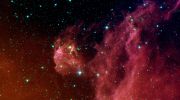
M-042-PIA09412.jpgOut of Orion's Head (2)61 visiteThis image from NASA's SST shows infant stars "hatching" in the Head of the Hunter constellation, Orion. Astronomers suspect that shockwaves from a supernova explosion in Orion's head, nearly 3 MY ago, may have initiated this newfound birth
The Region featured in this Spitzer image is called Barnard 30.
It is located approximately 1300 LY away and sits on the right side of Orion's "Head" just North of the massive star Lambda Orionis. Wisps of red in the cloud are organic molecules called polycyclic aromatic hydrocarbons. These molecules are formed anytime carbon-based materials are burned incompletely. On Earth, they can be found in the sooty exhaust from automobile and airplane engines. They also coat the grills where charcoal-broiled meats are cooked.
This image shows infrared light captured by Spitzer's infrared array camera. Light with wavelengths of 8 and 5.8 microns (red and orange) comes mainly from dust that has been heated by starlight.
Light of 4.5 microns (green) shows hot gas and dust; and light of 3.6 microns (blue) is from starlight.
MareKromium
|
|
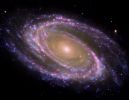
M-081-PIA09579.jpgThe M 81 Galaxy is "Pretty in Pink"62 visiteThe perfectly picturesque Spiral Galaxy known as Messier 81, or M81, looks sharp in this new composite from NASA's Spitzer (SST) and Hubble Space Telescopes (HST) and NASA's Galaxy Evolution Explorer.
M81 is a "grand design" spiral galaxy, which means its elegant arms curl all the way down into its center. It is located about 12 MLY away in the Ursa Major Constellation and is one of the brightest galaxies that can be seen from Earth through telescopes.
The colors in this picture represent a trio of light wavelengths: blue is ultraviolet light captured by the Galaxy Evolution Explorer; yellowish white is visible light seen by Hubble; and red is infrared light detected by Spitzer.
The blue areas show the hottest, youngest stars, while the reddish-pink denotes lanes of dust that line the spiral arms. The orange center is made up of older stars. MareKromium
|
|

M-083-a.jpgHubble Wide Field Camera 3 - Image Details Star Birth in Galaxy M-8389 visiteThe spectacular new camera installed on NASA's Hubble Space Telescope during Servicing Mission 4 in May has delivered the most detailed view of star birth in the graceful, curving arms of the nearby spiral galaxy M83.
Nicknamed the Southern Pinwheel, M83 is undergoing more rapid star formation than our own Milky Way galaxy, especially in its nucleus. The sharp "eye" of the Wide Field Camera 3 (WFC3) has captured hundreds of young star clusters, ancient swarms of globular star clusters, and hundreds of thousands of individual stars, mostly blue supergiants and red supergiants.
The image, taken in August 2009, provides a close-up view of the myriad stars near the galaxy's core, the bright whitish region at far right.
WFC3's broad wavelength range, from ultraviolet to near-infrared, reveals stars at different stages of evolution, allowing astronomers to dissect the galaxy's star-formation history.
The image reveals in unprecedented detail the current rapid rate of star birth in this famous "grand design" spiral galaxy. The newest generations of stars are forming largely in clusters on the edges of the dark dust lanes, the backbone of the spiral arms. These fledgling stars, only a few million years old, are bursting out of their dusty cocoons and producing bubbles of reddish glowing hydrogen gas.
The excavated regions give a colorful "Swiss cheese" appearance to the spiral arm. Gradually, the young stars' fierce winds (streams of charged particles) blow away the gas, revealing bright blue star clusters. These stars are about 1 million to 10 million years old. The older populations of stars are not as blue.
A bar of stars, gas, and dust slicing across the core of the galaxy may be instigating most of the star birth in the galaxy's core. The bar funnels material to the galaxy's center, where the most active star formation is taking place. The brightest star clusters reside along an arc near the core.
The remains of about 60 supernova blasts, the deaths of massive stars, can be seen in the image, five times more than known previously in this region. WFC3 identified the remnants of exploded stars. By studying these remnants, astronomers can better understand the nature of the progenitor stars, which are responsible for the creation and dispersal of most of the galaxy's heavy elements.
M83, located in the Southern Hemisphere, is often compared to M51, dubbed the Whirlpool galaxy, in the Northern Hemisphere. Located 15 million light-years away in the constellation Hydra, M83 is two times closer to Earth than M51.
MareKromium
|
|

M-087-HST-2009-03-a-print.jpgHubble witnesses spectacular flaring in Gas Jet from M 87's Black Hole65 visiteA flare-up in a jet of matter blasting from a monster Black Hole is giving astronomers an incredible light show.
The outburst is coming from a blob of matter, called HST-1, embedded in the jet, a powerful narrow beam of hot gas produced by a supermassive Black Hole residing in the core of the giant elliptical galaxy M 87. HST-1 is so bright that it is outshining even M 87's brilliant core, whose monster black hole is one of the most massive yet discovered.
The glowing gas clump has taken astronomers on a rollercoaster ride of suspense.
Astronomers watched HST-1 brighten steadily for several years, then fade, and then brighten again. They say it's hard to predict what will happen next. NASA's Hubble Space Telescope has been following the surprising activity for seven years, providing the most detailed UltraViolet-Light view of the event.
Other telescopes have been monitoring HST-1 in other wavelengths, including radio and X-rays. The Chandra X-ray Observatory was the first to report the brightening in 2000. HST-1 was first discovered and named by Hubble astronomers in 1999. The gas knot is 214 LY from the galaxy's core.
The flare-up may provide insights into the variability of black hole jets in distant galaxies, which are difficult to study because they are too far away.
M 87 is located 54 MLY away in the Virgo Cluster, a region of the nearby universe with the highest density of galaxies.
"I did not expect the jet in M 87 or any other jet powered by accretion onto a Black Hole to increase in brightness in the way that this jet does," says astronomer Juan Madrid of McMaster University in Hamilton, Ontario, who conducted the Hubble study. "It grew 90 times brighter than normal. But the question is, does this happen to every single jet or active nucleus, or are we seeing some odd behavior from M 87?" Hubble gives astronomers a unique Near-UltraViolet view of the flare that cannot be accomplished with ground-based telescopes. "Hubble's sharp vision allows it to resolve HST-1 and separate it from the black hole," Madrid explains.
Despite the many observations by Hubble and other telescopes, astronomers are not sure what is causing the brightening. One of the simplest explanations is that the jet is hitting a dust lane or gas cloud and then glows due to the collision.
Another possibility is that the jet's magnetic field lines are squeezed together, unleashing a large amount of energy.
This phenomenon is similar to how solar flares develop on the Sun and is even a mechanism for creating Earth's auroras.
The disk around a rapidly spinning Black Hole has Magnetic Field lines that entrap ionized gas falling toward the Black Hole. These particles, along with radiation, flow rapidly away from the black hole along the Magnetic Field Lines. The rotational energy of the spinning accretion disk adds momentum to the outflowing jet.
Madrid assembled seven years' worth of Hubble archival images of the jet to capture changes in the HST-1's behavior over time. Hubble's view of the event. Some of the images came from observing programs that studied the galaxy, but not the jet.
He found data from the Space Telescope Imaging Spectrograph (STIS) that showed a noticeable brightening between 1999 and 2001.
In images from 2002 to 2005, HST-1 continued to rise steadily in brightness. In 2003 the jet knot was more brilliant than M 87's luminous core. In May 2005 HST-1 became 90 times brighter than it was in 1999. After May 2005 the flare began to fade, but it intensified again in November 2006. This second outburst was fainter than the first one.
"By watching the outburst over several years, I was able to follow the brightness and see the evolution of the flare over time," Madrid says. "We are lucky to have telescopes like Hubble and Chandra, because without them we would see the increase in brightness in the core of M 87, but we would not know where it was coming from."
Madrid hopes that future observations of HST-1 will reveal the cause of the mysterious activity. "We hope the observations will yield some theories that will give us some good explanations as to the mechanism that is causing the flaring," Madrid says. "Astronomers would like to know if this is an intrinsic instability of the jet when it plows its way out of the galaxy, or if it is something else."
The study's results are published in the April 2009 issue of the Astronomical Journal.MareKromium
|
|

M-087.jpgM 87 - Elliptical Galaxy88 visiteElliptical galaxy M 87 is a type of galaxy that looks much different than our own Milky Way Galaxy. Even for an elliptical galaxy, though, M 87 is peculiar. M 87 is MUCH bigger than an average galaxy, appears near the center of a whole cluster of galaxies (known as the Virgo Cluster) and shows an unusually high number of globular clusters. These globular clusters are visible as faint spots surrounding the bright center of M 87. In general, elliptical galaxies contain similar numbers of stars as spiral galaxies, but are ellipsoidal in shape (spirals are mostly flat), have no spiral structure and little gas and dust.
|
|
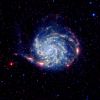
M-101-PIA10968.jpgM 101 - The "Pinwheel Galaxy"62 visiteThe Pinwheel Galaxy, otherwise known as Messier 101, sports bright reddish edges in this new infrared image from NASA's Spitzer Space Telescope. Research from Spitzer has revealed that this outer red zone lacks organic molecules present in the rest of the galaxy. The red and blue spots outside of the spiral galaxy are either foreground stars or more distant galaxies.
The organics, called Polycyclic Aromatic Hydrocarbons (PAH), are dusty, carbon-containing molecules that help in the formation of stars. On Earth, they are found anywhere combustion reactions take place, such as barbeque pits and exhaust pipes. Scientists also believe this space dust has the potential to be converted into the stuff of life.
Spitzer found that the PAH decrease in concentration toward the outer portion of the Pinwheel Galaxy, then quickly drop off and are no longer detected at its very outer rim. According to astronomers, there's a threshold at the rim where the organic material is being destroyed by harsh radiation from stars. Radiation is more damaging at the far reaches of a galaxy because the stars there have less heavy metals, and metals dampen the radiation.
The findings help researchers understand how stars can form in these harsh environments, where PAH are lacking. Under normal circumstances, the PAH help cool down star-forming clouds, allowing them to collapse into stars. In regions like the rim of the Pinwheel — as well as the very early universe — stars form without the organic dust. Astronomers don't know precisely how this works, so the rim of the Pinwheel provides them with a laboratory for examining the process relatively close up.
In this image, infrared light with a wavelength of 3,6 microns is colored blue; 8-micron light is green; and 24-micron light is red.
All three of Spitzer's instruments were used in the study: the infrared array camera, the multiband imaging photometer and the infrared spectrograph.MareKromium
|
|
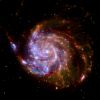
M-101-PIA11797.jpgM 10162 visiteIn 1609, Galileo improved the newly invented telescope, turned it toward the heavens, and revolutionized our view of the universe. In celebration of the 400th anniversary of this milestone, 2009 has been designated as the International Year of Astronomy.
Today, NASA's Great Observatories are continuing Galileo's legacy with stunning images and breakthrough science from the Hubble Space Telescope, the Spitzer Space Telescope, and the Chandra X-ray Observatory.
While Galileo observed the sky using visible light seen by the human eye, technology now allows us to observe in many wavelengths, including Spitzer's infrared view and Chandra's view in X-rays. Each wavelength region shows different aspects of celestial objects and often reveals new objects that could not otherwise be studied.
This image of the spiral galaxy Messier 101 is a composite of views from Spitzer, Hubble, and Chandra.
The red color shows Spitzer's view in infrared light. It highlights the heat emitted by dust lanes in the galaxy where stars can form.
The yellow color is Hubble's view in visible light. Most of this light comes from stars, and they trace the same spiral structure as the dust lanes.
The blue color shows Chandra's view in X-ray light. Sources of X-rays include million-degree gas, exploded stars, and material colliding around black holes.
Such composite images allow astronomers to see how features seen in one wavelength match up with those seen in another wavelength. It's like seeing with a camera, night vision goggles, and X-ray vision all at once.
In the four centuries since Galileo, astronomy has changed dramatically. Yet our curiosity and quest for knowledge remain the same. So, too, does our wonder at the splendor of the universe.
The International Year of Astronomy Great Observatories Image Unveiling is supported by the NASA Science Mission Directorate Astrophysics Division. The project is a collaboration between the Space Telescope Science Institute, the Spitzer Science Center, and the Chandra X-ray Center.
MareKromium
|
|
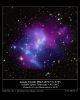
MACS-J0717_5+3745-hs-2009-17-a-print.jpgMACS J0717.5+3745 (Galaxy Cluster)63 visiteThis composite image shows the massive Galaxy Cluster MACS J0717.5+3745 (MACS J0717, for short), where four separate Galaxy Clusters have been involved in a collision — the first time such a phenomenon has been documented. Hot gas is shown in an image from NASA's Chandra X-ray Observatory, and galaxies are shown in an optical image from NASA's Hubble Space Telescope.
The hot gas is color-coded to show temperature, where the coolest gas is reddish purple, the hottest gas is blue, and the temperatures in between are purple.
The repeated collisions in MACS J0717 are caused by a 13 MLY-long stream of galaxies, gas, and dark matter — known as a "Filament" — pouring into a region already full of matter. A collision between the gas in two or more clusters causes the hot gas to flow down. However, the massive and compact galaxies do not slow down as much as the gas does, and so move ahead of it. Therefore, the speed and direction of each cluster's motion — perpendicular to the line of sight — can be estimated by studying the offset between the average position of the galaxies and the peak in the hot gas.
MACS J0717 is located about 5,4 BLY from Earth. It is one of the most complex Galaxy Clusters ever seen. Other well-known Clusters, like the Bullet Cluster and MACS J0025.4-1222, involve the collision of only two galaxy clusters and show much simpler geometry.MareKromium
|
|
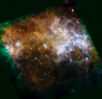
Milky_Way-PIA12251.jpgCold Region in the Milky Way62 visiteSome of the coldest and darkest dust in space shines brightly in this InfraRed image from the Herschel Observatory, a European Space Agency Mission with important participation from NASA.
The image is a composite of light captured simultaneously by two of Herschel's three instruments -- the photodetector array camera and spectrometer, and its spectral and photometric imaging receiver.
The image reveals a cold and turbulent region where material is just beginning to condense into new stars. It is located in the plane of our Milky Way galaxy, 60° from the center. Blue shows warmer material, red the coolest, while green represents intermediate temperatures.
The red filaments are made up of the coldest material pictured here -- material that is slightly warmer than the coldest temperature theoretically attainable in the Universe.
Light captured by the photodetector array camera and spectrometer is colored blue and green (blue represents 70-micron light, and green, 160 micron light). The light detected by the spectral and photometric imaging receiver is colored red (and shows the combined wavelengths of 250, 350 and 500 microns). The image spans a region 2.1 by 2.2 degrees.MareKromium
|
|
| 157 immagini su 14 pagina(e) |
|
|
|
|
|
7 | |
|
|
|
|
|
|





