The Universe in Super Definition
|
|
|

M 74-PIA08533.jpgM 74 - Spiral Galaxy60 visite
|
|

M 74-PIA08533_fig1.jpgM 74 and Supernova SN2003gd60 visiteThis image is the galaxy M 74, as seen by SST's infrared array camera. The white box to the left of the Galaxy's center identifies the location of the Supernova Remnant. In all the images, the blue dots represent hot gas and stars. The galaxy's cool dust is shown in red.
Astronomers using NASA's SST have spotted a "dust factory" 30 MLY away in the spiral galaxy M 74. The factory is located at the scene of a massive star's explosive death, or supernova.
While astronomers have suspected for years that supernovae could be producers of cosmic dust particles, the technology to confirm this suspicion has only recently become available.
|
|

M 74-PIA08533_fig2.jpgSupernova SN2003gd in July 2004 (1)60 visiteThe dust factory, also known as supernova SN 2003gd, is shown at the center of the two small insets from Spitzer's infrared array camera. A white arrow points to its exact location.
The yellow-green dot shown in the July 2004 inset (here) shows that the source's temperature is warmer than the surrounding material. This is because newly formed dust within the Supernova is just starting to cool.
|
|

M 74-PIA08533_fig3.jpgSupernova SN2003gd in January 2005 (2)60 visiteBy January 2005, the dust had cooled and completely faded from the camera's view (here). However, it was still detected in January 2005 by another instrument aboard Spitzer called the Multiband Imaging Photometer.
All the images are false-color, infrared composites, in which 3,6-micron light is blue, 4,5-micron light is green, and 8-micron light is red.
|
|

M 82-PIA08093.jpgM 82: A "Space Rainbow"64 visiteCaption NASA originale:"NASA's Spitzer, Hubble and Chandra Space Observatories teamed up to create this multi-wavelength, false-colored view of the M82 galaxy.
The lively portrait celebrates Hubble's "sweet sixteen" birthday.
X-ray data recorded by Chandra appears in blue; infrared light recorded by Spitzer appears in red; Hubble's observations of hydrogen emission appear in orange, and the bluest visible light appears in yellow-green".
|
|

M 84.jpgM 84 - Galactic nucleus and... a Black Hole?71 visiteIs this "almost artistic graph" the signature of a supermassive Black Hole in the center of distant galaxy M 84 (based on data recorded by Hubble's new Space Telescope Imaging Spectrograph (STIS)?. The presence of a Black Hole can also be revealed by watching matter fall into it.
In fact, material spiraling into a Black Hole would find its speed increasing at a drastic rate. These extreme velocity increases provide what we call a 'signature' of the Black Hole's presence. The STIS data show that radiation from approaching gas, shifted to blue wavelengths left of the centerline, is suddenly redshifted to the right of center indicating a rapidly rotating disk of material near the galactic nucleus. The resulting sharp S-shape is effectively the signature of a Black Hole estimated to contain at least 300 million solar masses. Now the question is: do all galaxies have central Black Holes? And, if "Yes", then "Why"?
|
|
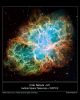
M-001.jpgM 1 - The "Crab Nebula"62 visitenessun commentoMareKromium
|
|

M-002-PIA04926.jpgM 2 - Globular Star Cluster in Aquarius81 visiteCaption NASA originale:"This image of the Globular Cluster Messier 2 (M2) was taken by Galaxy Evolution Explorer on August 20, 2003. This image is a small section of a single All Sky Imaging Survey exposure of only 129 seconds in the constellation Aquarius. This picture is a combination of Galaxy Evolution Explorer images taken with the far ultraviolet (colored blue) and near ultraviolet detectors (colored red). Globular clusters are gravitationally bound systems of hundreds of thousands of stars that orbit in the halos of galaxies. The globular clusters in out Milky Way galaxy contain some of the oldest stars known. M2 lies 33.000 LY from our Sun with stars distributed in a spherical system with a radius of approximately 100 LY".
|
|

M-016-PIA09107.jpgM 16 - The "Eagle Nebula"64 visiteThis majestic view taken by NASA's Spitzer Space Telescope tells an untold story of life and death in the Eagle Nebula, an industrious star-making factory located 7000 L.Y. away in the Serpens constellation. The image shows the region's entire network of turbulent clouds and newborn stars in infrared light.
The color green denotes cooler towers and fields of dust, including the three famous space pillars, dubbed the "Pillars of Creation," which were photographed by NASA's Hubble Space Telescope in 1995 (see inset).
But it is the color red that speaks of the drama taking place in this region. Red represents hotter dust thought to have been warmed by the explosion of a massive star about 8,000 to 9,000 years ago. Since light from the Eagle nebula takes 7000 years to reach us, this "supernova" explosion would have appeared as an oddly bright star in our skies about 1000 to 2000 years ago.
According to astronomers' estimations, the explosion's blast wave would have spread outward and toppled the three pillars about 6,000 years ago (which means we wouldn't witness the destruction for another 1,000 years or so). The blast wave would have crumbled the mighty towers, exposing newborn stars that were buried inside, and triggering the birth of new ones.
The pillars of the Eagle nebula were originally sculpted by radiation and wind from about 20 or so massive stars hidden from view in the upper left portion of the image. The radiation and wind blew dust away, carving out a hollow cavity (center) and leaving only the densest nuggets of dust and gas (tops of pillars) flanked by columns of lighter dust that lie in shadow (base of pillars). This sculpting process led to the creation of a second generation of stars inside the pillars.
If a star did blow up in this region, it is probably located among the other massive stars in the upper left portion of the image. Its blast wave might have already caused a third generation of stars to spring from the wreckage of the busted pillars.
This image is a composite of infrared light detected by Spitzer's infrared array camera and multiband imaging photometer. Blue is 4.5-micron light; green is 8-micron light; and red is 24-micron light.
|
|

M-016-PIA09108.jpgThe many colors of the Eagle63 visiteThis set of images from NASA's Spitzer Space Telescope shows the Eagle Nebula in different hues of infrared light. Each view tells a different tale. The left picture shows lots of stars and dusty structures with clarity. Dusty molecules found on Earth called polycyclic aromatic hydrocarbons produce most of the red; gas is green and stars are blue.
The middle view is packed with drama, because it tells astronomers that a star in this region violently erupted, or went supernova, heating surrounding dust (orange). This view also reveals that the hot dust is shell shaped, another indication that a star exploded.
The final picture highlights the contrast between the hot, supernova-heated dust (green) and the cooler dust making up the region's dusty star-forming clouds and towers (red, blue and purple).
The left image is a composite of infrared light with the following wavelengths: 3.6 microns (blue); 4.5 microns (green); 5.8 microns (orange); and 8 microns (red). The right image includes longer infrared wavelengths, and is a composite of light of 4.5 to 8.0 microns (blue); 24 microns (green); and 70 microns (red). The middle image is made up solely of 24-micron light.
|
|

M-016-PIA09109.jpgM 16 - The "Eagle Nebula"61 visiteThis image composite highlights the pillars of the Eagle Nebula, as seen in infrared light by NASA's Spitzer Space Telescope (bottom) and visible light by NASA's Hubble Space Telescope (top insets).
The top right inset focuses on the 3 famous pillars, dubbed the "Pillars of Creation", which were photographed by Hubble in 1995. Hubble's optical view shows the dusty towers in exquisite detail, while Spitzer's infrared eyes penetrate through the thick dust, revealing ghostly transparent structures. The same effect can be seen for the pillar outlined in the top left box.
In both cases, Spitzer's view exposes newborn stars that were hidden inside the cocoon-like pillars, invisible to Hubble. These stars were first uncovered by the European Space Agency's Infrared Satellite Observatory. In the Spitzer image, two embedded stars are visible at the tip and the base of the left pillar, while one star can be seen at the tip of the tallest pillar on the right.
|
|

M-033-PIA11969.jpgM 33 - Spiral Galaxy (3-color composite)62 visiteOne of our closest galactic neighbors shows its awesome beauty in this new image from NASA's Spitzer Space Telescope. M 33, also known as the "Triangulum Galaxy", is a member of what's known as our Local Group of galaxies.
Along with our own Milky Way, this group travels together in the universe, as they are gravitationally bound. In fact, M 33 is one of the few galaxies that is moving toward the Milky Way despite the fact that space itself is expanding, causing most galaxies in the universe to grow farther and farther apart.
When viewed with Spitzer's InfraRed eyes, this elegant spiral galaxy sparkles with color and detail. Stars appear as glistening blue gems (several of which are actually foreground stars in our own galaxy), while dust rich in organic molecules glows green. The diffuse orange-red glowing areas indicate star-forming regions, while small red flecks outside the spiral disk of M 33 are most likely distant background galaxies. But not only is this new image beautiful, it also shows M 33 to be surprising large — bigger than its Visible-Light appearance would suggest.
With its ability to detect cold, dark dust, Spitzer can see emission from cooler material well beyond the visible range of M 33's disk. Exactly how this cold material moved outward from the galaxy is still a mystery, but winds from giant stars or supernovas may be responsible.
M 33 is located about 2,9 MLY away in the constellation Triangulum. This is a three-color composite image showing InfraRed observations from two of Spitzer instruments. Blue represents combined 3.6- and 4.5-micron light and green shows light of 8 microns, both captured by Spitzer's IRAC.
Red is 24-micron light detected by Spitzer's Multiband Imaging Photometer.MareKromium
|
|
| 157 immagini su 14 pagina(e) |
 |
|
|
|
6 | |
|
|
|
|
|





