| |

The Universe in Super Definition
|
|
|
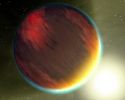
HD189733b-PIA09200.jpgJust like Jupiter...70 visiteThis artist's concept shows a cloudy Jupiter-like planet that orbits very close to its fiery hot star. NASA's Spitzer Space Telescope was recently used to capture spectra, or molecular fingerprints, of two "hot Jupiter" worlds like the one depicted here. This is the first time a spectrum has ever been obtained for an exoplanet, or a planet beyond our solar system.
The ground-breaking observations were made with Spitzer's spectrograph, which pries apart infrared light into its basic wavelengths, revealing the "fingerprints" of molecules imprinted inside. Spitzer studied two planets, HD 209458b and HD 189733b, both of which were found, surprisingly, to have no water in the tops of their atmospheres. The results suggest that the hot planets are socked in with dry, high clouds, which are obscuring water that lies underneath. In addition, HD209458b showed hints of silicates, suggesting that the high clouds on that planet contain very fine sand-like particles.
Capturing the spectra from the two hot-Jupiter planets was no easy feat. The planets cannot be distinguished from their stars and instead appear to telescopes as single blurs of light. One way to get around this is through what is known as the secondary eclipse technique. In this method, changes in the total light from a so-called transiting planet system are measured as a planet is eclipsed by its star, vanishing from our Earthly point of view. The dip in observed light can then be attributed to the planet alone.
This technique, first used by Spitzer in 2005 to directly detect the light from an exoplanet, currently only works at infrared wavelengths, where the differences in brightness between the planet and star are less, and the planet's light is easier to pick out. For example, if the experiment had been done in visible light, the total light from the system would appear to be unchanged, even as the planet disappeared from view.
To capture spectra of the planets, Spitzer observed their secondary eclipses with its spectrograph. It took a spectrum of a star together with its planet, then, as the planet disappeared from view, a spectrum of just the star. By subtracting the spectrum of the star from the spectrum of the star and planet together, astronomers were able to determine the spectrum of the planet itself.
Neither of the parent stars for HD 209458b or HD 189733b can be seen with the naked eye. HD 209458b is located about 153 light-years away in the constellation Pegasus, while HD 189733b is about 62 light-years away in the constellation Vulpecula. Both planets zip around their stars in very tight orbits; HD 209458b circles once every 3.5 days, while HD 189733b orbits once every 2.2 days.
Of the approximately 200 known exoplanets, there are 12 besides HD 209458b and HD 189733b whose orbits are inclined in such a way that, from our point of view, they pass in front of their stars. At least three of these transiting exoplanets are bright enough to follow in the footsteps of HD 209458b and HD 189733 and reveal their infrared spectra to Spitzer. Astronomers hope to use Spitzer's spectrograph in the future to study HD 209458b and HD 189733b again in much greater detail, and to examine some of the other candidates for the first time.
|
|
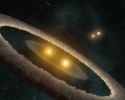
HD98800-PIA09939.jpgEvidence for Strange Stellar Family83 visiteThis artist concept depicts a Quadruple-Star System called HD 98800. The System is approx. 10 MY old, and is located 150 LY away in the constellation TW Hydrae.
HD 98800 contains four stars, which are paired off into doublets, or binaries.
The stars in the binary pairs orbit around each other, and the two pairs also circle each other like choreographed ballerinas. One of the stellar pairs, called HD 98800B, has a disk of dust around it, while the other pair does not.
Although the four stars are gravitationally bound, the distance separating the two binary pairs is about 50 astronomical units (AU) -- slightly more than the average distance between our sun and Pluto.
Using NASA's Spitzer Space Telescope, scientists finally have a detailed view of HD 98800B's potential planet-forming disk. Astronomers used the telescope's infrared spectrometer to detect the presence of two belts in the disk made of large dust grains. One belt sits approx. 5.9 AU away from the central binary, or about the distance from the sun to Jupiter, and is likely made up of asteroids and comets. The other belt sits at 1.5 to 2 AU, comparable to the area where Mars and the asteroid belt sit, and is made up of sand-sized dust grains.
MareKromium
|
|

HD_189733b-PIA09715_01.jpgExoplanet HD 189733b69 visiteCaption NASA:"This plot of data from NASA's Spitzer Space Telescope (SST) tells astronomers that a toasty gas exoplanet, or a planet beyond our Solar System, contains water vapor.
Spitzer observed the Planet, called HD 189733b, cross in front of its star at three different infrared wavelengths: 3,6; 4,5 and 8 microns (see lime-colored dots). For each wavelength, the Planet's Atmosphere absorbed different amounts of the starlight that passed through it. The pattern by which this absorption varies with wavelength matches known signatures of water, as shown by the theoretical model in blue".MareKromium
|
|
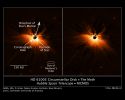
HD_61005.jpgCircumstellar Dust Takes Flight in 'The Moth'69 visiteWhat superficially resembles a giant moth floating in space is giving astronomers new insight into the formation and evolution of planetary systems.
This is not your typical flying insect. It has a wingspan of about 22 billion miles. The wing- like structure is actually a dust disk encircling the nearby, young star HD 61005, dubbed "The Moth." Its shape is produced by starlight scattering off dust.
Dust disks around roughly 100-million-year-old stars like HD 61005 are typically flat, pancake-shaped structures where planets can form. But images taken with NASA's Hubble Space Telescope of "The Moth" are showing that some disks sport surprising shapes.
"It is completely unexpected to find a dust disk with this unusual shape," said senior research scientist Dean Hines of the Space Science Institute, New Mexico Office in Corrales, New Mexico, and a member of the Hubble team that discovered the disk. "We think HD 61005 is plowing through a local patch of higher-density gas in the interstellar medium, causing material within HD 61005's disk to be swept behind the star. What effect this might have on the disk, and any planets forming within it, is unknown."
Hines called this possible collision "unusual, because we don't expect very much interstellar material to be in the solar neighborhood. That's because the area through which our Sun is moving was evacuated within the past few million years by at least one supernova, the explosion of a massive star. Yet, here's evidence of dense material that's very close, only 100 light-years away."
Astronomers have found evidence that the environment in which a star forms influences its prospects for planet formation. Hubble has actually seen that young planet-forming disks can be affected directly by their environment. The harsh stellar radiation from the Trapezium stars in the Orion Nebula has altered some disks. It is unclear, however, what effect passage through a cloud similar to the one in which HD 61005 finds itself would have on planet formation. Researchers have speculated that passage through dense regions of the interstellar medium could impact the atmospheres of evolving planets.
The Moth is part of a survey of Sun-like stars that Hines and collaborators observed with Hubble's Near-Infrared Camera and Multi-Object Spectrometer (NICMOS) and NASA's Spitzer Space Telescope to study the formation and evolution of planetary systems. Under the lead of Michael Meyer of the University of Arizona in Tucson, the team initially used Spitzer to look for heat radiation—the tell-tale sign of dust warmed by the star—to identify interesting star systems.
Hines then teamed with Glenn Schneider of the University of Arizona to use Hubble's high- contrast imaging capability of the NICMOS coronagraph to image these disks and reveal where the dust detected by Spitzer resides. The NICMOS coronagraph blocked out the starlight so that astronomers could see details in the surrounding disk.
"These symbiotic capabilities, uniquely implemented in NASA's Great Observatories, provide astronomers with the powerful observational tools to study the circumstellar environments of potentially planet-forming systems," Schneider said.
Added Meyer: "Combining observations from these two spacecraft gives us information about the composition of the dust grains, whether they're icy or sandy, or whether they're like the sooty smoke particles rising from a chimney. The composition and sizes of the dust can tell us a lot about the dynamics and evolution of a solar system. In our solar system, for example, astronomers have evidence of rocks smashing into each other and generating dust, as in the asteroid and Kuiper belts. We're seeing these same processes unfold in other planetary systems."
MareKromium
|
|

HR8799b.jpgExoplanet HR8799b71 visiteA powerful, newly refined image-processing technique may allow astronomers to discover extrasolar planets that are possibly lurking in over a decade's worth of Hubble Space Telescope archival data.
David Lafreniere of the University of Toronto, Ontario, Canada, has successfully demonstrated this new strategy for planet hunting by identifying an exoplanet that went undetected in Hubble images taken in 1998 with its Near Infrared Camera and Multi-Object Spectrometer (NICMOS). In addition to illustrating the power of new data-processing techniques, this finding underscores the value of the Hubble data archive, on which those new techniques can be used.
The planet, estimated to be at least seven times Jupiter's mass, was originally discovered in images taken with the Keck and Gemini North telescopes in 2007 and 2008. It is the outermost of three massive planets known to orbit the dusty young star HR 8799, which is 130 light-years away. NICMOS could not see the other two planets because its coronagraphic spot — a device which blots out the glare of the star — also interferes with observing the two inner planets.
"We've shown that NICMOS is more powerful than previously thought for imaging planets," says Lafreniere. "Our new image-processing technique efficiently subtracts the glare from a star that spills over the coronagraph's edge, allowing us to see planets that are one-tenth the brightness of what could be detected before with Hubble." Lafreniere adapted an image reconstruction technique that was first developed for ground-based observatories.
Using the new technique, he recovered the planet in NICMOS observations taken 10 years before the Keck/Gemini discovery. The Hubble picture not only provides important confirmation of the planet's existence, it provides a longer baseline for demonstrating that the object is in an orbit about the star. "To get a good determination of the orbit we have to wait a very long time because the planet is moving so slowly (it has a 400-year period)," says Lafreniere. "The 10-year-old Hubble data take us that much closer to having a precise measure of the orbit."
NICMOS's view provided new insights into the physical characteristics of the planet, too. This was possible because NICMOS works at near-infrared wavelengths that are severely blocked by Earth's atmosphere due to absorption by water vapor.
"The planet seems to be only partially cloud covered and we could be detecting the absorption of water vapor in the atmosphere," says Travis Barman of Lowell Observatory, Flagstaff, Ariz. "The infrared light measured from the Hubble data is consistent with a spectrum showing a broad water absorption feature (at 1.4-1.49 microns), but the level of absorption seen is lower than it would be if the photosphere were completely devoid of dust. Dust clouds can smooth out many of the spectral features that would otherwise be there—including water absorption bands," Barman says. "Measuring the water absorption properties will tell us a great deal about the temperatures and pressures in the atmospheres, in addition to the cloud coverage. If we can accurately measure the water absorption features for the outermost planet around HR 8799, we will learn a great deal about their atmospheric properties. Hubble, situated well above the Earth's atmosphere, is excellently located for such a study."
"During the past 10 years Hubble has been used to look at over 200 stars with coronagraphy, looking for planets and disks. We plan to go back and look at all of those archived images and see if anything can be detected that has gone undetected until now," says Christian Marois of the Herzberg Institute of Astrophysics, Victoria, Canada. "We'll need a baseline of a few years for most objects to detect Keplerian motion and hence confirm their status as planets. The hardest part is to find them in the first place."
If his team sees a companion object to a star in more than one NICMOS picture, and it appears to have moved along an orbit, follow-up observations will be made with ground-based telescopes. If they see something once but its brightness and separation from the star would be reasonable for a planet, they will also do follow-up observations with ground-based telescopes.
Taking the image of an exoplanet is not an easy task. Planets can be billions of times fainter than the star around which they orbit and are typically located at separations smaller than 1/2000th the angular size of the full moon from their star. The planet recovered in the NICMOS data is about 100,000 times fainter than the star when viewed in the near-infrared.
"Even when using the best telescopes available, with the best resolution, the light from the bright star spills out in the area where the much fainter planets are located, making them impossible to see. It is essential to subtract out this bright glare of stellar light from the image to see faint dots, i.e., planets, that could be hidden underneath," says Rene Doyon of the University of Montreal.
The stability of how light is scattered in the NICMOS camera, called the point spread function (PSF), is key for using Hubble images to recover planets. This technique works by taking images of different stars and combining them to create a PSF of a star that closely resembles the star that is being studied for planets. This requires a reasonably steady PSF because images of different stars are taken on different days. Atmospheric conditions would vary from day-to-day for ground-based telescopes, but not for a space telescope that enjoys unprecedented image stability over repeated visits to a target.
MareKromium
|
|

IC-348-PIA12210.jpgCreation...152 visiteThis artist's conception shows a lump of material in a swirling, planet- forming disk. Astronomers using NASA's Spitzer Space Telescope found evidence that a companion to a star -- either another star or a planet -- could be pushing planetary material together, as illustrated here.
Planets are born out of spinning disks of gas and dust. They can carve out lanes or gaps in the disks as they grow bigger and bigger. Scientists used Spitzer's infrared vision to study the disk around a star called LRLL 31, located about 1000 LY away in the IC 348 Region of the constellation Perseus. Spitzer's new infrared observations reveal that the disk has both an inner and outer gap.
What's more, the data show that infrared light from the disk is changing over as little time as one week -- a very unusual occurrence. In particular, light of different wavelengths seesawed back and forth, with short-wavelength light going up when long-wavelength light went down, and vice versa.
According to astronomers, this change could be caused by a companion to the star (illustrated as a planet in this picture). As the companion spins around, its gravity would cause the wall of the inner disk to squeeze into a lump. This lump would also spin around the star, shadowing part of the outer disk. When the bright side of the lump is on the far side of the star, and facing Earth, more infrared light at shorter wavelengths should be observed (hotter material closer to the star emits shorter wavelengths of infrared light). In addition, the shadow of the lump should cause longer-wavelength infrared light from the outer disk to decrease. The opposite would be true when the lump is in front of the star and its bright side is hidden (shorter-wavelength light would go down, and longer- wavelength light up). This is precisely what Spitzer observed.
The size of the lump and the planet have been exaggerated to better illustrate the dynamics of the system.MareKromium
|
|

K4-55-HST.jpgK4-55 Planetary Nebula67 visiteThe Hubble Community bids farewell to the soon-to-be decommissioned Wide Field Planetary Camera 2 (WFPC2) onboard the Hubble Space Telescope.
In tribute to Hubble's longest-running optical camera, Planetary Nebula K 4-55 has been imaged as WFPC2's final "pretty picture".MareKromium
|
|

Kepler_10b-PIA13776.jpgExo-Planet "Kepler 10b"171 visiteCaption NASA:"Artist's concept of the first rocky world discovered by NASA's Kepler Mission. The Planet, called Kepler 10-b, is shown in front of its Host (Parent) Star".MareKromium
|
|
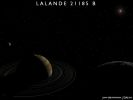
Lalande Solar System.jpgLalande 21185 and a possible extra-solar system166 visiteThe closest extrasolar planetary system could be made by the planets of the dim red dwarf star known as Lalande 21185: only 8 LY distant! This star is too faint to be seen by the naked eye and its planets have never been imaged directly but their presence is inferred by a long series of telescopic observations, tracking the star as it wiggles and wobbles in mutual gravitational response to the masses of its orbiting planets. University of Pitsburgh astronomer George Gatewood recently announced that much of Lalande 21185's wobble is most likely due to an unseen planet with approximately 90% of the mass of Jupiter and an orbital period of 5.8 years. His work also indicates that a second and possibly third planet of similar mass could well be present in the system.
|
|

Large Magellanic Cloud-1.jpgThe Large Cloud of Magellan (HR)70 visiteAn alluring sight in dark Southern skies, the Large Magellanic Cloud (LMC) is seen here through a narrow filter that transmits only the red light of Hydrogen Atoms. Ionized by energetic starlight, a Hydrogen Atom emits the characteristic red H-alpha light as its single electron is recaptured and transitions to lower energy states. As a result, this image of the LMC seems covered with shell-shaped clouds of Hydrogen gas surrounding massive, young stars. Sculpted by the strong stellar winds and ultraviolet radiation, the glowing Hydrogen clouds are known as "H-II" (such as Ionized Hydrogen) Regions. This HR mosaic view was recorded in 6 segments, each with 200 minutes of exposure time. Itself composed of many overlapping shells, the Tarantula Nebula, is the large star forming Region near top center. A satellite of our Milky Way Galaxy, the LMC is about 15,000 light-years across and lies a mere 180.000 LY away in the constellation known as Dorado.
|
|

Life-PIA03538.jpgLife!73 visiteThis artist's conception symbolically represents complex organic molecules, known as polycyclic aromatic hydrocarbons, seen in the early universe. These large molecules, comprised of carbon and hydrogen, are considered among the building blocks of life.
NASA's Spitzer Space Telescope is the first telescope to see polycyclic aromatic hydrocarbons so early -- 10 billion years further back in time than seen previously. Spitzer detected these molecules in galaxies when our universe was one-fourth of its current age of about 14 billion years.
These complex molecules are very common on Earth. They form any time carbon-based materials are not burned completely. They can be found in sooty exhaust from cars and airplanes, and in charcoal broiled hamburgers and burnt toast.
Polycyclic aromatic hydrocarbons are pervasive in galaxies like our own Milky Way, and play a significant role in star and planet formation.
|
|
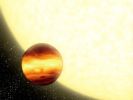
LonelyPlanet-PIA09118.jpgWhat's the weather like over there?75 visiteCaption NASA:"An artist's conception shows a gas-giant planet orbiting very close to its parent star, creating searingly hot conditions on the planet's surface.
New research suggests that for three such planets lying from 50 to 150 light-years from Earth, strong winds thousands of miles per hour mix the atmosphere so that the temperature is relatively uniform from the permanently light side to the permanently dark side.
This illustration represents an infrared view of a planetary system, in which brightness indicates warmer temperatures. For example, the bright band around the equator of the planet denotes warmer temperatures on both the dark and sunlit sides.
The planet's poles, shown in darker colors, would be cooler".MareKromium
|
|
| 157 immagini su 14 pagina(e) |
|
|
4 | |
|
|
|
|
|
|
|
|
|








