| |

The Universe in Super Definition
|
|
|

Black Hole-PIA08696.jpgBlack Hole71 visiteThis artist's concept depicts a supermassive black hole at the center of a galaxy. NASA's Galaxy Evolution Explorer found evidence that black holes -- once they grow to a critical size -- stifle the formation of new stars in elliptical galaxies. Black holes are thought to do this by heating up and blasting away the gas that fuels star formation.
The blue color here represents radiation pouring out from material very close to the black hole. The grayish structure surrounding the black hole, called a torus, is made up of gas and dust. Beyond the torus, only the old red-colored stars that make up the galaxy can be seen. There are no new stars in the galaxy.
|
|

Black Hole-PIA08697_fig1.jpgBlack Holes73 visiteThis diagram illustrates research from NASA's Galaxy Evolution Explorer showing that black holes -- once they reach a critical size -- can put the brakes on new star formation in elliptical galaxies.
In this graph, galaxies and their supermassive black holes are indicated by the drawings (the black circle at the center of each galaxy represents the black hole). The relative masses of the galaxies and their black holes are reflected in the sizes of the drawings. Blue indicates that the galaxy has new stars, while red means the galaxy does not have any detectable new stars.
The Galaxy Evolution Explorer observed the following trend: the biggest galaxies and black holes (shown in upper right corner) are more likely to have no observable star formation (red) than the smaller galaxies with smaller black holes. This is evidence that black holes can create environments unsuitable for stellar birth.
The white line in the diagram illustrates that, for any galaxy no matter what the mass, its black hole must reach a critical size before it can shut down star formation.
|
|

Black_Hole-PIA13275.jpgDisk around a massive "Baby Star"?85 visiteCaption NASA:"Astronomers have obtained the first clear look at a Dusty Disk closely encircling a massive "Baby Star", providing direct evidence that massive stars do form in the same way as their smaller brethren -- and closing an enduring debate.
This artist's concept shows what such a massive Disk might look like. The Flared Disk extends to about 130 times the Earth-Sun distance (such as 130 UA), and has a mass similar to that of the star, roughly twenty times the Sun. The inner parts of the Disk are shown to be devoid of dust).
Nota Lunexit: questa è dunque, according to NASA, la rappresentazione artistica di un Disco di polveri e materiale Primordiale posizionato attorno ad una giovane stella supermassiva.
Può anche darsi, ma secondo noi la NASA ha scelto male l'immagine da abbinare alla caption e questa, in effetti, è la rappresentazione artistica di un Buco Nero, oppure di un Quasar.
Chissà...MareKromium
|
|

Blue_Star-PIA12174.jpgSpace "Cube"84 visiteThis drawing illustrates the extent to which astronomers have been underestimating the proportion of small to big stars in certain galaxies. Data from NASA's Galaxy Evolution Explorer Spacecraft and the Cerro Tololo Inter-American Observatory in Chile have shown that, in some cases, there can be as many as four times more small stars compared to large ones.
In the drawing, a massive blue star is shown next to a stack of lighter, yellow stars. These big blue stars are 3 to 20 times more massive than our Sun, while the smaller stars are typically about the same mass as the Sun or smaller.
Before the Galaxy Evolution Explorer study, astronomers assumed there were 500 small stars for every massive one (lower stack on right). The new observations reveal that, in certain galaxies, this estimation is off by a factor of four; for every massive star, there could be as many as 2000 small counterparts (such as the entire stack - the "Cube" - on the right).MareKromium
|
|
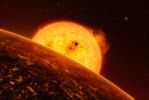
COROT7b-ESO.jpgExo-Planet CoRoT-7b73 visiteHow similar is exoplanet CoRoT-7b to Earth?
The newly discovered Extra-Solar Planet is the closest physical match yet, with a mass about five Earths and a radius of about 1,7 Earths. Also, the home star to CoRoT-7b, although 500 LY distant, is very similar to our Sun.
Unfortunately, the similarities likely end there, as CoRoT-7b orbits its home star well inside the orbit of Mercury, making its year last only 20 hours, and making its peak temperature much hotter than humans might find comfortable. CoRoT-7b was discovered in February by noting a predictable slight decrease in the brightness of its parent star.
Pictured above, an artist's depiction shows how CoRoT-7b might appear in front of its Parent Star. The composition of CoRoT-7b remains unknown, but given its size and mass, it cannot be a gas giant like Jupiter, and is very likely composed predominantly of rock. Future observations will likely narrow the composition of one of the first known rocky planets discovered outside of our Solar System.MareKromium
|
|

Cassiopeia_A-PIA11748.jpgSNR Cassiopeia "A"73 visiteFor the first time, a multiwavelength three-dimensional reconstruction of a SuperNova Remnant has been created. This stunning visualization of Cassiopeia A, or Cas A, the result of an explosion approximately 330 years ago, uses data from several telescopes: X-ray data from NASA's Chandra X-ray Observatory, InfraRed data from NASA's Spitzer Space Telescope and optical data from the National Optical Astronomy Observatory 4-meter telescope at Kitt Peak, Ariz., and the Michigan-Dartmouth-MIT 2.4-meter telescope, also at Kitt Peak. In this visualization, the green region is mostly Iron observed in X-rays. The yellow region is a combination of Argon and Silicon seen in X-rays, optical, and infrared — including jets of Silicon — plus outer debris seen in the optical. The red region is cold debris seen in the infrared. Finally, the blue reveals the outer blast wave, most prominently detected in X-rays.
Most of the material shown in this visualization is debris from the explosion that has been heated by a shock moving inwards. The red material interior to the yellow/orange ring has not yet encountered the inward moving shock and so has not yet been heated. These unshocked debris were known to exist because they absorb background radio light, but they were only recently discovered in infrared emission with Spitzer. The blue region is composed of gas surrounding the explosion that was heated when it was struck by the outgoing blast wave, as clearly seen in Chandra images.
To create this visualization, scientists took advantage of both a previously known phenomenon — the Doppler effect — and a new technology that bridges astronomy and medicine. When elements created inside a supernova, such as Iron, Silicon and Argon, are heated they emit light at certain wavelengths. Material moving towards the observer will have shorter wavelengths and material moving away will have longer wavelengths. Since the amount of the wavelength shift is related to the speed of motion, one can determine how fast the debris are moving in either direction.
Because Cas A is the result of an explosion, the stellar debris is expanding radially outwards from the explosion center. Using simple geometry, the scientists were able to construct a 3-D model using all of this information. A program called 3-D Slicer — modified for astronomical use by the Astronomical Medicine Project at Harvard University in Cambridge, Mass. — was used to display and manipulate the 3-D model. Commercial software was then used to create the 3-D fly-through.
The blue filaments defining the blast wave were not mapped using the Doppler Effect because they emit a different kind of light —synchrotron radiation — that does not emit light at discrete wavelengths, but rather in a broad continuum. The blue filaments are only a representation of the actual filaments observed at the blast wave.
This visualization shows that there are two main components to this supernova remnant: a spherical component in the outer parts of the remnant and a flattened (disk-like) component in the inner region. The spherical component consists of the outer layer of the star that exploded, probably made of helium and carbon. These layers drove a spherical blast wave into the diffuse gas surrounding the star.
The flattened component — that astronomers were unable to map into 3-D prior to these Spitzer observations — consists of the inner layers of the star. It is made from various heavier elements, not all shown in the visualization, such as Oxygen, Neon, Silicon, Sulphur, Argon and Iron.
High-velocity plumes, or jets, of this material are shooting out from the explosion in the plane of the disk-like component mentioned above. Plumes of Silicon appear in the North/East and South/West, while those of Iron are seen in the South/East and North. These jets were already known and Doppler velocity measurements have been made for these structures, but their orientation and position with respect to the rest of the debris field had never been mapped before now.
This new insight into the structure of Cas A gained from this 3-D visualization is important for astronomers who build models of supernova explosions. Now, they must consider that the outer layers of the star come off spherically, but the inner layers come out more disk-like with high-velocity jets in multiple directions.MareKromium
|
|

Cepheid-HST-2009-08-a-print.jpgRefined Hubble Constant narrows possible explanations for Dark Energy85 visiteWhatever Dark Energy is, explanations for it have less wiggle room following a Hubble Space Telescope observation that has refined the measurement of the Universe's present Expansion Rate to a precision where the error is smaller than 5%. The new value for the Expansion Rate, known as the "Hubble Constant", or "H0" (after Edwin Hubble who first measured the expansion of the universe nearly a century ago), is 74,2 Km-per-second-per-megaparsec (with an error margin of ± 3,6).
The results agree closely with an earlier measurement gleaned from Hubble of 72 ± 8 km/sec/megaparsec, but are now more than twice as precise.
The Hubble measurement, conducted by the SHOES (Supernova H0 for the Equation of State) Team and led by Adam Riess, of the Space Telescope Science Institute and the Johns Hopkins University, uses a number of refinements to streamline and strengthen the construction of a cosmic "Distance Ladder", a Billion LY in length, that astronomers use to determine the Universe's Expansion Rate.
Hubble observations of pulsating stars called "Cepheid Variables" in a nearby cosmic mile marker, the galaxy NGC 4258, and in the host galaxies of recent supernovae, directly link these distance indicators. The use of Hubble to bridge these rungs in the ladder eliminated the systematic errors that are almost unavoidably introduced by comparing measurements from different telescopes.
Riess explains the new technique: "It's like measuring a building with a long tape measure instead of moving a yard stick end over end. You avoid compounding the little errors you make every time you move the yardstick. The higher the building, the greater the error".
Lucas Macri, professor of physics and astronomy at Texas A&M, and a significant contributor to the results, said, "Cepheids are the backbone of the distance ladder because their pulsation periods, which are easily observed, correlate directly with their luminosities. Another refinement of our ladder is the fact that we have observed the Cepheids in the Near-InfraRed parts of the electromagnetic spectrum where these variable stars are better distance indicators than at optical wavelengths."
This new, more precise value of the Hubble Constant was used to test and constrain the properties of Dark Energy, the form of energy that produces a repulsive force in space, which is causing the expansion rate of the Universe to accelerate.
By bracketing the expansion history of the universe between today and when the universe was only approx. 380.000 years old, the astronomers were able to place limits on the nature of the Dark Energy that is causing the expansion to speed up.
(The measurement for the far, early universe is derived from fluctuations in the Cosmic Microwave Background (---> Radiazione di Fondo), as resolved by NASA's Wilkinson Microwave Anisotropy Probe, WMAP, in 2003.)
Their result is consistent with the simplest interpretation of Dark Energy: that it is mathematically equivalent to Albert Einstein's hypothesized Cosmological Constant, introduced a century ago to push on the fabric of space and prevent the Universe from collapsing under the pull of gravity. (Einstein, however, removed the Constant once the expansion of the universe was discovered by Edwin Hubble.)
"If you put in a box all the ways that Dark Energy might differ from the Cosmological Constant, that box would now be 3 times smaller", says Riess. "That's progress, but we still have a long way to go to pin down the nature of Dark Energy".
Though the cosmological constant was conceived of long ago, observational evidence for Dark Energy didn't come along until 11 years ago, when two studies, one led by Riess and Brian Schmidt of Mount Stromlo Observatory, and the other by Saul Perlmutter of Lawrence Berkeley National Laboratory, discovered Dark Energy independently, in part with Hubble observations. Since then astronomers have been pursuing observations to better characterize Dark Energy.
Riess's approach to narrowing alternative explanations for Dark Energy — whether it is a static Cosmological Constant or a dynamical field (like the repulsive force that drove inflation after the Big Bang) — is to further refine measurements of the Universe's expansion history.
Before Hubble was launched in 1990, the estimates of the Hubble Constant varied by a factor of two. In the late 1990s the Hubble Space Telescope Key Project on the Extragalactic Distance Scale refined the value of the Hubble constant to an error of only about 10%. This was accomplished by observing Cepheid variables at optical wavelengths out to greater distances than obtained previously and comparing those to similar measurements from ground-based telescopes.
The SHOES team used Hubble's Near Infrared Camera and Multi-Object Spectrometer (NICMOS) and the Advanced Camera for Surveys (ACS) to observe 240 Cepheid variable stars across 7 galaxies. One of these galaxies was NGC 4258, whose distance was very accurately determined through observations with radio telescopes. The other 6 galaxies recently hosted Type Ia Supernovae that are reliable distance indicators for even farther measurements in the Universe.
Type Ia Supernovae all explode with nearly the same amount of energy and therefore have almost the same intrinsic brightness.
By observing Cepheids with very similar properties at Near-InfraRed wavelengths in all 7 galaxies and using the same telescope and instrument, the team was able to more precisely calibrate the luminosity of Supernovae.
With Hubble's powerful capabilities, the team was able to sidestep some of the shakiest rungs along the previous Distance Ladder involving uncertainties in the behavior of Cepheids. Riess would eventually like to see the Hubble constant refined to a value with an error of no more than 1%, to put even tighter constraints on solutions to Dark Energy.MareKromium
|
|

DR22.jpgCygnus Region (DR22; NGC 4145 and NGC 4361)72 visiteThese images are some of the first to be taken during Spitzer's warm mission -- a new phase that began after the telescope, which operated for more than five-and-a-half years, ran out of liquid coolant. The pictures were snapped with the two InfraRed Channels that still work at Spitzer's still-quite-chilly temperature of 30 Kelvin (about - 406 degrees Fahrenheit). The two InfraRed Channels are part of Spitzer's InfraRed Array Camera: 3.6-micron light is blue and 4.5-micron light is orange.
The main image shows a cloud, known as DR22, bursting with new stars in the Cygnus Region of the sky.
Spitzer's infrared eyes can see dust, and see through dust, giving it a unique view into star-forming nests. The blue areas are dusty clouds, and the orange is mainly hot gas.MareKromium
|
|

Dark_Matter.jpgBright Universe, Dark Matter72 visiteAn international team of astronomers using NASA's Hubble Space Telescope has created a three-dimensional map that provides the first direct look at the large-scale distribution of dark matter in the universe.
Dark matter is an invisible form of matter that accounts for most of the universe's mass.
The map provides the best evidence yet that normal matter, largely in the form of galaxies, accumulates along the densest concentrations of dark matter. The map reveals a loose network of filaments that grew over time and intersect in massive structures at the locations of clusters of galaxies.
The map stretches halfway back to the beginning of the universe and shows how dark matter has grown increasingly "clumpy" as it collapses under gravity.
This milestone takes astronomers from inference to direct observation of dark matter's influence in the universe. Previous studies of dark matter are based largely on numerical simulations of the expected evolution of large-scale structure. This evolution is driven by the gravitational attraction of dark matter.
Mapping dark matter's distribution in space and time is fundamental to understanding how galaxies grew and clustered over billions of years. Tracing the growth of clustering in the dark matter may eventually also shed light on dark energy, a repulsive form of gravity that influences how dark matter clumps.
The new maps of dark matter and galaxies will provide critical observational underpinnings to future theories for how structure formed in the evolving universe under the relentless pull of gravity. Theories suggest the universe transitioned from a smooth distribution of matter into a sponge-like structure of long filaments.
The research results appeared online today in the journal Nature and were presented at the 209th meeting of the American Astronomical Society in Seattle, Wash., by Richard Massey for the dark matter and Nick Scoville for the galaxies. Both researchers are from the California Institute of Technology, Pasadena, Calif.
"It's reassuring how well our map confirms the standard theories for structure formation." said Massey. He calls dark matter the "scaffolding" inside of which stars and galaxies have been assembled over billions of years.
Researchers created the map using Hubble's largest survey of the universe, the Cosmic Evolution Survey ("COSMOS") with an international team of 70 astronomers led by Scoville. The COSMOS survey covers a sufficiently wide area of sky – nine times the area of the Earth's Moon. This allows for the large-scale filamentary structure of dark matter to be evident. To add 3-D distance information, the Hubble observations were combined with multicolor data from powerful ground-based telescopes. "The 3-D information is vital to studying the evolution of the structures over cosmic time," said Jason Rhodes, a collaborator in the study at the Jet Propulsion Laboratory in Pasadena, Calif.
The dark matter map was constructed by measuring the shapes of half a million faraway galaxies. To reach us, the galaxies' light has traveled through intervening dark matter. The dark matter deflected the light slightly as it traveled through space. Researchers used the observed, subtle distortion of the galaxies' shapes to reconstruct the distribution of intervening mass along Hubble's line of sight — a method called weak gravitational lensing. This effect is analogous to deducing the rippling pattern in a glass shower door by measuring how light from behind it is distorted as it passes through the glass.
"Although this technique has been employed previously, the depth of the COSMOS image and its superior resolution enables a more precise and detailed map, covering a large enough area to see the extended filamentary structures," said co-investigator Richard Ellis of the California Institute of Technology.
For astronomers, the challenge of mapping the universe has been similar to mapping a city from nighttime aerial snapshots showing only streetlights. Dark matter is invisible, so only the luminous galaxies can be seen directly. The new images are equivalent to seeing a city, its suburbs and country roads — in daylight, for the first time. Major arteries and intersections become evident, and a variety of neighborhoods are revealed.
A separate COSMOS team led by Scoville presented images of the large scale galactic structures in the same area with the dark matter. Galaxies appear in visible light seen with Hubble and in ground-based Subaru telescope images by Yoshiaku Taniguchi and colleagues. The hot gas in the densest galaxy clusters was imaged in X-rays by Gunther Hasinger and colleagues using the European Space Agency's XMM-Newton telescope.
Galaxy structures inside the dark matter scaffolding show clusters of galaxies in the process of assembly. These structures can be traced over more than 80 million light-years in the COSMOS survey – approximately five times the extent of the nearby Virgo galaxy cluster. In the densest early universe structures, many galaxies already have old stellar populations, implying that these galaxies formed first and accumulated the greatest masses in a bottom-up assembly process where smaller galaxies merge to make bigger galaxies — like tributaries converging to form a large river.
The COSMOS survey shows that galaxies with on-going star formation, even to the present epoch, dwell in less populated voids and dark matter filaments. "It is remarkable how the environment on the enormous cosmic scales seen in the dark matter structures can influence the properties of individual stars and galaxies — both the maturity of the stellar populations and the progressive 'downsizing' of star formation to smaller galaxies is clearly dependent on the dark matter environment," said Scoville.
"The comparison is of fundamental importance," said Massey. "Almost all current scientific knowledge concerns only baryonic matter. Now that we have begun to map out where dark matter is, the next challenge is to determine what it is, and specifically its relationship to normal matter."
In making the COSMOS survey, Hubble photographed 575 slightly overlapping views of the universe using the Advanced Camera for Surveys' (ACS) Wide Field Camera onboard Hubble. It took nearly 1,000 hours of observations. Thousands of galaxies' spectra were obtained by using the European Southern Observatory's Very Large Telescope in Chile, and the Subaru telescope in Hawaii. The distances to the galaxies were accurately determined through their spectral redshifts. The distribution of the normal matter was partly determined with the European Space Agency's XMM-Newton telescope.
MareKromium
|
|

EpsilonEridani-PIA11375.jpgEpsilon Eridani74 visiteThis artist's conception shows the closest known Planetary System to our own, called Epsilon Eridani. Observations from NASA's Spitzer Space Telescope show that the system hosts two Asteroid Belts, in addition to previously identified candidate planets and an outer Comet Ring.
Epsilon Eridani is located about 10 LY away in the constellation Eridanus. It is visible in the night skies with the naked eye.
The System's Inner Asteroid Belt appears as the yellowish ring around the star, while the Outer Asteroid Belt is in the foreground. The outermost Comet Ring is too far out to be seen in this view, but comets originating from it are shown in the upper right corner.
Astronomers think that each of Epsilon Eridani's Asteroid Belts could have a planet orbiting just outside it, shepherding its rocky debris into a ring in the same way that Jupiter helps keep our asteroid belt confined.
The planet near the inner belt was previously identified in 2000 via the radial velocity, or "star wobble", technique, while the planet near the outer belt was inferred when Spitzer discovered the belt.
The inner belt orbits at a distance of about 3 AU from its star — or about the same position as the Asteroid Belt in our own Solar System (an astronomical unit is the distance between Earth and the Sun). The second Asteroid Belt lies at about 20 AU from the star, or a position comparable to Uranus in our Solar System.
The outer Comet Ring orbits from 35 to 90 AU from the star; our Solar System's analogous Kuiper Belt extends from about 30 to 50 AU from the sun.MareKromium
|
|
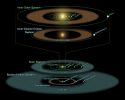
Epsilon_Eridani-PIA11376.JPGSolar Systems70 visiteThis artist's diagram compares the Epsilon Eridani System to our own Solar System. The two systems are structured similarly, and both host asteroids (brown), comets (blue) and planets (white dots).
Epsilon Eridani is our closest known planetary system, located about 10 LY away in the constellation Eridanus. Its central star is a younger, fainter version of our Sun, and is about 800 million years old — about the same age of our Solar System when life first took root on Earth.
Observations from NASA's Spitzer Space Telescope show that the System hosts two Asteroid Belts, in addition to previously identified candidate planets and an Outer Comet Ring.
Epsilon Eridani's inner Asteroid Belt is located at about the same position as ours, approximately 3 AU from its star (aone AU is the distance between Earth and Sun). The system's second, denser Belt lies at about the same place where Uranus orbits in our Solar System, or 20 AU from the star.
In the same way that Jupiter lies just outside our Asteroid Belt, shepherding its rocky debris into a ring, Epsilon Eridani is thought to have planets orbiting near the rims of its two Belts. The first of these planets was identified in 2000 via the Radial Velocity Technique.
Called "Epsilon Eridani b", it orbits at an average distance of 3,4 AU — placing it just outside the System's inner Asteroid Belt.
The second planet orbiting near the rim of the outer Asteroid Belt at 20 AU was inferred when Spitzer discovered the belt.
A third planet might orbit in Epsilon Eridani at the inner edge of its outermost Comet Ring, which lies between 35 and 90 AU. This planet was first hinted at in 1998 due to observed lumpiness in the Comet Ring.
The outer Comet Ring around Epsilon Eridani is denser than our Comet Ring, called Kuiper Belt, because the system is younger.
Over time, Epsilon Eridani's ring will become wispier like the Kuiper Belt. Its comets will collide with each other and break up, or get pushed out of the ring by the gravitational influences of the planets. MareKromium
|
|

From_HST-2009-19-a-print.jpgStarbursts in Dwarf Galaxies are a Global Affair72 visiteBursts of star making in a galaxy have been compared to a Fourth of July fireworks display: They occur at a fast and furious pace, lighting up a region for a short time before winking out.
But these fleeting starbursts are only pieces of the story, astronomers say. An analysis of archival images of small, or dwarf, galaxies taken by NASA's Hubble Space Telescope suggests that starbursts, intense regions of star formation, sweep across the whole galaxy and last 100 times longer than astronomers thought. The longer duration may affect how dwarf galaxies change over time, and therefore may shed light on galaxy evolution.
"Our analysis shows that starburst activity in a dwarf galaxy happens on a global scale", explains Kristen McQuinn of the University of Minnesota in Minneapolis and leader of the study. "There are pockets of intense star formation that propagate throughout the galaxy, like a string of firecrackers going off". According to McQuinn, the duration of all the starburst events in a single dwarf galaxy would total 200 to 400 MYs.
These longer timescales are vastly more than the 5 to 10 MYs proposed by astronomers who have studied star formation in dwarf galaxies. "They were only looking at individual clusters and not the whole galaxy, so they assumed starbursts in galaxies lasted for a short time".
Dwarf galaxies are considered by many astronomers to be the building blocks of the large galaxies seen today, so the length of starbursts is important for understanding how galaxies evolve.
"Astronomers are really interested to find out the steps of galaxy evolution", McQuinn says. "Exploring these smaller galaxies is important because, according to popular theory, large galaxies are created from the merger of smaller, dwarf galaxies. So understanding these smaller pieces is an important part of filling in that scenario".
McQuinn's team analyzed archival Advanced Camera for Surveys data of three dwarf galaxies, NGC 4163, NGC 4068 and IC 4662. Their distances range from 8 to 14 MLYs away. The trio is part of a survey of starbursts in 18 nearby dwarf galaxies. Hubble's superb resolution allowed McQuinn's team to pick out individual stars in the galaxies and measure their brightness and color, two important characteristics astronomers use to determine stellar ages.
By determining the ages of the stars, the astronomers could reconstruct the starburst history in each galaxy.
Two of the galaxies, NGC 4068 and IC 4662, show active, brilliant starburst regions in the Hubble images. The most recent starburst in the third galaxy, NGC 4163, occurred 200 MYs ago and has faded from view. The team looked at regions of high and low densities of stars, piecing together a picture of the starbursts. The galaxies were making a few stars, when something, perhaps an encounter with another galaxy, pushed them into high star-making mode. Instead of forming eight stars every thousand years, the galaxies started making 40 stars every thousand years, which is a lot for a small galaxy, McQuinn says. The typical dwarf is 10 to 30.000 LYs wide. By comparison, a normal-sized galaxy such as our Milky Way is about 100.000 LYs wide.
About 300 to 400 MYs ago star formation occurred in the outer areas of the galaxies. Then it began migrating inward as explosions of massive stars triggered new star formation in adjoining regions. Starbursts are still occurring in the inner parts of NGC 4068 and IC 4662.
The total duration of starburst activity depends on many factors, including the amount of gas in a galaxy, the distribution and density of the gas, and the event that triggered the starburst. A merger or an interaction with a large galaxy, for example, could create a longer starburst event than an interaction with a smaller system.
McQuinn plans to expand her study to a larger sample of more than 20 galaxies. "Studying nearby dwarf galaxies, where we can see the stars in great detail, will help us interpret observations of galaxies in the distant universe, where starbursts were much more common because galaxies had more gas with which to make stars".
McQuinn's results appeared in the April 10 issue of The Astrophysical Journal.MareKromium
|
|
| 157 immagini su 14 pagina(e) |
2 | |
|
|
|
|
|
|
|
|
|
|
|








