| |

The Universe in Super Definition
|
|
|

SN-1987A-Starfield_-_HST_(dtl).jpgSupernova 1987A - HST218 visiteDa NASA - Picture of the Day del 9-02-1999: "Bright stars don't last forever. A bright star similar to others in this field exploded in a spectacular supernova that was witnessed on Earth in 1987. The result is visible even today as unusual rings and glowing gas. The above picture is a composite of recent images taken over several years. The explosion originated from a bright massive star that ran out of nuclear fuel. SN1987A occurred in the Large Magellanic Cloud (LMC), a satellite galaxy only 150.000 LY from our Milky Way Galaxy. The rings of SN1987A are currently excited by light from the initial explosion. Astronomers expect the inner ring to brighten in the next few years as expanding supernova debris overtakes it".
|
|
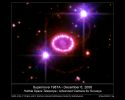
SN-1987A.jpgSupernova 1987A72 visiteTwenty years ago, astronomers witnessed one of the brightest stellar explosions in more than 400 years. The titanic supernova, called SN 1987A, blazed with the power of 100 million suns for several months following its discovery on Feb. 23, 1987.
Observations of SN 1987A, made over the past 20 years by NASA's Hubble Space Telescope and many other major ground- and space-based telescopes, have significantly changed astronomers' views of how massive stars end their lives. Astronomers credit Hubble's sharp vision with yielding important clues about the massive star's demise.
"The sharp pictures from the Hubble telescope help us ask and answer new questions about Supernova 1987A," said Robert Kirshner, of the Harvard-Smithsonian Center for Astrophysics in Cambridge, Mass. "In fact, without Hubble we wouldn't even know what to ask."
Kirshner is the lead investigator of an international collaboration to study the doomed star. Studying supernovae like SN 1987A is important because the exploding stars create elements, such as carbon and iron, that make up new stars, galaxies, and even humans. The iron in a person's blood, for example, was manufactured in supernova explosions. SN 1987A ejected 20,000 Earth masses of radioactive iron. The core of the shredded star is now glowing because of radioactive titanium that was cooked up in the explosion.
The star is 163,000 light-years away in the Large Magellanic Cloud. It actually blew up about 161,000 B.C., but its light arrived here in 1987.
Kirshner has used the Hubble telescope to monitor the supernova. "The Hubble observations have helped us rewrite the textbooks on exploding stars. We found that the actual world is more complicated and interesting than anyone dared to imagine. There are mysterious triple rings of glowing gas and powerful blasts sent out from the explosion that are just having an impact now, 20 years later."
Before SN 1987A, astronomers had a "simplified, idealized model of a supernova," Kirshner explained. "We thought the explosions were spherical and we didn't think much about the gas a star would exhale in the thousands of years before it exploded. The actual shreds of the star in SN 1987A are elongated — more like a jellybean than a gumball, and the fastest-moving debris is slamming into the gas that was already out there from previous millennia. Who would have guessed?"
Hubble wasn't even around when astronomers first spotted the supernova in 1987. When Hubble was launched three years later, astronomers didn't waste any time in using the telescope to study the stellar blast. Its first peek was in 1990, the year the observatory launched. Since then, the telescope has taken hundreds of pictures of the doomed star.
The Hubble studies have revealed the following details about the supernova:
*A glowing ring, about a light-year in diameter, around the supernova. The ring was there at least 20,000 years before the star exploded. X-rays from the explosion energized the gas in the ring, making it glow for two decades.
*Two outer loops of glowing gas, which had been imaged by ground-based telescopes, were seen more clearly by Hubble.
*A dumbbell-shaped central structure that has now grown to one-tenth of a light-year long. The structure consists of two blobs of debris in the center of the supernova racing away from each other at roughly 20 million miles an hour.
*The onrushing stellar shock wave from the stellar explosion is slamming into, heating up, and illuminating the inner regions of the narrow ring surrounding the doomed star.
Hubble continues to watch as the blast debris moves through the ring. The light show makes the glowing ring look like a pearl necklace. Astronomers think the whole ring will be illuminated in a few years.
The glowing ring is expected to become bright enough to illuminate the star's surroundings, which will provide astronomers with new information on how the star ejected material before the explosion.
Astronomers are analyzing images by NASA's Spitzer Space Telescope to try to understand the fate of the dust that surrounds the exploded star and in the neighborhood around the blast.
"We will learn more in the future when the shock wave moves through the inner ring and slams into the outer rings and illuminates them," Kirshner said. "It could lead to clues about the last 20,000 years of the star. But there are many things that are still a mystery. We still do not understand the evolution of the star before the explosion or how the three rings formed. We also think that the star may be part of a binary system."
Astronomers also are still looking for evidence of a black hole or a neutron star left behind by the blast. The fiery death of massive stars usually creates these energetic objects. Most astronomers think a neutron star formed 20 years ago. Kirshner said the object could be obscured by dust or it could have become a black hole.
He plans to use the infrared capabilities of the Wide Field Camera 3 — an instrument scheduled to be installed during the upcoming Hubble servicing mission — to hunt for a stellar remnant. Scientists will use another instrument planned for installment during the mission, the Cosmic Origins Spectrograph, to analyze the supernova's chemical composition and velocities.
The James Webb Space Telescope, scheduled for launch in 2013, will be able to see infrared light from the ring that is 10 times fainter than what astronomers see today. The debris inside the ring will begin to brighten, and astronomers will get another chance to study the interior of an exploded star.
|
|
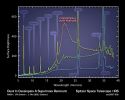
SN-Cassiopeia_A_-PIA10207.jpgCassiopeia "A": Dissecting the Wake of a Supernova Explosion69 visiteThe elements and molecules that flew out of the Cassiopeia A star when it exploded about 300 years ago can be seen clearly for the first time in this plot of data, called a Spectrum, taken by NASA's SST.
The Spectrum, which was created by splitting light into its basic components, reveals the composition of gas and dust that were synthesized in the explosion. It also provides some of the best evidence yet that stellar explosions, called Supernovae, were a significant source of fresh dust in the very young universe.
Prior to these observations, nobody was certain where this early dust — the same dust that ultimately made its way into future stars, planets and people — came from.
One of the most interesting features of the plot is a bump labeled Cassiopeia A Dust Feature. This bump is actually the signature of a collection of dust composed of proto-silicates, Silicon Dioxide and Iron Oxide. The Spectrum reveals that the brightness of the dust feature is correlated to that of Argon gas (yellow vertical line at left), known to have been expelled and synthesized during the star's explosion. The fact that the dust is associated with the expelled gas, or ejecta, tells astronomers that this Supernova manufactured new dust.
Each of the 3 lines of this plot represents a different layer of the Supernova remnant, with the top yellow and red line being the outermost layer.
Similar correlations between gas and dust are also seen in the middle layer (green line). For example, neon gas correlates with dust composed of Carbon and Aluminum Oxide.MareKromium
|
|
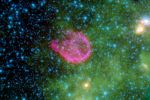
SNR-N132D-PIA09604.jpgThe "Shock-Waves" of N132D66 visiteSupernovae are the explosive deaths of the universe's most massive stars. In death, these volatile creatures blast tons of energetic waves into the cosmos, destroying much of the dust surrounding them.
This false-color composite from NASA's Spitzer Space Telescope and NASA's Chandra X-ray Observatory shows the remnant of one such explosion. The remnant, called N132D, is the wispy pink shell of gas at the center of this image. The pinkish color reveals a clash between the explosion's high-energy shockwaves and surrounding dust grains.
In the background, small organic molecules called polycyclic aromatic hydrocarbons are shown as tints of green. The blue spots represent stars in our galaxy along this line of sight.
N132D is located 163.000 LY away in the Large Magellanic Cloud.
In this image, infrared light at 4,5 microns is mapped to blue, 8,0 microns to green and 24 microns to red. Broadband X-ray light is mapped purple. The infrared data were taken by Spitzer's infrared array camera and multiband imaging photometer, while the X-ray data were captured by Chandra.
MareKromium
|
|
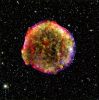
SNR-Tycho-SR-PIA11435.jpgTycho: the most colourful Supernova Remnant86 visiteThis composite image of the Tycho Supernova Remnant combines InfraRed and X-Ray observations obtained with NASA's Spitzer and Chandra space observatories, respectively, and the Calar Alto observatory, Spain.
It shows the scene more than four centuries after the brilliant star explosion witnessed by Tycho Brahe and other astronomers of that era.
The explosion has left a blazing hot cloud of expanding debris (green and yellow). The location of the blast's outer shock wave can be seen as a blue sphere of ultra-energetic electrons. Newly synthesized dust in the ejected material and heated pre-existing dust from the area around the supernova radiate at infrared wavelengths of 24 microns (red).
Foreground and background stars in the image are white.MareKromium
|
|

Sharpless308-Goldman.jpgSharpless 30867 visiteCaption NASA:"Blown by fast winds from a hot, massive star, this cosmic bubble is huge. Cataloged as Sharpless 308 it lies some 5200 LY away in the constellation Canis Major and covers over 2/3° on the sky (compared with 0,5° for the Full Moon). That corresponds to a diameter of 60 LY at its estimated distance. The massive star itself, a Wolf-Rayet Star, is the bright blue one near the center of the Nebula.
Wolf-Rayet Stars have over 20 times the mass of the Sun and are thought to be in a brief, pre-supernova phase of massive star evolution. Fast winds from this Wolf-Rayet Star create the bubble-shaped nebula as they sweep up slower moving material from an earlier phase of evolution.
The windblown nebula has an age of about 70.000 years. Relatively faint emission captured in the expansive image is dominated by the glow of Ionized Oxygen atoms mapped to bluish hues".MareKromium
|
|

Spectrum-PIA09196.jpgHow to get a Spectrum of an Alien World65 visiteThis diagram illustrates how astronomers using NASA's Spitzer Space Telescope can capture the elusive spectra of hot-Jupiter planets. Spectra are an object's light spread apart into its basic components, or wavelengths. By dissecting light in this way, scientists can sort through it and uncover clues about the composition of the object giving off the light.
To obtain a spectrum for an object, one first needs to capture its light. Hot-Jupiter planets are so close to their stars that even the most powerful telescopes can't distinguish their light from the light of their much brighter stars.
But, there are a few planetary systems that allow astronomers to measure the light from just the planet by using a clever technique. Such "transiting" systems are oriented in such a way that, from our vantage point, the planets' orbits are seen edge-on and cross directly in front of and behind their stars.
In this technique, known as the secondary eclipse method, changes in the total infrared light from a star system are measured as its planet transits behind the star, vanishing from our Earthly point of view. The dip in observed light can then be attributed to the planet alone.
To capture a spectrum of the planet, Spitzer must observe the system twice. It takes a spectrum of the star together with the planet (first panel), then, as the planet disappears from view, a spectrum of just the star (second panel). By subtracting the star's spectrum from the combined spectrum of the star plus the planet, it is able to get the spectrum for just the planet (third panel).
This ground-breaking technique was used by Spitzer to obtain the first-ever spectra of two planets beyond our solar system, HD 209458b and HD 189733b. The results suggest that the hot planets are socked in with dry clouds high up in the planet's stratospheres. In addition, HD 209458b showed hints of silicates, indicating those high clouds might be made of very fine sand-like particles.
|
|

Spectrum-PIA09197.jpgSpectrum of an Alien World67 visiteThis infrared data from NASA's Spitzer Space Telescope - called a spectrum - tells astronomers that a distant gas planet, a so-called "hot Jupiter" called HD 209458b, might be smothered with high clouds. It is one of the first spectra of an alien world.
A spectrum is created when an instrument called a spectrograph cracks light from an object open into a rainbow of different wavelengths. Patterns or ripples within the spectrum indicate the presence, or absence, of molecules making up the object.
Astronomers using Spitzer's spectrograph were able to obtain infrared spectra for two so-called "transiting" hot-Jupiter planets using the "secondary eclipse" technique. In this method, the spectrograph first collects the combined infrared light from the planet plus its star, then, as the planet is eclipsed by the star, the infrared light of just the star. Subtracting the latter from the former reveals the planet's own rainbow of infrared colors.
When astronomers first saw the infrared spectrum above, they were shocked. It doesn't look anything like what theorists had predicted. For example, theorists thought there'd be signatures of water in the wavelength ranges of 8 to 9 microns. The fact that water is not detected might indicate that it is hidden under a thick blanket of high, dry clouds.
In addition, the spectrum shows signs of silicate dust -- tiny grains of sand -- in the wavelength range of 9 to 10 microns. This suggests that the planet's skies could be filled with high clouds of dust unlike anything seen in our own solar system.
There is also an unidentified molecular signature at 7.78 microns. Future observations using Spitzer's spectrograph should be able to determine the nature of the mysterious feature.
This spectrum was produced by Dr. Jeremy Richardson of NASA's Goddard Space Flight Center, Greenbelt, Md. and his colleagues. The data were taken by Spitzer's infrared spectrograph on July 6 and 13, 2005.
|
|

Spectrum-PIA09198.jpgSpectrum of an Alien World63 visiteThis infrared data from NASA's Spitzer Space Telescope - called a spectrum - tells astronomers that a distant gas planet, a so-called "hot Jupiter" called HD 209458b, might be smothered with high clouds. It is one of the first spectra of an alien world.
A spectrum is created when an instrument called a spectrograph spreads light from an object apart into a rainbow of different wavelengths. Patterns or ripples within the spectrum indicate the presence, or absence, of molecules making up the object.
Astronomers using Spitzer's spectrograph were able to obtain infrared spectra for two so-called "transiting" hot-Jupiter planets using the "secondary eclipse" technique. In this method, the spectrograph first collects the combined infrared light from the planet plus its star, then, as the planet is eclipsed by the star, the infrared light of just the star. Subtracting the latter from the former reveals the planet's own rainbow of infrared colors.
When astronomers first saw the infrared spectrum above, they were shocked. It doesn't look anything like what theorists had predicted. Theorists though the spectra for hot, Jupiter-like planets like this one would be filled with the signatures of molecules in the planets' atmospheres. But the spectrum doesn't show any molecules. It is what astronomers call "flat." For example, theorists thought there'd be signatures of water in the wavelength ranges of 8 to 9 microns. The fact that water is not seen there might indicate that the water is hidden under a thick blanket of high, dry clouds.
This spectrum was produced by Dr. Mark R. Swain of NASA's Jet Propulsion Laboratory in Pasadena, Calif., using a complex set of mathematical tools. It was derived using two different methods, both of which led to the same result. The data were taken on July 6 and 13, 2005, by Dr. Jeremy Richardson of NASA's Goddard Space Flight Center and his team using Spitzer's infrared spectrograph.
|
|

Spectrum-PIA09199.jpgSpectrum of an Alien World69 visiteThis infrared data from NASA's Spitzer Space Telescope - called a spectrum - tells astronomers that a distant gas planet, a so-called "hot Jupiter" called HD 189733b, might be smothered with high clouds. It is one of the first spectra of an alien world.
A spectrum is created when an instrument called a spectrograph cracks light from an object open into a rainbow of different wavelengths. Patterns or ripples within the spectrum indicate the presence, or absence, of molecules making up the object.
Astronomers using Spitzer's spectrograph were able to obtain infrared spectra for two so-called "transiting" hot-Jupiter planets using the "secondary eclipse" technique. In this method, the spectrograph first collects the combined infrared light from the planet plus its star, then, as the planet is eclipsed by the star, the infrared light of just the star. Subtracting the latter from the former reveals the planet's own rainbow of infrared colors.
Astronomers were perplexed when they first saw the infrared spectrum above. It doesn't look anything like what theorists had predicted. Theorists thought the spectra of hot, Jupiter-like planets like this one would be filled with the signatures of molecules in the planets' atmospheres. But the spectrum doesn't show any molecules, and is instead what astronomers call "flat." For example, theorists thought there'd be a strong signature of water in the form of a big drop in the wavelength range between 7 and 10 microns. The fact that water is not detected may indicate that it is hidden underneath a thick blanket of high, dry clouds. The average brightness of the spectrum is also a bit lower than theoretical predictions, suggesting that very high winds are rapidly moving the terrific heat of the noonday sun from the day side of HD 189733b to the night side.
This spectrum was produced by Dr. Carl Grillmair of NASA's Spitzer Science Center at the California Institute of Technology in Pasadena, Calif., and his colleagues. The data were taken by Spitzer's infrared spectrograph on November 22, 2006.
|
|
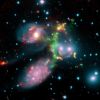
Stephan_s Quintet-PIA02587.jpgStephan's Quintet68 visiteThis false-color composite image of the Stephan's Quintet galaxy cluster clearly shows one of the largest shock waves ever seen (green arc). The wave was produced by one galaxy falling toward another at speeds of more than one million miles per hour. The image is made up of data from NASA's Spitzer Space Telescope and a ground-based telescope in Spain.
Four of the five galaxies in this picture are involved in a violent collision, which has already stripped most of the hydrogen gas from the interiors of the galaxies. The centers of the galaxies appear as bright yellow-pink knots inside a blue haze of stars, and the galaxy producing all the turmoil, NGC7318b, is the left of two small bright regions in the middle right of the image. One galaxy, the large spiral at the bottom left of the image, is a foreground object and is not associated with the cluster.
The titanic shock wave, larger than our own Milky Way galaxy, was detected by the ground-based telescope using visible-light wavelengths. It consists of hot hydrogen gas. As NGC7318b collides with gas spread throughout the cluster, atoms of hydrogen are heated in the shock wave, producing the green glow.
Spitzer pointed its infrared spectrograph at the peak of this shock wave (middle of green glow) to learn more about its inner workings. This instrument breaks light apart into its basic components. Data from the instrument are referred to as spectra and are displayed as curving lines that indicate the amount of light coming at each specific wavelength.
The Spitzer spectrum showed a strong infrared signature for incredibly turbulent gas made up of hydrogen molecules. This gas is caused when atoms of hydrogen rapidly pair-up to form molecules in the wake of the shock wave. Molecular hydrogen, unlike atomic hydrogen, gives off most of its energy through vibrations that emit in the infrared.
This highly disturbed gas is the most turbulent molecular hydrogen ever seen. Astronomers were surprised not only by the turbulence of the gas, but by the incredible strength of the emission. The reason the molecular hydrogen emission is so powerful is not yet completely understood.
Stephan's Quintet is located 300 million light-years away in the Pegasus constellation.
This image is composed of three data sets: near-infrared light (blue) and visible light called H-alpha (green) from the Calar Alto Observatory in Spain, operated by the Max Planck Institute in Germany; and 8-micron infrared light (red) from Spitzer's infrared array camera.
|
|
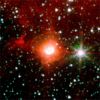
Supernova-PIA09119.jpgBipolar Nebula70 visiteCaption NASA:"A luminous blue variable star in our galaxy, named HD168625, surrounded by a bipolar nebula that is similar to the one around SN1987A.
SN1987A was a supernova that exploded in 1987 in the Large Magellanic Cloud, and was the nearest supernova in about 400 years.
Rings near the equator are sometimes seen around stars that shed mass from their surfaces, but the larger rings above the poles are very rare. Tipped toward Earth and illuminated by the star, the rings look like ellipses in images taken with NASA's Spitzer Space Telescope.
The image was taken in 2004 by the infrared array camera on Spitzer at wavelengths between 3,6 and 8 microns. The massive star at the center, which lies within the constellation Sagittarius, is about 7.200 Light-Years from Earth". MareKromium
|
|
| 157 immagini su 14 pagina(e) |
|
|
|
|
|
|
|
|
12 | |
|
|
|








