| |

The Universe in Super Definition
|
|
|
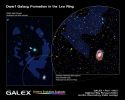
PIA11805.JPGBaby Dwarf Galaxies72 visiteThe unique Ultraviolet (UV) Vision of NASA's Galaxy Evolution Explorer reveals, for the first time, dwarf galaxies forming out of nothing more than pristine gas likely leftover from the early universe. Dwarf galaxies are relatively small collections of stars that often orbit around larger galaxies like our Milky Way.
The forming dwarf galaxies shine in the far UV Spectrum, rendered as blue in the call-out on the right hand side of this image. Near UV Light, also obtained by the Galaxy Evolution Explorer, is displayed in green, and Visible Light from the blue part of the spectrum here is represented by red. The clumps (in circles) are distinctively blue, indicating they are primarily detected in far UV Light.
The faint blue overlay traces the outline of the Leo Ring, a huge cloud of Hydrogen and helium that orbits around two massive galaxies in the constellation Leo (left panel). The cloud is thought likely to be a primordial object, an ancient remnant of material that has remained relatively unchanged since the very earliest days of the universe. Identified about 25 years ago by radio waves, the ring cannot be seen in Visible Light.
Only a portion of the Leo Ring has been imaged in the UV, but this section contains the telltale UV signature of recent massive star formation within this ring of pristine gas. Astronomers have previously only seen dwarf galaxies form out of gas that has already been cycled through a galaxy and enriched with metals — elements heavier than Helium — produced as stars evolve.
The visible data come from the Digitized Sky Survey of the Space Telescope Science Institute in Baltimore, Md. The Leo Ring visible image (left) represents the survey's blue, red, and infrared bands with the colors blue, green, and red. The overlay indicating the location of Hydrogen gas in the Leo Ring is based on observations made at the Arecibo Observatory in Puerto Rico.MareKromium
|
|

PIA13120.jpgWISE Eyes...79 visiteThis frame shows the progress of the WISE All-Sky Survey at the present time. WISE, or NASA's Wide-field InfraRed Survey Explorer, is perched up in the sky like a wise, old owl, scanning the whole sky one-and-a-half times in IR Light. On July 17, 2010, it will have completed its first scan of the entire sky, delivering more than one million image frames so far.
This map is filled in to show the sky areas that WISE scanned over time. Red indicates regions with the greatest coverage, and blue the least. The Poles received the most coverage because WISE orbits Earth around the Poles, scanning out strips of sky as Earth moves around the Sun. The red lines between the Poles show areas that received extra coverage because of the mission's strategy to avoid the Moon.
When the moon is in WISE's field of view, about twice every month, the space telescope captures the region it blocks, by first moving ahead of the moon and then behind it. This results in overlapped coverage for certain slices of sky. During this first all-sky scan, every point was covered by at least eight image frames.
The Infrared Astronomical Satellite was a joint project of the United States, United Kingdom and the Netherlands.
The Two-Micron All-Sky Survey was a project of NASA; the National Science Foundation; the University of Massachusetts, Amherst, and the California Institute of Technology, Pasadena, California.MareKromium
|
|
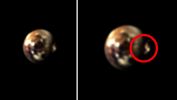
Proxima_Centauri_B_-_1.jpgProxima Centauri "b" - Alien City Lights or Super-volcanic Activity? (1)191 visiteE', a mio umile avviso, un Fenomeno di Super-vulcanismo che accade su scala (di fatto) planetaria. Guardate BENE! E guardate bene le foto di "Io"...MareKromium
|
|
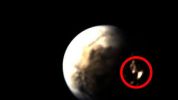
Proxima_Centauri_B_-_2.jpgProxima Centauri "b" - Alien City Lights or Super-volcanic Activity? (2)155 visiteE', a mio umile avviso, un Fenomeno di Super-vulcanismo che accade su scala (di fatto) planetaria. Guardate BENE! E guardate bene le foto di "Io"...MareKromium
|
|
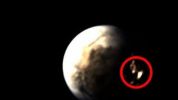
Proxima_Centauri_B_-_3~0.jpgProxima Centauri "b" - Just like Tharsis, BUT ACTIVE! (Extra Mgnf - 3)148 visiteE' come Tharsis, attiva, enorme e situata sul Pianeta (una "Super-Terra") Proxima Centauri b.MareKromium
|
|

Proxima_Centauri_B_-_4.jpgNightside of Proxima Centauri "b" (Imagination)139 visitenessun commentoMareKromium
|
|

Proxima_Centauri_B_-_5.jpgOverview of Proxima and its Parent Star120 visiteOverview and comparison of the orbital distance of the habitable zones of Proxima Centauri compared to the Solar System.MareKromium
|
|

Red_Sun-PIA13994.jpgRed Sun133 visiteCaption NASA:"This artist's concept illustrates a young, Red Dwarf Star surrounded by three planets. Such stars are dimmer and smaller than yellow stars like our Sun, which makes them ideal targets for astronomers wishing to take images of planets (called "Exoplanets") outside our Solar System. NASA's Galaxy Evolution Explorer is helping to identify young, Red Dwarf Stars that are close to us by detecting their UltraViolet Light (stars give off a lot of UV Light in their youth). Astronomers will use telescopes to try to image giant planets that orbit farther out from these stars, such as the one depicted here at lower left".MareKromium
|
|
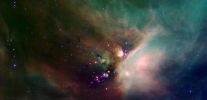
Rho_Ophiuci-PIA10181.jpgRho Ophiuci78 visiteNewborn stars peek out from beneath their natal blanket of dust in this dynamic image of the Rho Ophiuchi dark cloud from NASA's Spitzer Space Telescope. Called "Rho Oph" by astronomers, it's one of the closest star-forming regions to our own solar system. Located near the constellations Scorpius and Ophiuchus, the nebula is about 407 light years away from Earth.
Rho Oph is a complex made up of a large main cloud of molecular hydrogen, a key molecule allowing new stars to form from cold cosmic gas, with two long streamers trailing off in different directions. Recent studies using the latest X-ray and infrared observations reveal more than 300 young stellar objects within the large central cloud. Their median age is only 300,000 years, very young compared to some of the universe's oldest stars, which are more than 12 billion years old.
This false-color image of Rho Oph's main cloud, Lynds 1688, was created with data from Spitzer's infrared array camera, which has the highest spatial resolution of Spitzer's three imaging instruments, and its multiband imaging photometer, best for detecting cooler materials. Blue represents 3.6-micron light; green shows light of 8 microns; and red is 24-micron light. The multiple wavelengths reveal different aspects of the dust surrounding and between the embedded stars, yielding information about the stars and their birthplace.
The colors in this image reflect the relative temperatures and evolutionary states of the various stars. The youngest stars are surrounded by dusty disks of gas from which they, and their potential planetary systems, are forming. These young disk systems show up as red in this image. Some of these young stellar objects are surrounded by their own compact nebulae. More evolved stars, which have shed their natal material, are blue.
The extended white nebula in the center right of the image is a region of the cloud which is glowing in infrared light due to the heating of dust by bright young stars near the right edge of the cloud. Fainter multi-hued diffuse emission fills the image. The color of the nebulosity depends on the temperature, composition and size of the dust grains. Most of the stars forming now are concentrated in a filament of cold, dense gas that shows up as a dark cloud in the lower center and left side of the image against the bright background of the warm dust. Although infrared radiation at 24 microns pierces through dust easily, this dark filament is incredibly opaque, appearing dark even at the longest wavelengths in the image.
MareKromium
|
|
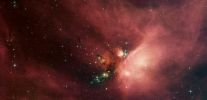
Rho_Ophiuci-PIA10182.jpgRho Ophiuci72 visiteNewborn stars peek out from beneath their natal blanket of dust in this dynamic image of the Rho Ophiuchi dark cloud from NASA's Spitzer Space Telescope. Called "Rho Oph" by astronomers, it's one of the closest star-forming regions to our own solar system. Located near the constellations Scorpius and Ophiuchus, the nebula is about 407 light years away from Earth.
Rho Oph is a complex made up of a large main cloud of molecular hydrogen, a key molecule allowing new stars to form from cold cosmic gas, with two long streamers trailing off in different directions. Recent studies using the latest X-ray and infrared observations reveal more than 300 young stellar objects within the large central cloud. Their median age is only 300,000 years, very young compared to some of the universe's oldest stars, which are more than 12 billion years old.
This false-color image of Rho Oph's main cloud, Lynds 1688, was created with data from Spitzer's infrared array camera, which has the highest spatial resolution of Spitzer's three imaging instruments. Blue represents 3.6 micron light, green is 4.5 micron light, orange is 5.8, and red is 8.0. The multiple wavelengths reveal different aspects of the dust surrounding and between the embedded stars, yielding information about the stars and their birthplace.
The colors in this image reflect the relative temperatures and evolutionary states of the various stars. The youngest stars are surrounded by dusty disks of gas from which they, and their potential planetary systems, are forming. These young disk systems show up as yellow-green tinted stars in this image. Some of these young stellar objects are surrounded by their own compact nebulae. More evolved stars, which have shed their natal material, are blue-white.
The extended white nebula in the center right of the image is a region of the cloud which is glowing in infrared light due to the illumination of dust by bright young stars near the right edge of the cloud. Red and pink diffuse emission from carbon-rich dust molecules fills the image. Most of the stars forming now are concentrated in a filament of cold, dense gas that shows up as a dark cloud in the lower center and left side of the image against the bright background of the warm dust. Although infrared radiation at 8 microns pierces through dust easily, this dark filament is incredibly opaque, appearing dark even at the longest wavelengths in the image.
MareKromium
|
|
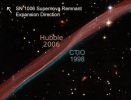
SN-1006-PIA10926.jpgStars and a Stripe in Celestial Fireworks70 visiteA delicate ribbon of gas floats eerily in our galaxy. A contrail from an alien spaceship? A jet from a black-hole? Actually this image, taken by NASA's Hubble Space Telescope, is a very thin section of a supernova remnant caused by a stellar explosion that occurred more than 1,000 years ago.
On or around May 1, 1006 A.D., observers from Africa to Europe to the Far East witnessed and recorded the arrival of light from what is now called SN 1006, a tremendous supernova explosion caused by the final death throes of a white dwarf star nearly 7,000 light-years away. The supernova was probably the brightest star ever seen by humans, and surpassed Venus as the brightest object in the night time sky, only to be surpassed by the moon. It was visible even during the day for weeks, and remained visible to the naked eye for at least two and a half years before fading away.
It wasn't until the mid-1960s that radio astronomers first detected a nearly circular ring of material at the recorded position of the supernova. The ring was almost 30 arcminutes across, the same angular diameter as the full moon. The size of the remnant implied that the blast wave from the supernova had expanded at nearly 20 million miles per hour over the nearly 1,000 years since the explosion occurred.
In 1976, the first detection of exceedingly faint optical emission of the supernova remnant was reported, but only for a filament located on the northwest edge of the radio ring. A tiny portion of this filament is revealed in detail by the Hubble observation. The twisting ribbon of light seen by Hubble corresponds to locations where the expanding blast wave from the supernova is now sweeping into very tenuous surrounding gas.
The hydrogen gas heated by this fast shock wave emits radiation in visible light. Hence, the optical emission provides astronomers with a detailed "snapshot" of the actual position and geometry of the shock front at any given time. Bright edges within the ribbon correspond to places where the shock wave is seen exactly edge on to our line of sight.
Today we know that SN 1006 has a diameter of nearly 60 light-years, and it is still expanding at roughly 6 million miles per hour. Even at this tremendous speed, however, it takes observations typically separated by years to see significant outward motion of the shock wave against the grid of background stars. In the Hubble image as displayed, the supernova would have occurred far off the lower right corner of the image, and the motion would be toward the upper left.
SN 1006 resides within our Milky Way Galaxy. Located more than 14 degrees off the plane of the galaxy's disk, there is relatively little confusion with other foreground and background objects in the field when trying to study this object. In the Hubble image, many background galaxies (orange extended objects) far off in the distant universe can be seen dotting the image. Most of the white dots are foreground or background stars in our Milky Way galaxy.
This image is a composite of hydrogen-light observations taken with Hubble's Advanced Camera for Surveys in February 2006 and Wide Field Planetary Camera 2 observations in blue, yellow-green, and near-infrared light taken in April 2008. The supernova remnant, visible only in the hydrogen-light filter was assigned a red hue in the Heritage color image.
For images and more information about SN 1006, visit:
http://hubblesite.org/news/2008/22
http://heritage.stsci.edu/2008/22
For additional information, contact:
Ray Villard Space Telescope Science Institute, Baltimore, Md. 410-338-4514 villard@stsci.edu
William Blair Johns Hopkins University, Baltimore, Md. 410-516-8447 wpb@pha.jhu.edu
MareKromium
|
|
![SN-1987A-PIA09119_fig1[1].jpg](albums/userpics/10060/small_SN-1987A-PIA09119_fig1%5B1%5D.jpg "Nome del file=SN-1987A-PIA09119_fig1[1].jpg
Dimensione del file=576KiB
Dimensioni=3000x2400
Aggiunta il=Mar 06, 2007")
SN-1987A-PIA09119_fig1[1].jpgSupernova 1987A and the Bipolar Nebula around HD16862572 visitenessun commentoMareKromium
|
|
| 157 immagini su 14 pagina(e) |
|
|
|
|
|
|
|
11 | |
|
|
|
|








