| |

The Universe in Super Definition
|
|
|

NGC-2976.jpgNGC 2976 - Galaxy or "Galactic Star-Factory"?71 visiteGalaxies throughout the Universe are ablaze with star birth. But for a nearby, small spiral galaxy, the star-making party is almost over. Astronomers were surprised to find that star-formation activities in the outer regions of NGC 2976 have been virtually asleep because they shut down millions of years ago. The celebration is confined to a few die-hard partygoers huddled in the galaxy's inner region.
The explanation, astronomers say, is that a raucous interaction with the neighboring M 81 group of galaxies ignited star birth in NGC 2976.
Now the star-making fun is beginning to end. Images from NASA's Hubble Space Telescope show that star formation in the galaxy began fizzling out in its outskirts about 500 MY ago as some of the gas was stripped away and the rest collapsed toward the center. With no gas left to fuel the party, more and more regions of the galaxy are taking a much-needed nap. The star-making region is now confined to about 5000 LY around the core.
NGC 2976 does not look like a typical Spiral Galaxy, as this Hubble image shows. In this view of the oddball galaxy's inner region, there are no obvious spiral arms. Dusty filaments running through the disk show no clear spiral structure. Although the gas is centrally concentrated, the galaxy does not have a central bulge of stars. Astronomers pieced together the galaxy's star-formation story with the help of Hubble's sharp vision. The galaxy's relatively close distance to Earth allowed Hubble's Advanced Camera for Surveys (ACS) to resolve hundreds of thousands of individual stars. What look like grains of sand in the image are actually individual stars.
Studying the individual stars allowed astronomers to determine their color and brightness, which provided information about when they formed. The astronomers combined the Hubble results with a map, made from radio observations, showing the current distribution of hydrogen across the galaxy. By analyzing the combined data, the Hubble research team then reconstructed the star-making history for large areas of the galaxy. The Hubble observations are part of the ACS Nearby Galaxy Survey Treasury (ANGST) program. The map is part of The HI Nearby Galaxy Survey by the National Radio Astronomy Observatory's Very Large Array in New Mexico.
The blue dots are fledgling blue giant stars residing in the remaining active star-birth regions. NGC 2976 resides on the fringe of the M 81 Group of Galaxies, located about 12 MLY away in the constellation Ursa Major.MareKromium
|
|
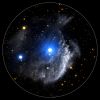
NGC-3242-PIA11968.jpgThe Extended Region around the Planetary Nebula NGC 324267 visiteThe unfortunate name of Planetary Nebula for this class of Celestial Objects is a historical legacy credited to William Herschel during the 18th Century — a time when telescopes where small and objects like these, at least the central region, looked very similar to gas-giant planets such as Saturn and Jupiter. In fact, NGC 3242 has no relation to Jupiter or any other planet.
Telescopes and their detectors have dramatically improved over the past few centuries. Our understanding of what Planetary Nebulae truly are has improved accordingly.
When stars with a mass similar to our Sun approach the end of their lives by exhausting supplies of Hydrogen and Helium fuel in their cores, they swell up into cool red-giant stars. In a last gasp before death, they expel the layers of gas in their Outer Atmosphere. This exposes the core of the dying star, a dense hot ball of Carbon and Oxygen called a "White Dwarf".
The White Dwarf is so hot that it shines very brightly in the UltraViolet Spectrum. The UltraViolet Light from the White Dwarf, in turn, ionizes the gaseous material expelled by the star causing it to glow. A Planetary Nebula is really the death of a low-mass star.
Although low-mass stars like our Sun live for billions of years, Planetary Nebulae only last for about ten thousand years. As the central white dwarf quickly cools and the UltraViolet Light dwindles, the surrounding gas also cools and fades.
In this image of NGC 3242 from the Galaxy Evolution Explorer, the Extended Region around the Planetary Nebula is shown in dramatic detail. The small circular white and blue area at the center of the image is the well-known portion of the famous Planetary Nebula. The precise origin and composition of the extended wispy white features is not known for certain. It is most likely material ejected during the star's red-giant phase before the White Dwarf was exposed.
However, it may be possible that the extended material is simply interstellar gas that, by coincidence, is located close enough to the White Dwarf to be energized by it, and induced to glow with UltraViolet Light.
NGC 3242 is located 1400 to 2500 Light-Years away in the constellation of Hydra. It was discovered by William Herschel in 1785.MareKromium
|
|

NGC-3324-HST.jpgNGC 3324 - Star-forming Region73 visiteThe landmark 10th anniversary of the Hubble Space Telescope's Hubble Heritage Project is being celebrated with a 'landscape' image from the cosmos. Cutting across a nearby star-forming region are the "hills and valleys" of gas and dust displayed in intricate detail. Set amid a backdrop of soft, glowing blue light are wispy tendrils of gas as well as dark trunks of dust that are light-years in height.
The Hubble Heritage Project, which began in October 1998, has released nearly 130 images mined from the Hubble data archive as well as a number of observations taken specifically for the project. By releasing a new, previously unseen Hubble image every month, the team's intent was to showcase some of the most attractive images ever taken by the Hubble telescope, and share them with a wide audience. The Heritage team continues to create aesthetic images that present the universe from an artistic perspective.
This month's three-dimensional-looking Hubble image shows the edge of the giant gaseous cavity within the star-forming region called NGC 3324. The glowing nebula has been carved out by intense ultraviolet radiation and stellar winds from several hot, young stars. A cluster of extremely massive stars, located well outside this image in the center of the nebula, is responsible for the ionization of the nebula and excavation of the cavity.
The image also reveals dramatic dark towers of cool gas and dust that rise above the glowing wall of gas. The dense gas at the top resists the blistering ultraviolet radiation from the central stars, and creates a tower that points in the direction of the energy flow. The high-energy radiation blazing out from the hot, young stars in NGC 3324 is sculpting the wall of the nebula by slowly eroding it away.
Located in the Southern Hemisphere, NGC 3324 is at the northwest corner of the Carina Nebula (NGC 3372), home of the Keyhole Nebula and the active, outbursting star Eta Carinae. The entire Carina Nebula complex is located at a distance of roughly 7,200 light-years, and lies in the constellation Carina.
This image is a composite of data taken with two of Hubble's science instruments. Data taken with the Advanced Camera for Surveys (ACS) in 2006 isolated light emitted by hydrogen. More recent data, taken in 2008 with the Wide Field Planetary Camera 2 (WFPC2), isolated light emitted by sulfur and oxygen gas. To create a color composite, the data from the sulfur filter are represented by red, from the oxygen filter by blue, and from the hydrogen filter by green.
The Heritage project has released images using several of Hubble's optical cameras: the Wide Field Planetary Camera (WF/PC), which was installed when the telescope was first deployed in 1990; WFPC2, which replaced WFPC in 1993 and is still in service today; and ACS, which was added in 2002. After the Hubble Servicing Mission in early 2009, the Hubble Heritage team hopes to continue using ACS as well as the newest of the optical cameras, Wide Field Camera 3.
MareKromium
|
|

NGC-4696.jpgNGC 4696106 visiteIn many cosmic environments, when material falls toward a Black Hole energy is produced as some of the matter is blasted back out in jets. In fact, such Black Hole "Engines" appear to be the most efficient in the Universe, at least on a galactic scale. This composite image illustrates one example of an elliptical galaxy with an efficient Black Hole Engine, NGC 4696. The large galaxy is the brightest member of the Centaurus galaxy cluster, some 150 MLY away. Exploring NGC 4696 in X-Rays (red) astronomers can measure the rate at which infalling matter fuels the supermassive Black Hole and compare it to the energy output in the jets to produce giant radio emitting bubbles. The bubbles, shown here in blue, are about 10.000 LY across. The results confirm that the process is much more efficient than producing energy through nuclear reactions - not to mention using fossil fuels. Astronomers also suggest that as the Black Hole pumps out energy and heats the surrounding gas, star formation is ultimately shut off, limiting the size of large galaxies like NGC 4696.
|
|
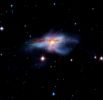
NGC-6240-PIA11828.jpgNGC 6240 - Colliding Galaxies75 visiteThis image of a pair of colliding galaxies called NGC 6240 shows them in a rare, short-lived phase of their evolution just before they merge into a single, larger galaxy. The prolonged, violent collision has drastically altered the appearance of both galaxies and created huge amounts of heat turning NGC 6240 into an "InfraRed Luminous" Active Galaxy.
A rich variety of active galaxies, with different shapes, luminosities and radiation profiles exist. These galaxies may be related astronomers have suspected that they may represent an evolutionary sequence. By catching different galaxies in different stages of merging, a story emerges as one type of active galaxy changes into another. NGC 6240 provides an important "missing link" in this process.
This image was created from combined data from the infrared array camera of NASA's Spitzer Space Telescope at 3.6 and 8.0 microns (red) and Visible Light from NASA's Hubble Space Telescope (green and blue).MareKromium
|
|
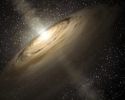
PIA03243.jpgThe way we were...85 visiteThis artist's concept illustrates a solar system that is a much younger version of our own. Dusty disks, like the one shown here circling the star, are thought to be the breeding grounds of planets, including rocky ones like Earth. Astronomers using NASA's Spitzer Space Telescope spotted some of the raw ingredients for DNA and protein in one such disk belonging to a star called IRS 46. The ingredients, gaseous precursors to DNA and protein called acetylene and hydrogen cyanide, were detected in the star's inner disk, the region where scientists believe Earth-like planets would be most likely to form.
|
|

PIA07854.jpgA beautiful "Asteroid Belt"70 visiteThis artist's animation illustrates a massive asteroid belt in orbit around a star the same age and size as our Sun. Evidence for this possible belt was discovered by NASA's Spitzer Space Telescope when it spotted warm dust around the star, presumably from asteroids smashing together.
The view starts from outside the belt, where planets like the one shown here might possibly reside, then moves into to the dusty belt itself. A collision between two asteroids is depicted near the end of the movie. Collisions like this replenish the dust in the asteroid belt, making it detectable to Spitzer.
The alien belt circles a faint, nearby star called HD 69830 located 41 light-years away in the constellation Puppis. Compared to our own solar system's asteroid belt, this one is larger and closer to its star - it is 25 times as massive, and lies just inside an orbit equivalent to that of Venus. Our asteroid belt circles between the orbits of Mars and Jupiter.
Because Jupiter acts as an outer wall to our asteroid belt, shepherding its debris into a series of bands, it is possible that an unseen planet is likewise marshalling this belt's rubble. Previous observations using the radial velocity technique did not locate any large gas giant planets, indicating that any planets present in this system would have to be the size of Saturn or smaller.
Asteroids are chunks of rock from "failed" planets, which never managed to coalesce into full-sized planets. Asteroid belts can be thought of as construction sites that accompany the building of rocky planets.
|
|
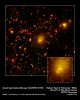
PIA09955_fig1.jpgFearsome Foursome (Figure 1)70 visiteOne of the biggest galaxy collisions ever observed is taking place at the center of this image. The four yellow blobs in the middle are large galaxies that have begun to tangle and ultimately merge into a single gargantuan galaxy. The yellowish cloud around the colliding galaxies contains billions of stars tossed out during the messy encounter. Other galaxies and stars appear in yellow and orange hues.
NASA's Spitzer Space Telescope spotted the four-way collision, or merger, in a giant cluster of galaxies, called CL0958+4702, located nearly 5 BLY away.
The dots in the picture are a combination of galaxies in the cluster; background galaxies located behind the cluster; and foreground stars in our own Milky Way galaxy.
Infrared data from Spitzer are colored red in this picture, while visible-light data from a telescope known as WIYN are green. Areas where green and red overlap appear orange or yellow.
Since most galaxies in the cluster contain old stars that are visible to Spitzer and WIYN, those galaxies appear orange.
MareKromium
|
|
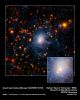
PIA09955_fig2.jpgFearsome Foursome (Figure 2)72 visiteFigure 2 is similar to figure 1 except the color blue represents X-ray light captured by NASA's Chandra X-ray Observatory. The colliding galaxies appear white in this picture because they are in areas where all the colors overlap.
The WIYN telescope, located near Tucson, Ariz., is owned and operated by the WIYN Consortium, which consists of the University of Wisconsin, Indiana University, Yale University, and the National Optical Astronomy Observatory.MareKromium
|
|
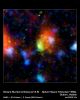
PIA10932.jpgBaby Boom!70 visiteThe green and red splotch in this image is the most active star-making galaxy in the very distant universe. Nicknamed "Baby Boom", the galaxy is churning out an average of up to 4000 stars per year, more than 100 times the number produced in our own Milky Way galaxy. It was spotted 12,3 Billion Light-Years away by a suite of telescopes, including NASA's Spitzer Space Telescope.
Baby Boom is a type of galaxy called a "Starburst".
Like some other Starbursts, it is thought to be a collection of colliding galaxies. As the galaxies smash together, gas becomes compressed, triggering the birth of stars. In this multi-wavelength portrait, the color red shows where loads of new stars are forming in Baby Boom, and where warm dust heated by the stars is giving off infrared light.
Green (visible-light wavelengths) denotes gas in the Baby Boom galaxy, while blue (also visible light) shows galaxies in the foreground that are not producing nearly as many stars. Yellow/orange (near-infrared light) indicates starlight from the outer portion of Baby Boom. The red blob to the left is another foreground galaxy that is not producing a lot of stars.
This composite contains data from NASA's Hubble Space Telescope, Spitzer and Japan's Subaru Telescope in Hawaii.MareKromium
|
|
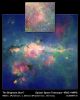
PIA10955.jpgThe brightest Stars of the (known) Universe69 visiteIf our galaxy, the Milky Way, were to host its own version of the Olympics, the title for the brightest known star would go to a massive star called Eta Carinae. However, a new runner-up — now the second-brightest star in our galaxy — has been discovered in the galaxy's dusty and frenzied interior. This image from NASA's Spitzer Space Telescope shows the new silver medalist, circled in the inset above, in the central region of our Milky Way.
Dubbed the 'Peony Nebula' star, this blazing ball of gas shines with the equivalent light of 3,2 million Suns. The reigning champ, Eta Carinae, produces the equivalent of 4,7 million Suns worth of light — though astronomers say these estimates are uncertain, and it's possible that the Peony Nebula star could be even brighter than Eta Carinae.
If the Peony Star is so bright, why doesn't it stand out more in this view? The answer is dust. This star is located in a very dusty region jam packed with stars. In fact, there could be other super bright stars still hidden deep in the stellar crowd. Spitzer's infrared eyes allowed it to pierce the dust and assess the Peony Nebula star's true brightness.
Likewise, infrared data from the European Southern Observatory's New Technology Telescope in Chile were integral in calculating the Peony Nebula star's luminosity.
The Peony Nebula, which surrounds the Peony nebular star, is the reddish cloud of dust in and around the white circle.
This is a three-color composite showing infrared observations from two Spitzer instruments. Blue represents 3.6-micron light and green shows light of 8 microns, both captured by Spitzer's infrared array camera. Red is 24-micron light detected by Spitzer's multiband imaging photometer.MareKromium
|
|

PIA11417.jpgQuartz-like Crystals found in Planetary Disks71 visiteNASA's Spitzer Space Telescope has, for the first time, detected tiny quartz-like crystals sprinkled in young planetary systems. The crystals, which are types of silica minerals called Cristobalite and Tridymite, can be seen close-up in the black-and-white insets (Cristobalite is on the left, and Tridymite on the right). The main picture is an artist's concept of a young star and its swirling disk of planet-forming materials.
Cristobalite and Tridymite are thought to be two of many planet ingredients. On Earth, they are normally found as tiny crystals in volcanic lava flows and meteorites from space. These minerals are both related to quartz. For example, if you were to heat the familiar quartz crystals often sold as mystical tokens, the quartz would transform into Cristobalite and Tridymite.
Because Cristobalite and Tridymite require rapid heating and cooling to form, astronomers say they were most likely generated by shock waves traveling through the planetary disks.
The insets are Scanning Electron Microscope pictures courtesy of George Rossman of the California Institute of Technology, Pasadena, Calif.MareKromium
|
|
| 157 immagini su 14 pagina(e) |
|
|
|
|
|
|
10 | |
|
|
|
|
|








