Inizio Registrati Login

Elenco album Ultimi arrivi Ultimi commenti Più viste Più votate Preferiti Cerca

Inizio > MARS > Walking on Mars with Spirit and Opportunity
Ritorna alla pagina delle miniature FILE 4974/5456 Torna all'inizio Guarda foto precedente Guarda foto successiva Salta alla fine
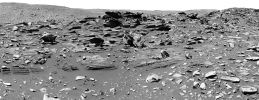
Home Plate Panorama - Sol 746
This week, NASA's Spirit arrived at Home Plate, a feature that, when seen from orbit, looks like the home plate of a baseball diamond. Home Plate is a roughly circular feature about 80 mt (260 feet) in diameter that might be an old impact crater or a volcanic feature. The Spirit Team has been eager to get to Home Plate and has been enjoying distant views of the feature and a curious "bathtub ring" of light-colored materials along its edges. The Team has pushed the Rover hard to get here before the deep Martian winter sets in. 
After scientists had identified Home Plate from orbit, they had many theories about what it could be and what they might see. But when Spirit's Pancam took this and other images, the Science Team was stunned. This PanCam image is of an outcrop nicknamed "Barnhill" and surrounding rocks on the north side of Home Plate, showing the most spectacular layering that Spirit has seen. 
Pancam and MI views of the layers in the rocks reveal a range of grain sizes and textures that change from the lower to the upper part of the outcrop. This may help scientists figure out how the material was emplaced. Spirit is also conducting work with its arm instruments to figure out the chemistry and mineralogy of the rocks. Scientists have several hypotheses about what Home Plate could be, including features made by volcanoes and impact craters, and ways that water could have played a role. They are busy trying to figure out what the data from Spirit is really telling us. 

As Spirit works at Home Plate during February, the science team is choosing informal names for rocks from the great players and managers of the Negro Leagues of baseball. This outcrop, "Barnhill," is informally named for David Barnhill, the ace of the New York Cubans' pitching staff during the early 1940s. He compiled an 18-3 record in 1941 and defeated Satchel Paige in the 1942 East-West all-star game. Other rocks in the area are informally named for Josh Gibson, "Bullet Joe" Rogan, and Cumberland Posey. Stay tuned this month, as the Baseball Hall of Fame elects more players from the Negro Leagues and Spirit continues to examine these spectacular rocks.

Parole chiave: Martian Outcrops - Home Plate

Home Plate Panorama - Sol 746

This week, NASA's Spirit arrived at Home Plate, a feature that, when seen from orbit, looks like the home plate of a baseball diamond. Home Plate is a roughly circular feature about 80 mt (260 feet) in diameter that might be an old impact crater or a volcanic feature. The Spirit Team has been eager to get to Home Plate and has been enjoying distant views of the feature and a curious "bathtub ring" of light-colored materials along its edges. The Team has pushed the Rover hard to get here before the deep Martian winter sets in.
After scientists had identified Home Plate from orbit, they had many theories about what it could be and what they might see. But when Spirit's Pancam took this and other images, the Science Team was stunned. This PanCam image is of an outcrop nicknamed "Barnhill" and surrounding rocks on the north side of Home Plate, showing the most spectacular layering that Spirit has seen.
Pancam and MI views of the layers in the rocks reveal a range of grain sizes and textures that change from the lower to the upper part of the outcrop. This may help scientists figure out how the material was emplaced. Spirit is also conducting work with its arm instruments to figure out the chemistry and mineralogy of the rocks. Scientists have several hypotheses about what Home Plate could be, including features made by volcanoes and impact craters, and ways that water could have played a role. They are busy trying to figure out what the data from Spirit is really telling us.

As Spirit works at Home Plate during February, the science team is choosing informal names for rocks from the great players and managers of the Negro Leagues of baseball. This outcrop, "Barnhill," is informally named for David Barnhill, the ace of the New York Cubans' pitching staff during the early 1940s. He compiled an 18-3 record in 1941 and defeated Satchel Paige in the 1942 East-West all-star game. Other rocks in the area are informally named for Josh Gibson, "Bullet Joe" Rogan, and Cumberland Posey. Stay tuned this month, as the Baseball Hall of Fame elects more players from the Negro Leagues and Spirit continues to examine these spectacular rocks.

SOL746-2N192598815EFFAO55P1926L0M1.jpg SOL746-2N192598932EFFAO55P1926R0M1.jpg SOL746-PIA02187.jpg SOL747-1.jpg SOL747-2F192678390EFFAO55P1206R0M1.jpg
Informazioni sul file
Nome del file:SOL746-PIA02187.jpg
Nome album:Walking on Mars with Spirit and Opportunity
Valutazione (3 voti):55555(Mostra dettagli)
Parole chiave:Martian / Outcrops / - / Home / Plate
Copyright:NASA - Spirit Rover Mission
Dimensione del file:291 KiB
Data di inserimento:Feb 19, 2006
Dimensioni:1936 x 746 pixels
Visualizzato:67 volte
URL:https://www.lunexit.it/gallery/displayimage.php?pid=9812
Preferiti:Aggiungi ai preferiti


Powered by Coppermine Photo Gallery