|
|
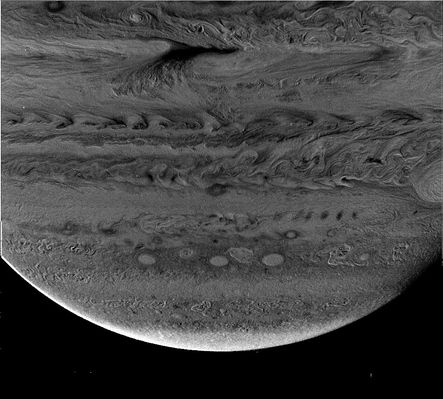
Jupiter's clouds - 619 nnmts filter
|
The images shown here demonstrate the power of these filters in studies of cloud stratigraphy. The images cover latitudes from about 15° North at the top down to the Southern Polar Region at the bottom. (...)
The most prominent feature seen in all 3 filters is the Polar Stratospheric Haze that makes Jupiter bright near the Pole. The equatorial band is also very bright in the strong 890-nnmts image and to a lesser extent in the 727 band, but is subdued in the weak 619-nnmts image. These are high, thin, haze layers that are nearly transparent at wavelengths outside the methane absorption bands.
Another prominent feature is the Great Red Spot: about a third of it appears at the right-hand edge of the frame.
It is a bright feature in methane absorption because it has extensive cloud cover reaching to high altitude.
A wisp of high thin cloud can be seen trailing off its western rim in the 2nd and 3rd image.
|
|