Inizio Registrati Login

Elenco album Ultimi arrivi Ultimi commenti Più viste Più votate Preferiti Cerca

Inizio > MARS > Walking on Mars with Spirit and Opportunity
Ritorna alla pagina delle miniature FILE 4461/5456 Torna all'inizio Guarda foto precedente Guarda foto successiva Salta alla fine
"Phobal" eclypse (2) - Sol 639
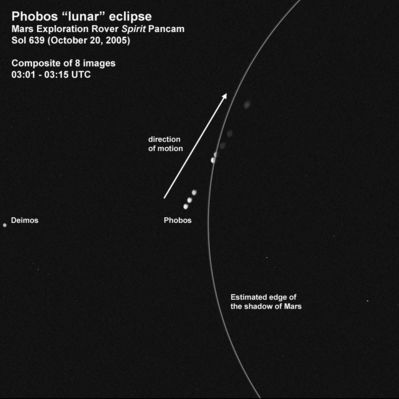
Jim Bell, the astronomer in charge of the rover's panoramic camera (Pancam), suggested calling it a "Phobal" eclipse rather than a lunar eclipse as a way of identifying which of the dozens of moons in our solar system was being cast into shadow. 

With the help of the Jet Propulsion Laboratory's navigation team, the Pancam team planned instructions to Spirit for acquiring the views shown here of Phobos as it entered into a lunar eclipse on the evening of the rover's 639th martian day, or sol (Oct. 20, 2005) on Mars. This image is a time-lapse composite of eight Pancam images of Phobos moving across the martian sky. The entire eclipse lasted more than 26 minutes, but Spirit was able to observe only in the first 15 minutes. During the time closest to the shadow crossing, Spirit's cameras were programmed to take images every 10 seconds. 

In the first three images, Phobos was in sunlight, moving toward the upper right. After a 100-second delay while Spirit's computer processed the first three images, the rover then took the fourth image, showing Phobos just starting to enter the darkness of the martian shadow. At that point, an observer sitting on Phobos and looking back toward the Sun would have seen a spectacular sunset! In the fifth image, Phobos appeared like a crescent, almost completely shrouded in darkness. 

In the last three images, Phobos had slipped entirely into the shadow of Mars. However, as with our own Moon during lunar eclipses on Earth, it was not entirely dark. The small amount of light still visible from Phobos is a kind of "Mars-shine" -- sunlight reflected through Mars' atmosphere and into the shadowed region. 

Rover scientists took some images later in the sequence to try to figure out if this "Mars-shine" made Phobos colorful while in eclipse, but they'll need more time to complete the analysis because the signal levels are so low. Meanwhile, they will use the information on the timing of the eclipse to refine the orbital path of Phobos. The precise position of Phobos will be important to any future spacecraft taking detailed pictures of the moon or landing on its surface. In the near future it might be possible for one of the rovers to take images of a "Deimal" eclipse to learn more about Mars' other enigmatic satellite, Deimos, as well.

Parole chiave: Martian Night-Sky

"Phobal" eclypse (2) - Sol 639

Jim Bell, the astronomer in charge of the rover's panoramic camera (Pancam), suggested calling it a "Phobal" eclipse rather than a lunar eclipse as a way of identifying which of the dozens of moons in our solar system was being cast into shadow.

With the help of the Jet Propulsion Laboratory's navigation team, the Pancam team planned instructions to Spirit for acquiring the views shown here of Phobos as it entered into a lunar eclipse on the evening of the rover's 639th martian day, or sol (Oct. 20, 2005) on Mars. This image is a time-lapse composite of eight Pancam images of Phobos moving across the martian sky. The entire eclipse lasted more than 26 minutes, but Spirit was able to observe only in the first 15 minutes. During the time closest to the shadow crossing, Spirit's cameras were programmed to take images every 10 seconds.

In the first three images, Phobos was in sunlight, moving toward the upper right. After a 100-second delay while Spirit's computer processed the first three images, the rover then took the fourth image, showing Phobos just starting to enter the darkness of the martian shadow. At that point, an observer sitting on Phobos and looking back toward the Sun would have seen a spectacular sunset! In the fifth image, Phobos appeared like a crescent, almost completely shrouded in darkness.

In the last three images, Phobos had slipped entirely into the shadow of Mars. However, as with our own Moon during lunar eclipses on Earth, it was not entirely dark. The small amount of light still visible from Phobos is a kind of "Mars-shine" -- sunlight reflected through Mars' atmosphere and into the shadowed region.

Rover scientists took some images later in the sequence to try to figure out if this "Mars-shine" made Phobos colorful while in eclipse, but they'll need more time to complete the analysis because the signal levels are so low. Meanwhile, they will use the information on the timing of the eclipse to refine the orbital path of Phobos. The precise position of Phobos will be important to any future spacecraft taking detailed pictures of the moon or landing on its surface. In the near future it might be possible for one of the rovers to take images of a "Deimal" eclipse to learn more about Mars' other enigmatic satellite, Deimos, as well.

SOL639-MF.jpg SOL639-PIA03201.jpg SOL639-PIA03201_fig1.jpg SOL640-2N183180207EFFAI00P1755L0M1.jpg SOL641-2P183259820EDNAI00P2630L4M1.jpg
Informazioni sul file
Nome del file:SOL639-PIA03201_fig1.jpg
Nome album:Walking on Mars with Spirit and Opportunity
Valutazione (3 voti):55555(Mostra dettagli)
Parole chiave:Martian / Night-Sky
Copyright:NASA - Spirit Rover Mission
Dimensione del file:130 KiB
Data di inserimento:Nov 16, 2005
Dimensioni:872 x 872 pixels
Visualizzato:78 volte
URL:https://www.lunexit.it/gallery/displayimage.php?pid=8293
Preferiti:Aggiungi ai preferiti

Commento 1 a 3 di 3
Pagina: 1

MareKromium   [Giu 21, 2020 at 04:55 PM]
...carino il commento NASA...
Anakin   [Giu 23, 2020 at 08:57 AM]
ci hanno messo un pò di romanticismo :-)
MareKromium   [Giu 24, 2020 at 05:50 PM]
...Già. Peccato che la NASA non sia romantica.... ;-)

Commento 1 a 3 di 3
Pagina: 1


Powered by Coppermine Photo Gallery