Inizio Registrati Login

Elenco album Ultimi arrivi Ultimi commenti Più viste Più votate Preferiti Cerca

Inizio > SOLAR SYSTEM > Jupiter: the "King" and His Moons
Ritorna alla pagina delle miniature FILE 2/325 Torna all'inizio Guarda foto precedente Guarda foto successiva Salta alla fine
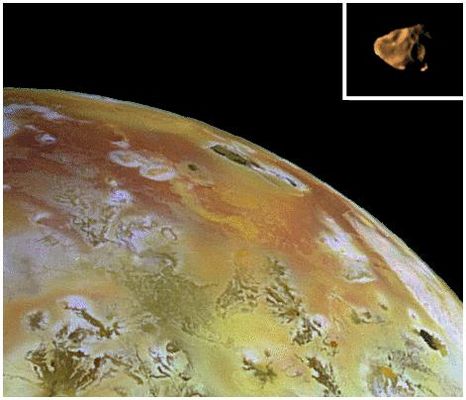
Amalthea and Io (approx. true colors)
Composite view of Amalthea and Io at the same scale. The visible part of Amalthea is about 150 Km across. The colors are just approximate. Amalthea is actually much darker than Io, but is displayed at a similar brightness for ease of viewing. The shape of Amalthea is controlled largely by impact cratering and fragmentation. In contrast, Io, like Earth, has gravity sufficient to form it into a slightly ellipsoidal sphere. Amalthea is covered by craters because there are no processes which erode or cover them efficiently. On extremely volcanically active Io, impact craters are covered quickly by lavas and other volcanic materials. Some of the volcanic materials escape from Io and probably contribute to the reddish colors of Amalthea and the other small inner satellites. The Amalthea and Io composites, obtained by the Solid State Imaging (SSI) camera on NASA's Galileo spacecraft on different orbits, were placed side by side for comparison purposes. The Amalthea composite combines data taken with the clear filter of the SSI system during orbit six, with lower resolution color images taken with the green, violet, and 1 micrometer filters during orbit 4. The Io data was obtained on July 2nd, 1998 (orbit 14) using the green, violet, and 1 micrometer filters.

Parole chiave: Jupiter Moons - Amalthea and Io

Amalthea and Io (approx. true colors)

Composite view of Amalthea and Io at the same scale. The visible part of Amalthea is about 150 Km across. The colors are just approximate. Amalthea is actually much darker than Io, but is displayed at a similar brightness for ease of viewing. The shape of Amalthea is controlled largely by impact cratering and fragmentation. In contrast, Io, like Earth, has gravity sufficient to form it into a slightly ellipsoidal sphere. Amalthea is covered by craters because there are no processes which erode or cover them efficiently. On extremely volcanically active Io, impact craters are covered quickly by lavas and other volcanic materials. Some of the volcanic materials escape from Io and probably contribute to the reddish colors of Amalthea and the other small inner satellites. The Amalthea and Io composites, obtained by the Solid State Imaging (SSI) camera on NASA's Galileo spacecraft on different orbits, were placed side by side for comparison purposes. The Amalthea composite combines data taken with the clear filter of the SSI system during orbit six, with lower resolution color images taken with the green, violet, and 1 micrometer filters during orbit 4. The Io data was obtained on July 2nd, 1998 (orbit 14) using the green, violet, and 1 micrometer filters.

AA-Jupiter-PIA02666_modest.jpg Amalthea and Io-PIA01626.jpg Amalthea-Galileo.jpg Amalthea-PIA01072.jpg Amalthea-PIA01074.jpg
Informazioni sul file
Nome del file:Amalthea and Io-PIA01626.jpg
Nome album:Jupiter: the "King" and His Moons
Valutazione (11 voti):55555(Mostra dettagli)
Parole chiave:Jupiter / Moons / - / Amalthea / and / Io
Copyright:NASA - Galileo Project
Dimensione del file:29 KiB
Data di inserimento:Ott 20, 2005
Dimensioni:471 x 404 pixels
Visualizzato:140 volte
URL:https://www.lunexit.it/gallery/displayimage.php?pid=7893
Preferiti:Aggiungi ai preferiti


Powered by Coppermine Photo Gallery