|
|
The "Rings": the most spectacular view ever seen!
|
Specially designed Cassini orbits place Earth and Cassini on opposite sides of Saturn's rings, a geometry known as "occultation". Cassini conducted the 1st radio occultation observation of Saturn's Rings on May 3, 2005.
Three simultaneous radio signals of 0,94; 3,6, and 13 cm wavelengths (Ka-, X-, and S-bands) were sent from Cassini through the rings to Earth. The observed change of each signal as Cassini moved behind the Rings provided a profile of the distribution of ring material as a function of distance from Saturn, or an optical depth profile.
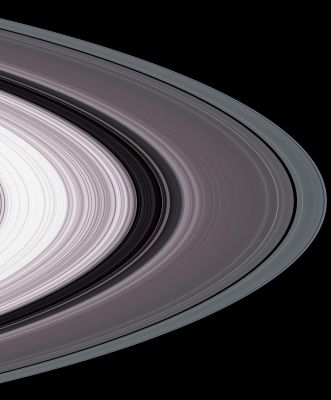
This simulated image was constructed from the measured optical depth profiles. It depicts the observed ring structure at about 10 Km in resolution. Color is used to represent information about ring particle sizes in different regions based on the measured effects of the 3 radio signals. Shades of purple, primarily over most of the inner ring (ring B) and the inner portion of the next ring (ring A), indicate regions where there is a lack of particles less than 5 centimeters (about 2 inches) in diameter. Green and blue shades indicate regions where there are particles of sizes smaller than 5 centimeters (2 inches) and 1 centimeter (less than one third of an inch), respectively, primarily in outer ring A and within most of ring C. From other evidence in the radio observations, all ring regions appear to be populated by a broad range of particle size distribution that extends to boulder sizes (several to many meters or yards across).
|
|