|
|
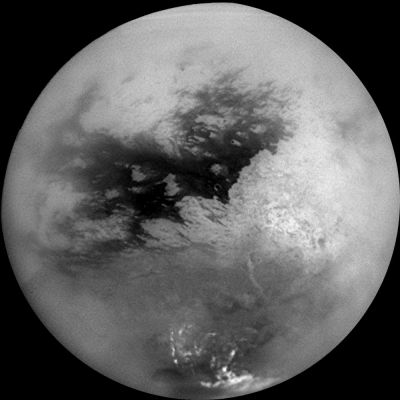
Titan (full disk, no haze) from 300.000 up to 650.000 Km
|
The images that comprise the mosaic have been processed to reduce the effects of the atmosphere and to sharpen surface features. The mosaic has been trimmed to show only the illuminated surface and not the atmosphere above the edge of the moon. Pixel scales of the composite images vary from 2 to 4 Km per pixel. Surface features are best seen near the center of the disc, where the spacecraft is looking directly downwards; the contrast becomes progressively lower and surface features become fuzzier toward the outside, where the spacecraft is peering through haze, which washes out surface features. The brighter region on the right side and equatorial region is named Xanadu. Scientists are debating what processes may have created the bizarre surface brightness patterns seen here. The images hint at a young surface with no obvious craters. The exact nature of that activity, whether tectonic, wind-blown, fluvial, marine or volcanic is still unknown.
|
|