Inizio Registrati Login

Elenco album Ultimi arrivi Ultimi commenti Più viste Più votate Preferiti Cerca

Inizio > SOLAR SYSTEM > Pluto and Charon: The "Double Planet"
Ritorna alla pagina delle miniature FILE 55/79 Torna all'inizio Guarda foto precedente Guarda foto successiva Salta alla fine
Interstellar Navigation
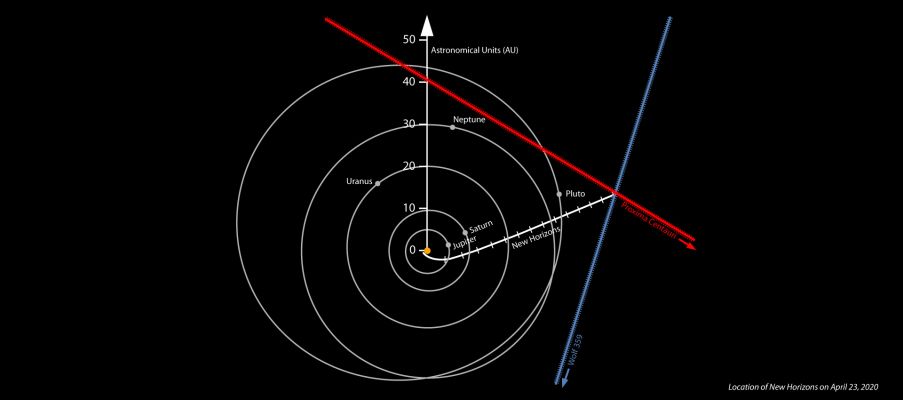
Since its launch in 2006, New Horizons has been on a trajectory that brought it past Pluto and then Kuiper Belt object Arrokoth and will eventually take it out of the solar system, into interstellar space over the next decade. In 2020, the New Horizons science team, in an effort led by Lauer, obtained images of the star fields around the nearby stars Proxima Centauri and Wolf 359 simultaneously from New Horizons and Earth. This program vividly demonstrated New Horizons’ change in perspective as it ventured from the inner to the outer solar system.

But more recent and sophisticated analyses of the exact positions of the two stars in those 2020 images allowed Lauer, working with retired Lawrence Livermore National Laboratory researcher David Munro, as well as members of the New Horizons team and external collaborators, to deduce New Horizons’ three-dimensional position relative to nearby stars – accomplishing the first use of stars imaged directly from a spacecraft to provide its navigational fix, and the first demonstration of interstellar navigation by any spacecraft on an interstellar trajectory.

A paper describing the results was accepted for publication in The Astronomical Journal. The preprint is available on the server arXiv.

“This pioneering interstellar navigation demonstration and its accompanying publication show that a deep-space mission can use its onboard imaging system to find its way among the stars,” said Alan Stern, principal investigator for New Horizons from the Southwest Research Institute in Boulder, Colorado. “While for New Horizons, this method isn’t as accurate as NASA’s sophisticated tracking from Earth, it could be highly useful for future deep space missions in the far reaches of the solar system and in interstellar space.”
Parole chiave: New Horizons

Interstellar Navigation

Since its launch in 2006, New Horizons has been on a trajectory that brought it past Pluto and then Kuiper Belt object Arrokoth and will eventually take it out of the solar system, into interstellar space over the next decade. In 2020, the New Horizons science team, in an effort led by Lauer, obtained images of the star fields around the nearby stars Proxima Centauri and Wolf 359 simultaneously from New Horizons and Earth. This program vividly demonstrated New Horizons’ change in perspective as it ventured from the inner to the outer solar system.

But more recent and sophisticated analyses of the exact positions of the two stars in those 2020 images allowed Lauer, working with retired Lawrence Livermore National Laboratory researcher David Munro, as well as members of the New Horizons team and external collaborators, to deduce New Horizons’ three-dimensional position relative to nearby stars – accomplishing the first use of stars imaged directly from a spacecraft to provide its navigational fix, and the first demonstration of interstellar navigation by any spacecraft on an interstellar trajectory.

A paper describing the results was accepted for publication in The Astronomical Journal. The preprint is available on the server arXiv.

“This pioneering interstellar navigation demonstration and its accompanying publication show that a deep-space mission can use its onboard imaging system to find its way among the stars,” said Alan Stern, principal investigator for New Horizons from the Southwest Research Institute in Boulder, Colorado. “While for New Horizons, this method isn’t as accurate as NASA’s sophisticated tracking from Earth, it could be highly useful for future deep space missions in the far reaches of the solar system and in interstellar space.”

ZZ-ZZ-ZZ-ZZ-ZZ-Z-New_Horizons_-_Map.png ZZ-ZZ-ZZ-ZZ-ZZ-Z-New_Horizons_Proxima-2025_28129.gif ZZ-ZZ-ZZ-ZZ-ZZ-Z-New_Horizons_Proxima-2025_28129_gifH_Interstellar_v2.jpg ZZ-ZZ-ZZ-ZZ-ZZ-ZZ-Charon-PIA19709-PCF-LXTT-IPF-1.jpg ZZ-ZZ-ZZ-ZZ-ZZ-ZZ-Charon-PIA19709-PCF-LXTT-IPF.jpg
Informazioni sul file
Nome del file:ZZ-ZZ-ZZ-ZZ-ZZ-Z-New_Horizons_Proxima-2025_28129_gifH_Interstellar_v2.jpg
Nome album:MareKromium / Pluto and Charon: The "Double Planet"
Valutazione (1 voti):55555(Mostra dettagli)
Parole chiave:New / Horizons
Copyright:NASA/JPL - New Horizons Mission
Dimensione del file:203 KiB
Data di inserimento:Mag 20, 2026
Dimensioni:1920 x 850 pixels
Visualizzato:114 volte
URL:https://www.lunexit.it/gallery/displayimage.php?pid=32072
Preferiti:Aggiungi ai preferiti


Powered by Coppermine Photo Gallery