Inizio Registrati Login

Elenco album Ultimi arrivi Ultimi commenti Più viste Più votate Preferiti Cerca

Inizio > SOLAR SYSTEM > Jupiter: the "King" and His Moons
Ritorna alla pagina delle miniature FILE 79/325 Torna all'inizio Guarda foto precedente Guarda foto successiva Salta alla fine
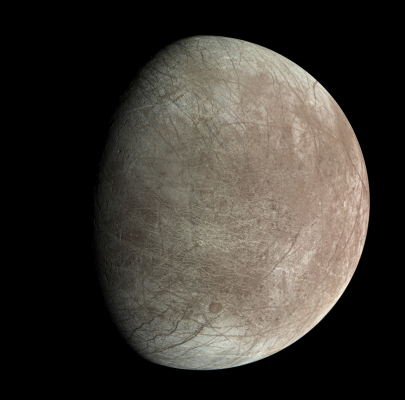
Europa from Juno (Credits: Image data: NASA/JPL-Caltech/SwRI/MSSS; Image processing: Björn Jónsson)
Jupiter’s moon Europa was captured by the JunoCam Instrument aboard NASA’s Juno Spacecraft during the Mission’s close flyby on Sept. 29, 2022. Data from NASA’s Juno mission has provided new insights into the thickness and subsurface structure of the icy shell encasing Jupiter’s moon Europa. Using the spacecraft’s Microwave Radiometer (MWR), mission scientists determined that the shell averages about 18 miles (29 kilometers) thick in the region observed during Juno’s 2022 flyby of Europa. The Juno measurement is the first to discriminate between thin and thick shell models that have suggested the ice shell is anywhere from less than half a mile to tens of miles thick.

Slightly smaller than Earth’s moon, Europa is one of the solar system’s highest-priority science targets for investigating habitability. Evidence suggests that the ingredients for life may exist in the saltwater ocean that lies beneath its ice shell. Uncovering a variety of characteristics of the ice shell, including its thickness, provides crucial pieces of the puzzle for understanding the moon’s internal workings and the potential for the existence of a habitable environment.
Parole chiave: Jovian Moons - Europa

Europa from Juno (Credits: Image data: NASA/JPL-Caltech/SwRI/MSSS; Image processing: Björn Jónsson)

Jupiter’s moon Europa was captured by the JunoCam Instrument aboard NASA’s Juno Spacecraft during the Mission’s close flyby on Sept. 29, 2022. Data from NASA’s Juno mission has provided new insights into the thickness and subsurface structure of the icy shell encasing Jupiter’s moon Europa. Using the spacecraft’s Microwave Radiometer (MWR), mission scientists determined that the shell averages about 18 miles (29 kilometers) thick in the region observed during Juno’s 2022 flyby of Europa. The Juno measurement is the first to discriminate between thin and thick shell models that have suggested the ice shell is anywhere from less than half a mile to tens of miles thick.

Slightly smaller than Earth’s moon, Europa is one of the solar system’s highest-priority science targets for investigating habitability. Evidence suggests that the ingredients for life may exist in the saltwater ocean that lies beneath its ice shell. Uncovering a variety of characteristics of the ice shell, including its thickness, provides crucial pieces of the puzzle for understanding the moon’s internal workings and the potential for the existence of a habitable environment.

Europa-mosaic-PIA01407.jpg Europa.jpg Europa_-_PIA26331-_JunoCam_6solgdm_width-1320.png Europa_and_Jupiter.jpg Ganymede and Europa-PIA02574.jpg
Informazioni sul file
Nome del file:Europa_-_PIA26331-_JunoCam_6solgdm_width-1320.png
Nome album:MareKromium / Jupiter: the "King" and His Moons
Valutazione (1 voti):55555(Mostra dettagli)
Parole chiave:Jovian / Moons / - / Europa
Copyright:Image data: NASA/JPL-Caltech/SwRI/MSSS. Image processing: Björn Jónsson (CC BY 3.0)
Dimensione del file:1421 KiB
Data di inserimento:Apr 08, 2026
Dimensioni:1320 x 1302 pixels
Visualizzato:138 volte
URL:https://www.lunexit.it/gallery/displayimage.php?pid=32035
Preferiti:Aggiungi ai preferiti


Powered by Coppermine Photo Gallery