Inizio Registrati Login

Elenco album Ultimi arrivi Ultimi commenti Più viste Più votate Preferiti Cerca

Inizio > MARS > Curiosity and the Exploration of Gale Crater
Ritorna alla pagina delle miniature FILE 175/259 Torna all'inizio Guarda foto precedente Guarda foto successiva Salta alla fine
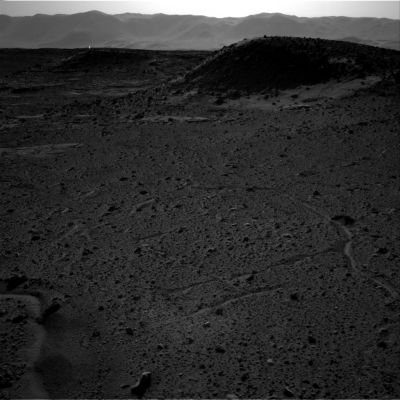
Bright Spark in the distance (Original NASA - Mer Curiosity Frame) - Sol 589
This image from the Navigation Camera (Navcam) on NASA's Curiosity Mars rover includes a bright spot near the upper left corner. The sun is in the same direction, west-northwest, above the frame. Bright spots appear in images from the rover nearly every week. Typical explanations for them are cosmic rays hitting the light detector or sunlight glinting from rocks.

The right-eye camera of the stereo Navcam recorded this frame during the afternoon of the 589th Martian day, or sol, of Curiosity's work on Mars (April 3, 2014), from the site where the rover reached a waypoint called "the Kimberley" by that sol's drive. An image taken by the Navcam's left-eye camera within one second of the same time (http://mars.jpl.nasa.gov/msl/multimedia/raw/?rawid=NLB_449790582EDR_F0310000NCAM00262M_&s=589) does not include a bright spot of this type. A pair of Navcam images in the same direction from the previous afternoon has a bright spot similarly located in the right-eye image http://mars.jpl.nasa.gov/msl/multimedia/raw/?rawid=NRB_449700848EDR_F0301254NCAM00252M_&s=588) but not in the left-eye image (http://mars.jpl.nasa.gov/msl/multimedia/raw/?rawid=NLB_449700848EDR_F0301254NCAM00252M_&s=588).

One possible explanation for the bright spot in this image is a glint from a rock surface reflecting the sun. Another is a cosmic ray hitting the camera's light detector, a CCD (charge-coupled device). Cosmic ray patterns in Mars rover images vary from a dot to a long line depending on the angle at which the ray strikes the detector.

NASA's Jet Propulsion Laboratory, a division of the California Institute of Technology, Pasadena, manages the Mars Science Laboratory Project for NASA's Science Mission Directorate, Washington. JPL designed and built the project's Curiosity rover and the Rover's Navcam.
Parole chiave: Martian Surface - possible Anomaly

Bright Spark in the distance (Original NASA - Mer Curiosity Frame) - Sol 589

This image from the Navigation Camera (Navcam) on NASA's Curiosity Mars rover includes a bright spot near the upper left corner. The sun is in the same direction, west-northwest, above the frame. Bright spots appear in images from the rover nearly every week. Typical explanations for them are cosmic rays hitting the light detector or sunlight glinting from rocks.

The right-eye camera of the stereo Navcam recorded this frame during the afternoon of the 589th Martian day, or sol, of Curiosity's work on Mars (April 3, 2014), from the site where the rover reached a waypoint called "the Kimberley" by that sol's drive. An image taken by the Navcam's left-eye camera within one second of the same time (http://mars.jpl.nasa.gov/msl/multimedia/raw/?rawid=NLB_449790582EDR_F0310000NCAM00262M_&s=589) does not include a bright spot of this type. A pair of Navcam images in the same direction from the previous afternoon has a bright spot similarly located in the right-eye image http://mars.jpl.nasa.gov/msl/multimedia/raw/?rawid=NRB_449700848EDR_F0301254NCAM00252M_&s=588) but not in the left-eye image (http://mars.jpl.nasa.gov/msl/multimedia/raw/?rawid=NLB_449700848EDR_F0301254NCAM00252M_&s=588).

One possible explanation for the bright spot in this image is a glint from a rock surface reflecting the sun. Another is a cosmic ray hitting the camera's light detector, a CCD (charge-coupled device). Cosmic ray patterns in Mars rover images vary from a dot to a long line depending on the angle at which the ray strikes the detector.

NASA's Jet Propulsion Laboratory, a division of the California Institute of Technology, Pasadena, manages the Mars Science Laboratory Project for NASA's Science Mission Directorate, Washington. JPL designed and built the project's Curiosity rover and the Rover's Navcam.

SOL0528-PIA17931-PCF-LXTT-IPF-3.jpg SOL0538-6012_PIA17944-FigA_Mcam-SOL538-raw-full2.jpg SOL0589-NRB_449790582EDR_F0310000NCAM00262M_.jpg SOL0710-0710MR0030150070402501E01_DXXX-000.jpg SOL0710-0710MR0030150070402501E01_DXXX-001.jpg
Informazioni sul file
Nome del file:SOL0589-NRB_449790582EDR_F0310000NCAM00262M_.jpg
Nome album:MareKromium / Curiosity and the Exploration of Gale Crater
Valutazione (4 voti):55555(Mostra dettagli)
Parole chiave:Martian / Surface / - / possible / Anomaly
Copyright:NASA - MER Curiosity
Dimensione del file:391 KiB
Data di inserimento:Dic 30, 2021
Dimensioni:1024 x 1024 pixels
Visualizzato:139 volte
URL:https://www.lunexit.it/gallery/displayimage.php?pid=31624
Preferiti:Aggiungi ai preferiti

Commento 1 a 1 di 1
Pagina: 1

MareKromium   [Dic 30, 2021 at 09:06 PM]
Non è stata una passeggiata, ma l'ho beccata per vie traverse. Questa è l'immagine Originale NASA. Le altre immagini di una "Luce" in lontananza a forma sferica e di un oggetto che sembra "levitare" con artefatto da sovra-saturazione NON sono del Sol 589. Quindi stiamo parlando di oggetti/eventi diversi...

Commento 1 a 1 di 1
Pagina: 1


Powered by Coppermine Photo Gallery