|
|
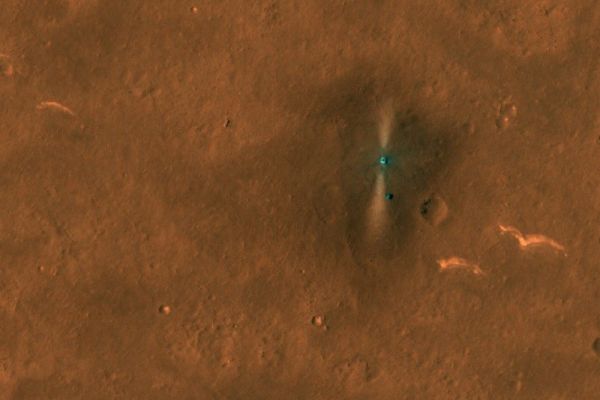
Zhurong from MRO
|
All three missions launched around the same time due to an alignment between Earth and Mars on the same side of the sun, making for a more efficient journey to the red planet.
Zhurong landed in a large plain in Mars' northern hemisphere called Utopia Planitia. It's where NASA's Viking 2 lander touched down in 1976.
China's ambitious space program triggered headlines earlier this month when an out-of-control rocket, weighing nearly 40,000 pounds, plunged into the Indian Ocean -- triggering a rebuke from NASA for failing to "meet responsibility standards regarding (its) space debris."
The Long March 5B rocket had launched part of China's new space station into orbit in late April and had been left to hurtle through space uncontrolled until Earth's gravity pulled it back in.
On Saturday, China's President Xi Jinping sent his congratulations on the successful Mars mission, hailing it as an "important step in China's interstellar exploration."
Though Chinese authorities and state media have hailed Tianwen-1 as the country's first mission to Mars, that isn't quite true.
China's first attempt to reach Mars was in 2011 with the Yinghuo-1 probe, which was supposed to orbit the red planet and study its environmental structure. It launched from Kazakhstan in tandem with the Russian Phobos-Grunt mission in November that year, which was supposed to orbit the red planet and study its environmental structure.
But the mission failed, with a malfunction that stranded the probe in Earth orbit's shortly after launch. In 2012, the spacecraft reentered the Earth's atmosphere and fell back to Earth, landing in the Pacific Ocean.
|
|