Inizio Registrati Login

Elenco album Ultimi arrivi Ultimi commenti Più viste Più votate Preferiti Cerca

Inizio > MARS > Mars Reconnaissance Orbiter (MRO)
Ritorna alla pagina delle miniature FILE 1059/2237 Torna all'inizio Guarda foto precedente Guarda foto successiva Salta alla fine
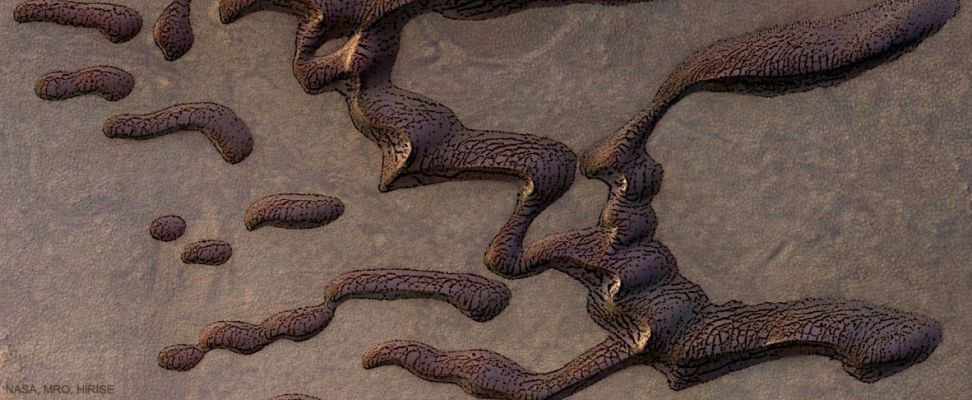
Striped Sand Dunes
Caption NASA:"Why are these sand dunes on Mars striped? 
No one is sure. 
The featured image shows striped dunes in Kunowsky Crater on Mars, photographed recently with the Mars Reconnaissance Orbiter’s HiRISE Camera. 
Many Martian dunes are known to be covered unevenly with carbon dioxide (dry ice) frost, creating patterns of light and dark areas. Carbon dioxide doesn’t melt, but sublimates, turning directly into a gas. Carbon dioxide is also a greenhouse material even as a solid, so it can trap heat under the ice and sublimate from the bottom up, causing geyser-like eruptions. During Martian spring, these eruptions can cause a pattern of dark defrosting spots, where the darker sand is exposed. 
The featured image, though, was taken during Martian Autumn, when the weather is getting colder – making these stripes particularly puzzling. One hypothesis is that they are caused by cracks in the ice that form from weaker eruptions or thermal stress as part of the day-night cycle, but research continues. 
Watching these dunes and others through more Martian seasons may give us more clues to solve this mystery".
Parole chiave: Mars from orbit

Striped Sand Dunes

Caption NASA:"Why are these sand dunes on Mars striped?
No one is sure.
The featured image shows striped dunes in Kunowsky Crater on Mars, photographed recently with the Mars Reconnaissance Orbiter’s HiRISE Camera.
Many Martian dunes are known to be covered unevenly with carbon dioxide (dry ice) frost, creating patterns of light and dark areas. Carbon dioxide doesn’t melt, but sublimates, turning directly into a gas. Carbon dioxide is also a greenhouse material even as a solid, so it can trap heat under the ice and sublimate from the bottom up, causing geyser-like eruptions. During Martian spring, these eruptions can cause a pattern of dark defrosting spots, where the darker sand is exposed.
The featured image, though, was taken during Martian Autumn, when the weather is getting colder – making these stripes particularly puzzling. One hypothesis is that they are caused by cracks in the ice that form from weaker eruptions or thermal stress as part of the day-night cycle, but research continues.
Watching these dunes and others through more Martian seasons may give us more clues to solve this mystery".

Juventae_Chasma_12m-02.jpg Kasei_Valles-PIA13265.jpg Kunowsky_Crater_-_Sand_Dunes-StripedDunes_HiRISE_1182.jpg Mars3-MF.jpg MartianTerminator-TRA_000841_1300_RED.jpg
Informazioni sul file
Nome del file:Kunowsky_Crater_-_Sand_Dunes-StripedDunes_HiRISE_1182.jpg
Nome album:MareKromium / Mars Reconnaissance Orbiter (MRO)
Valutazione (1 voti):55555(Mostra dettagli)
Parole chiave:Mars / from / orbit
Copyright: HiRISE, MRO, LPL (U. Arizona), NASA; Processing: Włodek Głażewski; Text: Alex R. Howe (NASA/USRA, Reader's History of SciFi Podcast)
Dimensione del file:172 KiB
Data di inserimento:Gen 08, 2021
Dimensioni:1182 x 486 pixels
Visualizzato:126 volte
URL:https://www.lunexit.it/gallery/displayimage.php?pid=31462
Preferiti:Aggiungi ai preferiti

Commento 1 a 4 di 4
Pagina: 1

MareKromium   [Gen 08, 2021 at 11:07 AM]
Ma questa immagine Vi pare verosimile?!?
Ufologo   [Gen 09, 2021 at 11:52 AM]
Certo che 'sto Marte ................
Anakin   [Gen 19, 2021 at 06:59 AM]
Nei colori o altro? Certo che mi piacerebbe proprio essere al suolo per capire cosa si vede
MareKromium   [Gen 20, 2021 at 10:34 AM]
Marte é strano, come Venere ed altre Lune dei Giganti Gassosi. E' chiaro - e condivido - che ci vorrebbero occhi umani in loco. Io, delle videocamere e delle foto, non mi fido più.

Commento 1 a 4 di 4
Pagina: 1


Powered by Coppermine Photo Gallery