Inizio Registrati Login

Elenco album Ultimi arrivi Ultimi commenti Più viste Più votate Preferiti Cerca

Inizio > SOLAR SYSTEM > Pluto and Charon: The "Double Planet"
Ritorna alla pagina delle miniature FILE 69/76 Torna all'inizio Guarda foto precedente Guarda foto successiva Salta alla fine
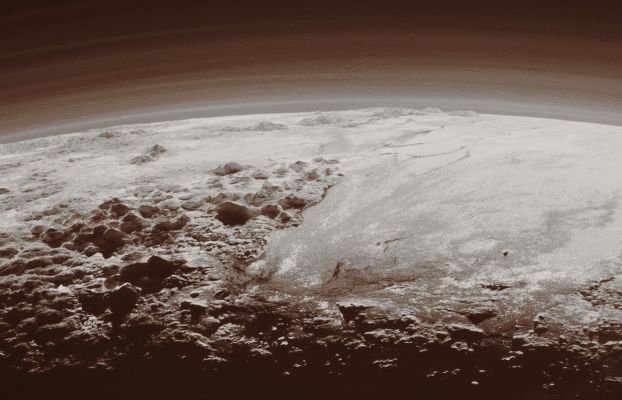
15 Minutes after Pluto - Closer View (Absolute Natural Colors; credits for the additional process. and color.: Dr Paolo C. Fienga - Lunexit Team)
Just 15 minutes after its Closest Approach to Pluto - which occurred on July, 14, 2015 -, the NASA - New Horizons Spacecraft looked back toward the Sun and captured this simply beautiful Near-Sunset View of the rugged, Icy Mountains and flat Ice Plains extending all over around and to Pluto's Horizon and Terminator Line. 

The smooth expanse of the Icy Plains which have (so far) been informally named Sputnik Planum (watch to the right - Dx - of the picture) is flanked to the West (left - Sx) by rugged Mountains that reach up an altitude of approx. 11.000 feet (such as, roughly, 3352,8 meters), including the (even in this case, so far) informally named Norgay Montes (visible in the foreground) and the Hillary Montes, visible on the Skyline (---> Outer Edge/Horizon of Pluto). To the right (Dx), such as to the East of Sputnik Planum, some rougher (---> highly irregular) Terrain is cut by - what they appear to be - Glaciers. Furthermore, the backlighting, highlights several Layers of Haze in Pluto's tenuous - but quite uniform and highly distended - Atmosphere. 

This image was taken from a distance of about 11.000 miles (such as approx. 17.702,74 Km) from the Surface of Pluto; finally, the whole scene is roughly 230 miles (about 370,1482 Km) wide. 

The image (which is an Original NASA - New Horizons Spacecraft's b/w and NON Map-Projected frame published on the NASA - Planetary Photojournal with the ID n. 19947) has been additionally processed, magnified to aid the visibility of the details, contrast enhanced and sharpened, Gamma corrected and then colorized (according to an educated guess carried out by Dr Paolo C. Fienga-LXTT-IPF) in Absolute Natural Colors (such as the colors that a normal human eye would actually perceive if someone were onboard the NASA - New Horizons Spacecraft and then looked outside, towards the Dwarf-Planet Pluto), by using an original technique created - and, in time, dramatically improved - by the Lunar Explorer Italia Team.
Parole chiave: Pluto

15 Minutes after Pluto - Closer View (Absolute Natural Colors; credits for the additional process. and color.: Dr Paolo C. Fienga - Lunexit Team)

Just 15 minutes after its Closest Approach to Pluto - which occurred on July, 14, 2015 -, the NASA - New Horizons Spacecraft looked back toward the Sun and captured this simply beautiful Near-Sunset View of the rugged, Icy Mountains and flat Ice Plains extending all over around and to Pluto's Horizon and Terminator Line.

The smooth expanse of the Icy Plains which have (so far) been informally named Sputnik Planum (watch to the right - Dx - of the picture) is flanked to the West (left - Sx) by rugged Mountains that reach up an altitude of approx. 11.000 feet (such as, roughly, 3352,8 meters), including the (even in this case, so far) informally named Norgay Montes (visible in the foreground) and the Hillary Montes, visible on the Skyline (---> Outer Edge/Horizon of Pluto). To the right (Dx), such as to the East of Sputnik Planum, some rougher (---> highly irregular) Terrain is cut by - what they appear to be - Glaciers. Furthermore, the backlighting, highlights several Layers of Haze in Pluto's tenuous - but quite uniform and highly distended - Atmosphere.

This image was taken from a distance of about 11.000 miles (such as approx. 17.702,74 Km) from the Surface of Pluto; finally, the whole scene is roughly 230 miles (about 370,1482 Km) wide.

The image (which is an Original NASA - New Horizons Spacecraft's b/w and NON Map-Projected frame published on the NASA - Planetary Photojournal with the ID n. 19947) has been additionally processed, magnified to aid the visibility of the details, contrast enhanced and sharpened, Gamma corrected and then colorized (according to an educated guess carried out by Dr Paolo C. Fienga-LXTT-IPF) in Absolute Natural Colors (such as the colors that a normal human eye would actually perceive if someone were onboard the NASA - New Horizons Spacecraft and then looked outside, towards the Dwarf-Planet Pluto), by using an original technique created - and, in time, dramatically improved - by the Lunar Explorer Italia Team.

ZZ-ZZ-ZZ-ZZ-ZZ-ZZ-ZZ-Pluto-PIA19936-PCF-LXTT-IPF.jpg ZZ-ZZ-ZZ-ZZ-ZZ-ZZ-ZZ-Pluto-PIA19937-PCF-LXTT-IPF.jpg ZZ-ZZ-ZZ-ZZ-ZZ-ZZ-ZZ-Pluto-PIA19947-PCF-LXTT-IPF.jpg ZZ-ZZ-ZZ-ZZ-ZZ-ZZ-ZZ-Pluto-PIA19948-PCF-LXTT-IPF.jpg ZZ-ZZ-ZZ-ZZ-ZZ-ZZ-ZZ-ZZ-Pluto-nh_01_stern_05_pluto_hazenew-PCF-LXTT-IPF-0.jpg
Informazioni sul file
Nome del file:ZZ-ZZ-ZZ-ZZ-ZZ-ZZ-ZZ-Pluto-PIA19947-PCF-LXTT-IPF.jpg
Nome album:MareKromium / Pluto and Charon: The "Double Planet"
Valutazione (2 voti):55555(Mostra dettagli)
Parole chiave:Pluto
Copyright:Credits: NASA/Johns Hopkins University Applied Physics Laboratory/Southwest Research Institute and Dr Paolo C. Fienga/LXTT/IPF for the additional process. and color.
Dimensione del file:644 KiB
Data di inserimento:Set 22, 2015
Dimensioni:2998 x 1927 pixels
Visualizzato:76 volte
URL:https://www.lunexit.it/gallery/displayimage.php?pid=31231
Preferiti:Aggiungi ai preferiti

Commento 1 a 12 di 12
Pagina: 1

Anakin   [Set 22, 2015 at 02:58 PM]
Spettacolare! Ma è vero che nessuno si immaginava un Plutone così?
KKK   [Set 22, 2015 at 04:05 PM]
Verissimo! Ci si aspettava un pianeta-nano senza Atmosfera, crivellato da crateri - e sono pochi -, senza ghiacci (di qualsiasi Natura) e senza (apparenti) Attività Geologiche (occorse e, per altro, tutt'ora in corso). Morale, Caro Anakin: gli "SCienziati" avevano sbagliato tutto.... paolo
AndreaGG   [Set 22, 2015 at 06:36 PM]
Sarà forse anche merito di Caronte?
Anakin   [Set 23, 2015 at 07:33 AM]
Forse è sbagliato il concetto in cui un pianeta nano venga visto solo come un accozzaglia di rocce fredde ed anonime di varia natura che nel tempo si sono agglomerate prendendo forma sferica, mentre in realtà l'attività geologica e anche vulcanica, laddove ci sia, sono in realtà una prerogativa di quasi tutti i corpi celesti a prescindere dalle dimensioni e magari, come suggerisce Andrea stimolati da satelliti come Caronte.
KKK   [Set 23, 2015 at 10:46 AM]
Riflessioni corrette. Unica eccezione: i Corpi Celesti NON rocciosi. O meglio, con prevalenza di ghiaccio sulla roccia. Anche se Encelado costituisce un'ulteriore eccezione a questa, pur sensata, valutazione. Abbraccio! paolo
Anakin   [Set 23, 2015 at 10:53 AM]
Viste le basse temperature è difficile non trovare formazioni prettamente rocciose.
Ma forse tu vuoi dire corpi prevalentemente "ghiacciosi"
KKK   [Set 23, 2015 at 02:00 PM]
...io intendo dire corpi fondamentalmente fatti di H2O ghiacciata (che, nelle Ere, diviene simile a roccia). Ce ne sono a bizzeffe nel Sistema Solare, è che pochi li conoscono e pochissimi ne parlano.... (argomento scomodo) :-) paolo
Anakin   [Set 24, 2015 at 12:52 PM]
AH! Esistono corpi che sono composti solo ed unicamente di acqua? Con un nucleo che è solamente acqua?
walthari   [Set 25, 2015 at 07:14 AM]
e se l'acqua sulla Terra fosse derivata da una collisione con un planetesimo costituito da acqua piuttosto che da un bombardamento di milioni di comete in milioni di anni?
Anakin   [Set 25, 2015 at 07:55 AM]
credo che sia possibile. E' una teoria così remota?
KKK   [Set 25, 2015 at 02:14 PM]
...Tutte le Teorie sono "remote"... e nessuna lo è! :-)
george_p   [Set 26, 2015 at 03:15 PM]
Ahhhhhhhh quanto amo vedere smentite le arroganze dell'essere umano presuntuoso. Senso di leggerezza ed estasi. Abbraccio a tutti, poi vi leggo con più calma. Giorgio

Commento 1 a 12 di 12
Pagina: 1


Powered by Coppermine Photo Gallery