Inizio Registrati Login

Elenco album Ultimi arrivi Ultimi commenti Più viste Più votate Preferiti Cerca

Inizio > SOLAR SYSTEM > Mercury
Ritorna alla pagina delle miniature FILE 148/248 Torna all'inizio Guarda foto precedente Guarda foto successiva Salta alla fine
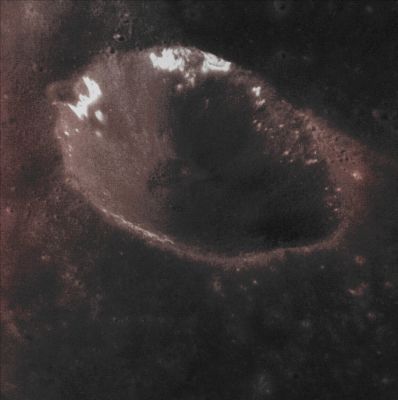
Unnamed Crater with Hollows (Absolute Natural Colors; credits for the additional process. and color.: Dr Paolo C. Fienga/Lunar Explorer Italia/Italian Planetary Foundation)
This frame, obtained by the NASA - MESSENGER Spacecraft on Frebruary, 25, 2014, which shows us a Mercurian Northern Hemisphere's Unnamed Impact Crater - approx. 12,5 Km - such as about 7,76 miles in diameter -, suggested a question that we would like to ask you as much as ourselves: do those extremely common and bright (---> highly reflective) Mercurian Surface Features known as "Hollows" form preferentially on those Crater Walls (---> Inner and Outer Slopes as wll as thier Rims) which receive a more direct (---> and therefore intense) Sunlight? 

In the Northern Hemisphere of Mercury, the Northern Walls of the Impact Craters are frequently flooded by a very intense Sunlight (meaning that they are almost always VERY well illuminated), while their Southern Walls only receive grazing Sunlight and therefore they are more often in Shadow; on the other hand (and we just say, "obviously"), in the Mercurian Southern Hemisphere, the Impact Craters' Northern Walls are the ones which receive just grazing Sunlight (and therefore are much less illuminated) while the Southern Walls get more direct (and therefore stronger) Sunlight. Said that, Planetary Scientists, on the base of their observations (mostly founded on the NASA - MESSENGER Spacecraft's images), believe that the greater the Solar Heating is experienced by the Walls of any given Impact Crater, the more Hollows will form on its (both Inner and Outer) Slopes and Rims (in other words: the direct Solar Illumination should reasonably be an important - if not decisive - factor in the formation of Hollows on the Walls of the Impact Craters located on both Mercury's Hemispheres). 

Images like the one here can help us to answer this question and what we see in today's APOD is found in an area of focus (---> interest) for the current NASA - MESSENGER Spacecraft's Low-Altitude Imaging Campaign. Perhaps, in the (near) future, we may know more about all this: let's just wait an see what happens...

Date acquired: February, 25th, 2014
Image Mission Elapsed Time (MET): 35646241
Image ID: 5828285
Instrument: Narrow Angle Camera (NAC) of the Mercury Dual Imaging System (MDIS)
Center Latitude: 42,92° North
Center Longitude: 330,90° East
Solar Incidence Angle: 43,5° (meaning that the Sun, at the time that the picture was taken, was about 46,5° above the imaged Local Mercurian Horizon)
Emission Angle: 46,1°
Sun-Mercury-Messenger (or "Phase") Angle: 30,1

This picture (which is an Original NASA - MESSENGER Spacecraft's b/w and NON-Map-Projected image published on the NASA - Planetary Photojournal with the ID n. PIA 18247) has been additionally processed, contrast enhanced, Gamma corrected, magnified to aid the visibility of the details and then colorized in Absolute Natural Colors (such as the colors that a human eye would actually perceive if someone were onboard the NASA - MESSENGER Spacecraft and then looked outside, towards the Surface of Mercury), by using an original technique created - and, in time, dramatically improved - by the Lunar Explorer Italia Team. Different colors, as well as different shades of the same color, mean, among other things, the existence of different Elements (Minerals) present on the Surface of Mercury, each having a different Albedo (---> Reflectivity) and Chemical Composition.
Parole chiave: Mercury from orbit - Craters - Unnamed Crater with Hollows

Unnamed Crater with Hollows (Absolute Natural Colors; credits for the additional process. and color.: Dr Paolo C. Fienga/Lunar Explorer Italia/Italian Planetary Foundation)

This frame, obtained by the NASA - MESSENGER Spacecraft on Frebruary, 25, 2014, which shows us a Mercurian Northern Hemisphere's Unnamed Impact Crater - approx. 12,5 Km - such as about 7,76 miles in diameter -, suggested a question that we would like to ask you as much as ourselves: do those extremely common and bright (---> highly reflective) Mercurian Surface Features known as "Hollows" form preferentially on those Crater Walls (---> Inner and Outer Slopes as wll as thier Rims) which receive a more direct (---> and therefore intense) Sunlight?

In the Northern Hemisphere of Mercury, the Northern Walls of the Impact Craters are frequently flooded by a very intense Sunlight (meaning that they are almost always VERY well illuminated), while their Southern Walls only receive grazing Sunlight and therefore they are more often in Shadow; on the other hand (and we just say, "obviously"), in the Mercurian Southern Hemisphere, the Impact Craters' Northern Walls are the ones which receive just grazing Sunlight (and therefore are much less illuminated) while the Southern Walls get more direct (and therefore stronger) Sunlight. Said that, Planetary Scientists, on the base of their observations (mostly founded on the NASA - MESSENGER Spacecraft's images), believe that the greater the Solar Heating is experienced by the Walls of any given Impact Crater, the more Hollows will form on its (both Inner and Outer) Slopes and Rims (in other words: the direct Solar Illumination should reasonably be an important - if not decisive - factor in the formation of Hollows on the Walls of the Impact Craters located on both Mercury's Hemispheres).

Images like the one here can help us to answer this question and what we see in today's APOD is found in an area of focus (---> interest) for the current NASA - MESSENGER Spacecraft's Low-Altitude Imaging Campaign. Perhaps, in the (near) future, we may know more about all this: let's just wait an see what happens...

Date acquired: February, 25th, 2014
Image Mission Elapsed Time (MET): 35646241
Image ID: 5828285
Instrument: Narrow Angle Camera (NAC) of the Mercury Dual Imaging System (MDIS)
Center Latitude: 42,92° North
Center Longitude: 330,90° East
Solar Incidence Angle: 43,5° (meaning that the Sun, at the time that the picture was taken, was about 46,5° above the imaged Local Mercurian Horizon)
Emission Angle: 46,1°
Sun-Mercury-Messenger (or "Phase") Angle: 30,1

This picture (which is an Original NASA - MESSENGER Spacecraft's b/w and NON-Map-Projected image published on the NASA - Planetary Photojournal with the ID n. PIA 18247) has been additionally processed, contrast enhanced, Gamma corrected, magnified to aid the visibility of the details and then colorized in Absolute Natural Colors (such as the colors that a human eye would actually perceive if someone were onboard the NASA - MESSENGER Spacecraft and then looked outside, towards the Surface of Mercury), by using an original technique created - and, in time, dramatically improved - by the Lunar Explorer Italia Team. Different colors, as well as different shades of the same color, mean, among other things, the existence of different Elements (Minerals) present on the Surface of Mercury, each having a different Albedo (---> Reflectivity) and Chemical Composition.

ZZ-Mercury-Craters-Unnamed_Crater-PIA17290-PCF-LXTT-IPF-1.jpg ZZ-Mercury-Craters-Unnamed_Crater-PIA18246-PCF-LXTT-IPF.jpg ZZ-Mercury-Craters-Unnamed_Crater-PIA18247-PCF-LXTT-IPF.jpg ZZ-Mercury-Craters-Unnamed_Crater-PIA18372-PCF-LXTT-IPF.jpg ZZ-Mercury-Craters-Unnamed_Crater_with_Hollows-PIA15069-PCF-LXTT.jpg
Informazioni sul file
Nome del file:ZZ-Mercury-Craters-Unnamed_Crater-PIA18247-PCF-LXTT-IPF.jpg
Nome album:MareKromium / Mercury
Valutazione (4 voti):55555(Mostra dettagli)
Parole chiave:Mercury / from / orbit / - / Craters / - / Unnamed / Crater / with / Hollows
Copyright:NASA/Johns Hopkins University Applied Physics Laboratory/Carnegie Institution of Washington and Dr Paolo C. Fienga/LXTT/IPF for the additional process. and color.
Dimensione del file:921 KiB
Data di inserimento:Mag 07, 2014
Dimensioni:2986 x 2998 pixels
Visualizzato:63 volte
URL:https://www.lunexit.it/gallery/displayimage.php?pid=31205
Preferiti:Aggiungi ai preferiti


Powered by Coppermine Photo Gallery