Inizio Registrati Login

Elenco album Ultimi arrivi Ultimi commenti Più viste Più votate Preferiti Cerca

Inizio > MARS > Mars Reconnaissance Orbiter (MRO)
Ritorna alla pagina delle miniature FILE 1069/2237 Torna all'inizio Guarda foto precedente Guarda foto successiva Salta alla fine
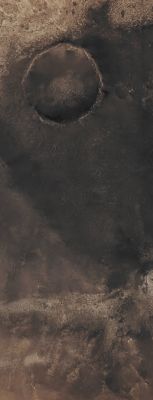
Features of Meridiani Planum (Absolute Natural Colors; credits for the additional process. and color.: Dr Paolo C. Fienga/Lunar Explorer Italia/Italian Planetary Foundation)
In this frame, taken by the NASA - Mars Reconnaissance Orbiter on the date of June, 1st, 2013, we can see a few interesting (although very common) Surface Features which characterize the Meridiani Planum Region of Mars. In particular, we can see an old and (still) Unnamed Impact Crater - with the "usual" Dunefield on its Floor - that is located on the very upper portion of the frame and just below a (relatively) Sand-free section of Surface known as "Martian Paving". Afterwards, moving down towards the South (such as towards the lower portion of the frame), we can find an area where there are many Sand Ripples and a few small Impact Craters. Finally, on the very lowest portion of the picture, we can also see more Sand Ripples, a number of Sand Dunes, several very small Impact Craters and quite a few Rocky Outcrops. 
However, the Martian Surface pictured here, in our opinion (as IPF), and contrary to the common idea of how the Meridiani Planum Region of Mars is - generally - characterized and known (such as an almost totally plain and reliefs-free Region), is really far from being flat at all: as a matter of fact, if you observe the picture carefully, you will be able to notice that the whole area which has been photographed by the NASA - Mars Reconnaissance Orbiter (and, particularly, the area visible in the central and lower portion of the frame - meaning the one located to the South of the main visible Feature, such as the Unnamed Impact Crater) appears to show several points of Subsidence, a few Ridges and some (most likely very short and small) Hillocks.

Mars Local Time: 14:09 (Early Afternoon)
Coord. (centered): 1,584° South Lat. and 3,132° East Long.
Spacecraft altitude: 268,9 Km (such as about 166,986 miles) 
Original image scale range: 26,9 cm/pixel (with 1 x 1 binning) so objects ~ 81 cm across are resolved
Map projected scale: 25 cm/pixel
Map projection: EQUIRECTANGULAR
Emission Angle: 0,0° 
Phase Angle: 34,0°
Solar Incidence Angle: 34° (meaning that the Sun was about 56° above the Local Horizon at the time the picture was taken)
Solar Longitude: 328,5° (Northern Winter - Southern Summer)
Credits: NASA/JPL/University of Arizona
Additional process. and coloring: Lunar Explorer Italia

This picturee (which is a NASA - Original Mars Reconnaissance Orbiter NON-Map Projected b/w frame identified by the serial n. ESP_032098_1785) has been additionally processed and then colorized in Absolute Natural Colors (such as the colors that a human eye would actually perceive if someone were onboard the NASA - Mars Reconnaissance Orbiter and then looked down, towards the Surface of Mars), by using an original technique created - and, in time, dramatically improved - by the Lunar Explorer Italia Team.
Parole chiave: Mars from orbit - Meridiani Planum Region

Features of Meridiani Planum (Absolute Natural Colors; credits for the additional process. and color.: Dr Paolo C. Fienga/Lunar Explorer Italia/Italian Planetary Foundation)

In this frame, taken by the NASA - Mars Reconnaissance Orbiter on the date of June, 1st, 2013, we can see a few interesting (although very common) Surface Features which characterize the Meridiani Planum Region of Mars. In particular, we can see an old and (still) Unnamed Impact Crater - with the "usual" Dunefield on its Floor - that is located on the very upper portion of the frame and just below a (relatively) Sand-free section of Surface known as "Martian Paving". Afterwards, moving down towards the South (such as towards the lower portion of the frame), we can find an area where there are many Sand Ripples and a few small Impact Craters. Finally, on the very lowest portion of the picture, we can also see more Sand Ripples, a number of Sand Dunes, several very small Impact Craters and quite a few Rocky Outcrops.
However, the Martian Surface pictured here, in our opinion (as IPF), and contrary to the common idea of how the Meridiani Planum Region of Mars is - generally - characterized and known (such as an almost totally plain and reliefs-free Region), is really far from being flat at all: as a matter of fact, if you observe the picture carefully, you will be able to notice that the whole area which has been photographed by the NASA - Mars Reconnaissance Orbiter (and, particularly, the area visible in the central and lower portion of the frame - meaning the one located to the South of the main visible Feature, such as the Unnamed Impact Crater) appears to show several points of Subsidence, a few Ridges and some (most likely very short and small) Hillocks.

Mars Local Time: 14:09 (Early Afternoon)
Coord. (centered): 1,584° South Lat. and 3,132° East Long.
Spacecraft altitude: 268,9 Km (such as about 166,986 miles)
Original image scale range: 26,9 cm/pixel (with 1 x 1 binning) so objects ~ 81 cm across are resolved
Map projected scale: 25 cm/pixel
Map projection: EQUIRECTANGULAR
Emission Angle: 0,0°
Phase Angle: 34,0°
Solar Incidence Angle: 34° (meaning that the Sun was about 56° above the Local Horizon at the time the picture was taken)
Solar Longitude: 328,5° (Northern Winter - Southern Summer)
Credits: NASA/JPL/University of Arizona
Additional process. and coloring: Lunar Explorer Italia

This picturee (which is a NASA - Original Mars Reconnaissance Orbiter NON-Map Projected b/w frame identified by the serial n. ESP_032098_1785) has been additionally processed and then colorized in Absolute Natural Colors (such as the colors that a human eye would actually perceive if someone were onboard the NASA - Mars Reconnaissance Orbiter and then looked down, towards the Surface of Mars), by using an original technique created - and, in time, dramatically improved - by the Lunar Explorer Italia Team.

Mawrth_Vallis-The_Waterfall-CC.gif Mawrth_Vallis.jpg Meridiani_Planum-ESP_032098_1785-PCF-LXTT-IPF.jpg Meridiani_Planum-PIA13598-PCF-LXTT.jpg Mud_Volcano-MRO.jpg
Informazioni sul file
Nome del file:Meridiani_Planum-ESP_032098_1785-PCF-LXTT-IPF.jpg
Nome album:MareKromium / Mars Reconnaissance Orbiter (MRO)
Valutazione (3 voti):55555(Mostra dettagli)
Parole chiave:Mars / from / orbit / - / Meridiani / Planum / Region
Copyright:NASA/JPL/Univ. of Arizona e Dr Paolo C. Fienga - Lunar Explorer Italia/IPF per l'additional process. e la colorizzazione
Dimensione del file:639 KiB
Data di inserimento:Lug 14, 2013
Dimensioni:1148 x 2990 pixels
Visualizzato:86 volte
URL:https://www.lunexit.it/gallery/displayimage.php?pid=31129
Preferiti:Aggiungi ai preferiti

Commento 1 a 5 di 5
Pagina: 1

cano00   [Ago 20, 2013 at 07:23 PM]
poco sopra il cratere,allargando bene l'immaghine, sulla sinistra per chi guarda, compaiono tre strane "apertura"ben riquadrate, due parzialmente insabbiate ma la prima molto ben definita. parrebbero portali! effetti otticici o cosa?
cicas65   [Ago 25, 2013 at 10:30 AM]
si le vedo anche io!
cano00   [Ago 25, 2013 at 02:51 PM]
un poco tutta l?area circostante i "portali"presenta strane formazioni!! ci vorrebbe un po più di nitidezza!!!
paolocf1963   [Ago 25, 2013 at 04:58 PM]
Cerco l'originale, isolo il dettaglio e lo pubblico in magnificazione x5. Abbraccio Forte a Voi! paolo
Anakin   [Ago 26, 2013 at 08:48 AM]
io non vedo nulla :(

Commento 1 a 5 di 5
Pagina: 1


Powered by Coppermine Photo Gallery