Inizio Registrati Login

Elenco album Ultimi arrivi Ultimi commenti Più viste Più votate Preferiti Cerca

Inizio > MARS > Mars from Orbit (from July 2009)
Ritorna alla pagina delle miniature FILE 957/1003 Torna all'inizio Guarda foto precedente Guarda foto successiva Salta alla fine
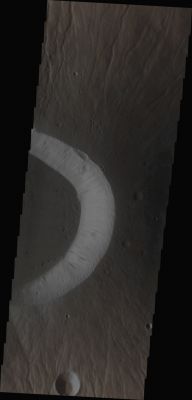
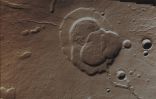
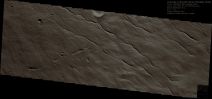
The Eastern Side of Ceraunius Tholus' Summit Caldera (Absolute Natural Colors; credits for the additional process. and color.: Dr Paolo C. Fienga/Lunar Explorer Italia/Italian Planetary Foundation)
This image (taken by the NASA - Mars Odyssey Orbiter during its 47827th orbit around the Red Planet) shows us the Eastern Side of the Summit Caldera of a Volcano known as Ceraunius Tholus (which is part, jointly with Uranius Mons and Uranius Tholus, of the so-called "Uranius Group of Volcanoes"). Ceraunius Tholus is approx. 130 Km across and approx. 5,5 Km high; it was so named after a Classical Albedo Feature and it is located in the Tharsis Quadrangle of Mars. Ceraunius Tholus is generally believed to be a Basaltic Shield-Volcano with the lower part buried beneath the lava-formed Plains forming. Earlier interpretations suggested also that it may be a "Stratovolcano". The Slopes on Ceraunius Tholus are quite steep with an average slope of 8° and with many Radial Erosional Channels and Pitted Valleys extending from just below the Rim of the Caldera, toward the base of the Volcano. The current view, however, is that the Valleys were eroded by Water. Interesting features that characterize Ceraunius Tholus are 3 (three) large Canyons located on the North/Western Flank of the Volcano and which are up to approx. 2,5 km wide and 300 meters deep. The biggest of these 3 (three) Canyons also appears to be the youngest one; it protrudes from the lowest point of the Volcanic Summit Caldera and it ends at the interesting Rahe Crater (an oblique Impact Crater with measures of about 35 × 18 Km), just North from the Volcano, where it formed a Depositional Fan. Its origin is (let us say, "obviously") still debatable and there are at least 3 (three) Main Models proposed to explain it: Creation by way of Fluvial Action, Volcanic (---> Lava) Flows or a combination of both of them. The Caldera of Ceranius Tholus is also dotted with many Collapse Pits (NOT visible in this frame), which, as you should know, are distinct from Impact Craters since they have no Rim and vary in abundance all across the Caldera. Some scientists believe that Glaciers may have existed on many of the Volcanoes located in the District of Tharsis, including Olympus Mons, Ascraeus Mons, and Pavonis Mons. Ceraunius Tholus, on uts side, may also have had its Glaciers Melt to form some temporary Lakes in the past. In fact, the smoothness and flatness of the Ceraunius Tholus' Summit Caldera Floor strongly suggests that, in a far and distant past, some meltwater might actually have accumulated over there, thus forming a so-called (and just temporary, as we said before) "Caldera Lake".

Latitude (centered): 24,0691° North
Longitude: 263,105° East 
Instrument: VIS 
Captured: September, 25th, 2012

This frame (which is an Original Mars Odyssey Orbiter b/w frame published on the NASA - Planetary Photojournal with the ID n. PIA 16595) has been additionally processed and then colorized in Absolute Natural Colors (such as the colors that a human eye would actually perceive if someone were onboard the NASA - Mars Odyssey Orbiter and then looked down, towards the Surface of Mars), by using an original technique created - and, in time, dramatically improved - by the Lunar Explorer Italia Team.
Parole chiave: Mars from orbit - Volcanoes - Ceraunius Tholus

The Eastern Side of Ceraunius Tholus' Summit Caldera (Absolute Natural Colors; credits for the additional process. and color.: Dr Paolo C. Fienga/Lunar Explorer Italia/Italian Planetary Foundation)

This image (taken by the NASA - Mars Odyssey Orbiter during its 47827th orbit around the Red Planet) shows us the Eastern Side of the Summit Caldera of a Volcano known as Ceraunius Tholus (which is part, jointly with Uranius Mons and Uranius Tholus, of the so-called "Uranius Group of Volcanoes"). Ceraunius Tholus is approx. 130 Km across and approx. 5,5 Km high; it was so named after a Classical Albedo Feature and it is located in the Tharsis Quadrangle of Mars. Ceraunius Tholus is generally believed to be a Basaltic Shield-Volcano with the lower part buried beneath the lava-formed Plains forming. Earlier interpretations suggested also that it may be a "Stratovolcano". The Slopes on Ceraunius Tholus are quite steep with an average slope of 8° and with many Radial Erosional Channels and Pitted Valleys extending from just below the Rim of the Caldera, toward the base of the Volcano. The current view, however, is that the Valleys were eroded by Water. Interesting features that characterize Ceraunius Tholus are 3 (three) large Canyons located on the North/Western Flank of the Volcano and which are up to approx. 2,5 km wide and 300 meters deep. The biggest of these 3 (three) Canyons also appears to be the youngest one; it protrudes from the lowest point of the Volcanic Summit Caldera and it ends at the interesting Rahe Crater (an oblique Impact Crater with measures of about 35 × 18 Km), just North from the Volcano, where it formed a Depositional Fan. Its origin is (let us say, "obviously") still debatable and there are at least 3 (three) Main Models proposed to explain it: Creation by way of Fluvial Action, Volcanic (---> Lava) Flows or a combination of both of them. The Caldera of Ceranius Tholus is also dotted with many Collapse Pits (NOT visible in this frame), which, as you should know, are distinct from Impact Craters since they have no Rim and vary in abundance all across the Caldera. Some scientists believe that Glaciers may have existed on many of the Volcanoes located in the District of Tharsis, including Olympus Mons, Ascraeus Mons, and Pavonis Mons. Ceraunius Tholus, on uts side, may also have had its Glaciers Melt to form some temporary Lakes in the past. In fact, the smoothness and flatness of the Ceraunius Tholus' Summit Caldera Floor strongly suggests that, in a far and distant past, some meltwater might actually have accumulated over there, thus forming a so-called (and just temporary, as we said before) "Caldera Lake".

Latitude (centered): 24,0691° North
Longitude: 263,105° East
Instrument: VIS
Captured: September, 25th, 2012

This frame (which is an Original Mars Odyssey Orbiter b/w frame published on the NASA - Planetary Photojournal with the ID n. PIA 16595) has been additionally processed and then colorized in Absolute Natural Colors (such as the colors that a human eye would actually perceive if someone were onboard the NASA - Mars Odyssey Orbiter and then looked down, towards the Surface of Mars), by using an original technique created - and, in time, dramatically improved - by the Lunar Explorer Italia Team.

Volcanoes-Ceraunius_Tholus-01.jpg Volcanoes-Ceraunius_Tholus-PIA13433-PCF-LXTT.jpg Volcanoes-Ceraunius_Tholus-Summit-PIA16595-PCF-LXTT-IPF.jpg Volcanoes-HecatesTolus-PIA02683-1.jpg Volcanoes-Hecates_Tholus-Channels-20080702a-PCF-LXTT.jpg
Informazioni sul file
Nome del file:Volcanoes-Ceraunius_Tholus-Summit-PIA16595-PCF-LXTT-IPF.jpg
Nome album:MareKromium / Mars from Orbit (from July 2009)
Valutazione (3 voti):55555(Mostra dettagli)
Parole chiave:Mars / from / orbit / - / Volcanoes / - / Ceraunius / Tholus
Copyright:NASA/JPL/ASU and Dr Paolo C. Fienga - Lunar Explorer Italia/Italian Planetary Foundation per l'additional processing e la colorizzazione
Dimensione del file:220 KiB
Data di inserimento:Dic 19, 2012
Dimensioni:1442 x 3000 pixels
Visualizzato:69 volte
URL:https://www.lunexit.it/gallery/displayimage.php?pid=30939
Preferiti:Aggiungi ai preferiti


Powered by Coppermine Photo Gallery