Inizio Registrati Login

Elenco album Ultimi arrivi Ultimi commenti Più viste Più votate Preferiti Cerca

Inizio > MARS > Mars from Orbit (from July 2009)
Ritorna alla pagina delle miniature FILE 881/1003 Torna all'inizio Guarda foto precedente Guarda foto successiva Salta alla fine
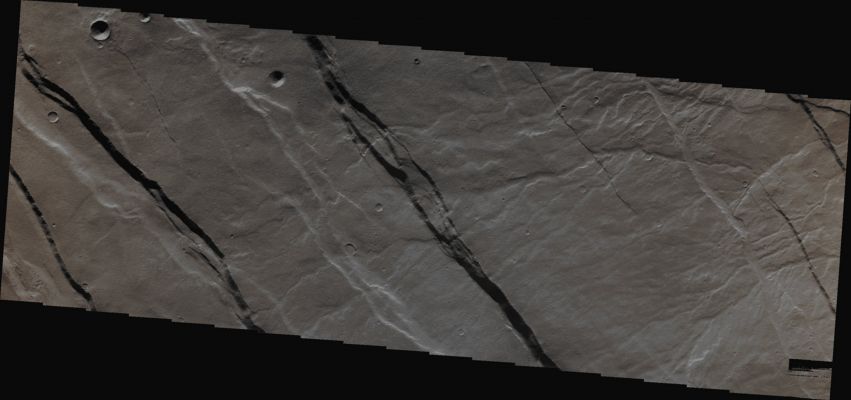
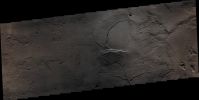
Fractures near and around Alba Mons (Absolute Natural Colors; credits for the additional process. and color.: Dr Paolo C. Fienga - Lunar Explorer Italia - Italian Planetary Foundation)
In addition to its great size (consider that its Lava Flow Fields extend from over than 1400 Km from the Summit) and relatively low relief (the Summit of the Volcano reaches an elevation of "only" 6,8 Km as to the surrounding Lava Plains), Alba Mons possesses a number of other very distinguishing features. For instance, the central portion of the Volcano is surrounded by an incomplete Ring of Faults (---> Graben) and Fractures (like the ones that we see in today's APOD), called Alba Fossae (the ones located on the Volcano's Western Flank), and Tantalus Fossae (which are found on its Eastern Flank). 
Alba Mons also has very long and well preserved Lava Flows that form a Radiating Pattern, starting from its Central Region. The enormous lengths of some individual Flow (something more than 300 Km - such as about 190 miles) implies that the Lavas which formed them were not only very fluid (---> meaning that they possessed very Low Viscosity) at the time of the eruption, but that they also must have been erupted in an extremely high volume (---> quantity). Many of the Flows have distinctive morphologies, consisting of long, sinuous Ridges with discontinuous Central Lava Channels. The low areas between the Ridges (and particularly along the Alba's Northern Flank) show a branching pattern of shallow Gullies and Channels (---> Valley Networks) that likely formed by water runoff. Last, but not least, Alba Mons shows, among other things, some of the oldest, and most extensively exposed Deposits that can be found in the whole Volcanic District of Tharsis.

Orbit Number: 47503
Latitude: 45,2558° North
Longitude: 248,587° East 
Instrument: VIS 
Captured: August, 29th, 2012

This frame (which is an Original Mars Odyssey Orbiter b/w frame published on the NASA - Planetary Photojournal with the ID n. PIA 16499) has been additionally processed and then colorized in Absolute Natural Colors (such as the colors that a human eye would actually perceive if someone were onboard the NASA - Mars Odyssey Orbiter and then looked down, towards the Surface of Mars), by using an original technique created - and, in time, dramatically improved - by the Lunar Explorer Italia Team.
Parole chiave: Mars from orbit - Volcanic Features - Fractures - Alba Fossae

Fractures near and around Alba Mons (Absolute Natural Colors; credits for the additional process. and color.: Dr Paolo C. Fienga - Lunar Explorer Italia - Italian Planetary Foundation)

In addition to its great size (consider that its Lava Flow Fields extend from over than 1400 Km from the Summit) and relatively low relief (the Summit of the Volcano reaches an elevation of "only" 6,8 Km as to the surrounding Lava Plains), Alba Mons possesses a number of other very distinguishing features. For instance, the central portion of the Volcano is surrounded by an incomplete Ring of Faults (---> Graben) and Fractures (like the ones that we see in today's APOD), called Alba Fossae (the ones located on the Volcano's Western Flank), and Tantalus Fossae (which are found on its Eastern Flank).
Alba Mons also has very long and well preserved Lava Flows that form a Radiating Pattern, starting from its Central Region. The enormous lengths of some individual Flow (something more than 300 Km - such as about 190 miles) implies that the Lavas which formed them were not only very fluid (---> meaning that they possessed very Low Viscosity) at the time of the eruption, but that they also must have been erupted in an extremely high volume (---> quantity). Many of the Flows have distinctive morphologies, consisting of long, sinuous Ridges with discontinuous Central Lava Channels. The low areas between the Ridges (and particularly along the Alba's Northern Flank) show a branching pattern of shallow Gullies and Channels (---> Valley Networks) that likely formed by water runoff. Last, but not least, Alba Mons shows, among other things, some of the oldest, and most extensively exposed Deposits that can be found in the whole Volcanic District of Tharsis.

Orbit Number: 47503
Latitude: 45,2558° North
Longitude: 248,587° East
Instrument: VIS
Captured: August, 29th, 2012

This frame (which is an Original Mars Odyssey Orbiter b/w frame published on the NASA - Planetary Photojournal with the ID n. PIA 16499) has been additionally processed and then colorized in Absolute Natural Colors (such as the colors that a human eye would actually perceive if someone were onboard the NASA - Mars Odyssey Orbiter and then looked down, towards the Surface of Mars), by using an original technique created - and, in time, dramatically improved - by the Lunar Explorer Italia Team.

Volcanic_Features-Escarpment-OM-PIA16651-PCF-LXTT-IPF.jpg Volcanic_Features-Faults-Alba_Patera-PCF-LXTT.jpg Volcanic_Features-Fractures-AM-PIA16499-PCF-LXTT-IPF.jpg Volcanic_Features-Fractures-BC-20080715a.jpg Volcanic_Features-Fractures-Echus_Montes-PIA15165-PCF-LXTT.jpg
Informazioni sul file
Nome del file:Volcanic_Features-Fractures-AM-PIA16499-PCF-LXTT-IPF.jpg
Nome album:MareKromium / Mars from Orbit (from July 2009)
Valutazione (3 voti):55555(Mostra dettagli)
Parole chiave:Mars / from / orbit / - / Volcanic / Features / - / Fractures / - / Alba / Fossae
Copyright:NASA/JPL/ASU - Dr Paolo C. Fienga per l'additional processing e la colorizzazione del frame
Dimensione del file:364 KiB
Data di inserimento:Nov 24, 2012
Dimensioni:2930 x 1376 pixels
Visualizzato:78 volte
URL:https://www.lunexit.it/gallery/displayimage.php?pid=30901
Preferiti:Aggiungi ai preferiti


Powered by Coppermine Photo Gallery