Inizio Registrati Login

Elenco album Ultimi arrivi Ultimi commenti Più viste Più votate Preferiti Cerca

Inizio > MARS > Mars Reconnaissance Orbiter (MRO)
Ritorna alla pagina delle miniature FILE 1027/2237 Torna all'inizio Guarda foto precedente Guarda foto successiva Salta alla fine
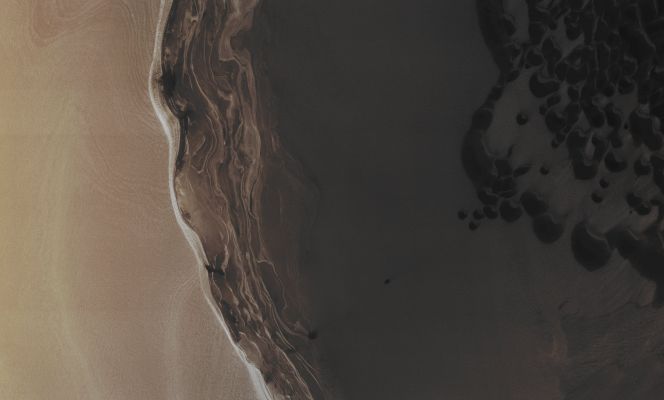
Features of the North Polar Regions (Absolute Natural Colors; credits for the additional process. and color.: Dr Paolo C. Fienga/Lunexit Team)
There is an Ice-Sheet at the North Pole of Mars that is a few miles thick at its center. At some places (like in this image) it ends in steep Cliffs that can be about 800 meters (2600 feet) high. 
The Slopes of these Cliffs are almost vertical, which causes "Slab-like Blocks" of Ice to periodically (and, actually, quite often) break off and crash down onto the Surrounding Plains. 
A dense Network of Cracks covers these Icy Cliff faces, thus making it easier for these Blocks to break free. New piles of Debris (located at the base of many of these Cliffs) have appeared in successive HiRISE images, and so the MRO Team shall regularly monitor sites like this in order to check for new Blocks that might have fallen. Understanding how these Cliffs are formed can help Scientists to better understand the "Climatic Record" which are stored in the Ice-Sheet itself.

Mars Local Time: 13:44 (Early Afternoon)
Coord. (centered): 83,618° North Lat. and 119,827° East Long.
Spacecraft altitude: 320,5 Km (such as about 200,3 miles) 
Original image scale range: 32,1 cm/pixel (with 1 x 1 binning) so objects ~ 96 cm across are resolved
Map projected scale: 25 cm/pixel
Map projection: POLAR STEREOGRAPHIC
Emission Angle: 0,1° 
Sun - Mars - MRO (or "Phase") Angle: 62,8°
Solar Incidence Angle: 63° (meaning that the Sun is about 27° above the Local Horizon)
Solar Longitude: 120,0° (Northern Summer - Southern Winter)
Credits: NASA/JPL/University of Arizona
Additional process. and coloring: Lunar Explorer Italia
Parole chiave: Mars from orbit - North Polar Regions - Scarp

Features of the North Polar Regions (Absolute Natural Colors; credits for the additional process. and color.: Dr Paolo C. Fienga/Lunexit Team)

There is an Ice-Sheet at the North Pole of Mars that is a few miles thick at its center. At some places (like in this image) it ends in steep Cliffs that can be about 800 meters (2600 feet) high.
The Slopes of these Cliffs are almost vertical, which causes "Slab-like Blocks" of Ice to periodically (and, actually, quite often) break off and crash down onto the Surrounding Plains.
A dense Network of Cracks covers these Icy Cliff faces, thus making it easier for these Blocks to break free. New piles of Debris (located at the base of many of these Cliffs) have appeared in successive HiRISE images, and so the MRO Team shall regularly monitor sites like this in order to check for new Blocks that might have fallen. Understanding how these Cliffs are formed can help Scientists to better understand the "Climatic Record" which are stored in the Ice-Sheet itself.

Mars Local Time: 13:44 (Early Afternoon)
Coord. (centered): 83,618° North Lat. and 119,827° East Long.
Spacecraft altitude: 320,5 Km (such as about 200,3 miles)
Original image scale range: 32,1 cm/pixel (with 1 x 1 binning) so objects ~ 96 cm across are resolved
Map projected scale: 25 cm/pixel
Map projection: POLAR STEREOGRAPHIC
Emission Angle: 0,1°
Sun - Mars - MRO (or "Phase") Angle: 62,8°
Solar Incidence Angle: 63° (meaning that the Sun is about 27° above the Local Horizon)
Solar Longitude: 120,0° (Northern Summer - Southern Winter)
Credits: NASA/JPL/University of Arizona
Additional process. and coloring: Lunar Explorer Italia

ESP_027378_2540-PCF-LXTT-IPF-1B.jpg ESP_027378_2540-PCF-LXTT-IPF-2.jpg ESP_027451_2635_RED-PCF-LXTT-IPF.jpg ESP_027758_1530-1-PCF-LXTT-IPF.jpg ESP_027758_1530-2-PCF-LXTT-IPF.jpg
Informazioni sul file
Nome del file:ESP_027451_2635_RED-PCF-LXTT-IPF.jpg
Nome album:MareKromium / Mars Reconnaissance Orbiter (MRO)
Valutazione (4 voti):55555(Mostra dettagli)
Parole chiave:Mars / from / orbit / - / North / Polar / Regions / - / Scarp
Copyright:NASA/JPL/Univ. of Arizona e Dr Paolo C. Fienga - Lunar Explorer Italia per l'additional process. e la colorizzazione
Dimensione del file:732 KiB
Data di inserimento:Lug 18, 2012
Dimensioni:3000 x 1805 pixels
Visualizzato:100 volte
URL:https://www.lunexit.it/gallery/displayimage.php?pid=30736
Preferiti:Aggiungi ai preferiti


Powered by Coppermine Photo Gallery