|
|
NOT ALONE!
|
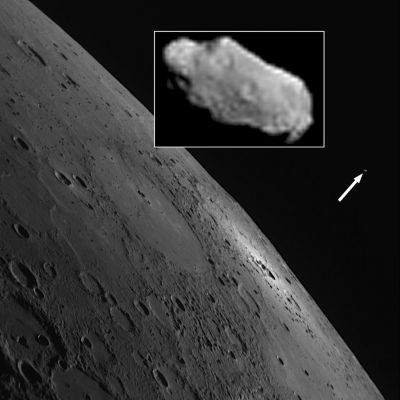
Caption NASA:"This discovery image provides the first evidence that Mercury has a small natural satellite or moon. Visible as a small bright spot in an image taken yesterday by the Mercury Dual Imaging System (MDIS) Wide Angle Camera (WAC), the moon is approximately 70 meters (230 feet) in diameter and orbits Mercury at a mean distance of 14.300 Km (such as 8890 miles). A proposal to name the moon "Caduceus", after the staff carried by the Roman god Mercury, has been submitted by the MESSENGER team to the International Astronomical Union, the body responsible for assigning names to celestial objects.
This discovery presents an unprecedented opportunity for a return of samples from the Mercury System, as Project Scientist Nat MacRulf explains. "We have yet to identify a sample from Mercury in any of the meteorite collections we have here on Earth. Such a sample would give us critical insight into the chemical composition of Mercury and the timing of crustal formation on that body, leading to a better understanding of how the planet formed and evolved. If we could obtain a sample of Caduceus, it would enhance the scientific return of the MESSENGER mission beyond our wildest dreams!"
Work on designing a scenario for sample return is already underway. MESSENGER Project Manager Burt Panini held an emergency meeting with the MESSENGER mission operations and navigation teams yesterday evening to determine if the spacecraft could be targeted toward the diminutive moon. After an intensive discussion, a unanimous decision was taken to abandon the orbit-correction maneuvers that had been planned for later this month to place the spacecraft in an eight-hour orbit. Instead, the new plan is to use the remaining propellant to crash MESSENGER into Caduceus. "Our detailed analysis tells us that if we act now, and with the right trajectory, MESSENGER will impart just enough momentum to the moon to break it free of Mercury's Gravity well and set it on an Earth-crossing trajectory suitable for recovery as a Mercury meteorite", said Panini.
This action will form the basis of a new request to NASA by the MESSENGER team for an extended extended mission, tentatively called "MESSENGER Infinitesimally Nudging Caduceus", or MIN-C for short. Once MIN-C is approved by NASA, the Spacecraft will be targeted for a collision trajectory. If Caduceus is successfully released from the pull of Mercury and placed on a course to reach Earth, we can expect the moon to arrive at Earth by 2014. "The risk to the public is reassuringly small", offers MESSENGER mission design lead Adam McJames. "We have designed a trajectory that will bring the moon to Earth at a remote location on the Wilkes Land ice sheet in Antarctica. This trajectory will avoid all population centers and will put the moon's impact site within reach for retrieval by the scientific staff at the U.S.-operated McMurdo Station".
If successful, MESSENGER's extended extended MIN-C mission will mark the first instance of the documented arrival to Earth of material from the Mercury system. Moreover, it will serve as the basis for a new Discovery-class mission proposal currently in development by the Applied Psychics Laboratory for a Mercury lander mission for in situ X-ray analysis of surface composition. That mission is to be named the Hermean On-surface Analysis with X-rays.
Date acquired: March 31, 2012
Image Mission Elapsed Time (MET): 131766564
Image ID: 6418
Instrument: Wide Angle Camera (WAC) of the Mercury Dual Imaging System (MDIS)
Center Latitude: 38,15° North
Center Longitude: 66,18° East
Resolution: 410 meters/pixel (0,25 miles/pixel) in the lower left corner of the image
Scale: the large crater in the center of the image (Copland) is about 210 Km (such as approx. 130 miles) in diameter.
Spacecraft Altitude: 16.200 Km (10.070 miles)
Incidence Angle: 69,1°
Emission Angle: 80,8°
Phase Angle: 138,2°
|
|









secondo me - ho riflettuto un bel pò.... - non ci sono errori: si tratta di due Corpi Celesti profondamente diversi (dimensionalmente) ma profondamente simili nella sagoma e nelle caratterizzazioni superficiali.
Cosa adduco a sostegno di questa (interlocutoria, per ora) conclusione? Una storiella che sentii all'Università, tanti anni fa, che un pò si attaglia alla nostra situazione. Allora...
Domanda: se siete su una spiaggia e cercate due granuli di sabbia identici, quante possibilità avete di trovarli?
Risposta: nessuna.
Domanda: se siete su una spiaggia e cercate due granuli di sabbia simili, quante possibilità avete di trovarli?
Risposta: tendenti ad infinito.
L'Universo è la nostra spiaggia; i granuli di sabbia sono i Corpi Celesti che lo popolano. Le domande (e relative risposte, secondo me) non cambiano. E la Logica sottostante ai due casi e ragionamenti, sempre a mio parere, è una Logica perfetta.
Abbraccio Circolare! paolo
Ok, Vi informo che oggi (per PURO caso) ho preso atto che questa "sensazionale scoperta" era un Pesce d'Aprile. Esattamente così come la "Flare" (Fiaccola) - sempre individuata su Mercurio - qualche giorno fa. Sul "nostro" APOD di oggi ho scritto un commentino un pò "duro" circa quello che la NASA, "scherzosamente", ha fatto: Essa ha, in pratica, dimostrato AL MONDO INTERO come sia facile "taroccare" i frames, una volta che si abbiano mezzi e competenze.
Sarò sincero: io potrò anche essere anche "naif", ma alla NASA stanno comportandosi in una maniera che io definirei, semplicemente, rivoltante (eticamente parlando). Essa ci dice, sempre "scherzosamente", che ci può far VEDERE o NON VEDERE esattamente quello che vuole.... Pensateci su.
Saluti Circolari - paolo
Date acquired: April 1, 2013
Image Mission Elapsed Time (MET): 6607500
Image ID: 3763800
Instrument: Wide Angle Camera (WAC) of the Mercury Dual Imaging System (MDIS)
WAC filter: 7 (749 nanometers)
Center Latitude: -83.1°
Center Longitude: 262.7° E
Resolution: The resolution near the center of the image is approximately 2 km (1.25 mi.) per pixel
Scale: Mercury's radius is 2,440 kilometers (1,520 miles)
Of Interest: In a groundbreaking discovery for Mercury science, the MESSENGER spacecraft imaged a plume of material erupting from the surface of the innermost planet. In an MDIS image taken early this morning, a bright source of light may be seen above Mercury’s southern hemisphere. Located at approximately 67°S, 55°E, close to the newly named Alver basin, this light source appears to be an eruptive plume from a previously unrecognized vent.
MESSENGER team members are currently analyzing images of the eruption. One hypothesis under consideration is that the brightness indicates the presence of a “fire fountain,” an eruption during which lava is ejected from depth in a jet-like spray of molten rock. There also appears to be a dimmer cloud of material above the central plume. Under the fire fountain hypothesis, this higher cloud may be composed of smaller droplets of lava of a size that allows them to be blasted to greater altitudes. Most of these droplets will probably fall back to the surface, producing a distinctive “pyroclastic halo” around the vent like those seen elsewhere on Mercury.
An alternative possibility is that the plume is a “geyser” of volatile materials, analogous to the plume at Saturn’s moon Enceladus. Under this scenario, a pocket of volatile-rich material may have been heated by the intrusion of subsurface magma, solar tidal dissipation, or some other process, fueling a geyser-like eruption at the surface. Because of the recent identification of water ice at Mercury’s poles, the MESSENGER team is pursuing the idea that water may be involved in the eruption. Given that possibility and the date of the discovery, the team has already proposed to the International Astronomical Union that the feature be given the name “Poisson d’Avril.”
Scientists will continue to acquire and examine as many images of the eruption as possible. The MESSENGER spacecraft has been conducting orbital operations at Mercury for two years, first during its primary mission and then during a year-long extended mission. The MESSENGER team recently submitted a proposal to NASA to extend the mission further by an additional two years of orbital operations.
“One of the objectives of our second extended mission is to seek evidence of recent geological activity, but never did I think we’d see such spectacular evidence this early,” enthused MESSENGER Project Scientist Nat MacRulf. MESSENGER Project Manager Ellen Hinter agreed. “An earlier design of the spacecraft included the Joint Analyzer for Plume Eruptions instrument, intended to collect samples of any plumes active during orbital operations. That instrument was not included in the final design because of mass limitations, but our plasma and energetic particle spectrometers should nonetheless have a field day.”
(PS - The MESSENGER Team would like to wish you a Happy April Fools' Day!) Credit: NASA/Johns Hopkins University Applied Physics Laboratory/Carnegie Institution of Washington
Per quanto attiene "Caduceo", come aveva già brillantemente intuito Big "G", era una bufalazza incredibile (un altro Pesce d'Aprile), ed io avrei dovuto capirlo dal "nome in codice" che era stato dato a Caduceo e cioè "Messenger Infinitesimally Nudging Caduceus" (MIN-C), laddove "nudging", in slang, vuol dire - quando si spara una cazzata mantenendo la faccia seria, "dare una gomitatina d'intesa a chi ti stà accanto", tanto per far capire che l'oratore stà prendendo in giro l'auditorio.
Beh, io parlo e comprendo un Inglese/Americano, ritenevo, quasi perfetto. Eppure la sfumatura mi è sfuggita...Mea culpa!
Comunque sia, questo modo di fare, in effetti, è parecchio scorretto e, lo ribadisco per l'ultima volta, quando hai "nome", "mezzi" e "carisma", puoi far vedere (o NON vedere) al Mondo tutto ed il contrario di tutto... Bah!. - paolo
Ma ormai, come sai e sapete, la "nostra" reputazione è finita nel cesso, quindi non serve più a nulla fare polemiche. Io, per parte mia, scriverò, tra qualche tempo, un articolo di "accusa" verso un certo modo di fare "divulgazione" (operato dalla NASA, come Agenzia Spaziale "Pubblica") e verso un certo modo di affrontare le problematiche di frontiera che esiste qui, in Italia. Anche all'Estero, un pò (USA, soprattutto), ma MAI come in Italia.
In Italia, infatti, non si scrive più per propugnare tesi alternative, o per confrontarsi su argomenti dibattuti o per proporre letture diverse dI fenomeni (controversi) analoghi o simili.
No.
E soprattutto, non si fa più nulla per il "Lettore" in sè. Oggi, in Italia si scrive SOLO ed ESCLUSIVAMENTE per SMERDARE qualcuno. Non importa né chi, nè perchè: conta solo SMERDARE.
Si vuole SOLO far vedere che chi scrive in ribattuta "sa", "è bravo", "è preparato" ed "è saggio" (e di regola, chi scrive in ribattuta è un anonimo, nel 99,99% dei casi), mentre chi ha scitto "inizialmente" (magari disponendo solo di pochi dati, interpratati al meglio, ancorchè, a volte, in maniera erronea) è "un cazzone", è "impreparato", è "in malafede", è "scemo" ed è "ignorante".
Beh, se questa è l'arena, allora capirai e capirete che il "giocare puliti" può portare solo a disfatte clamorose.
Perchè, come già dissi e scrissi, finchè fai bene, O ti copiano, O non ti cagano, mentre se sbagli (magari una volta ogni 1000 o più analisi di frames), allora sei un povero coglione.
No ragazzi, scusate, ma questo non mi va. Io aspetto sempre, con fiducia, che i "detrattori" di Lunexit e miei si presentino alla porta di casa mia, per insultarmi in faccia (sono trovabilissimo). Ma questo, ovviamente, non accadrà mai...
Ed io, di processi "di piazza" e organizzati "in contumacia", ne ho pieni i coglioni.
Abbraccio Circolare - paolo
Secondo me, sono pochissime (esagero: diciamo che non sono la maggioranza...). E quelle pochissime, quella minoranza,, sono/è isolate/a.
Il problema è tutto qui... Abbraccio - paolo