Inizio Registrati Login

Elenco album Ultimi arrivi Ultimi commenti Più viste Più votate Preferiti Cerca

Inizio > MARS > Mars Reconnaissance Orbiter (MRO)
Ritorna alla pagina delle miniature FILE 1718/2237 Torna all'inizio Guarda foto precedente Guarda foto successiva Salta alla fine
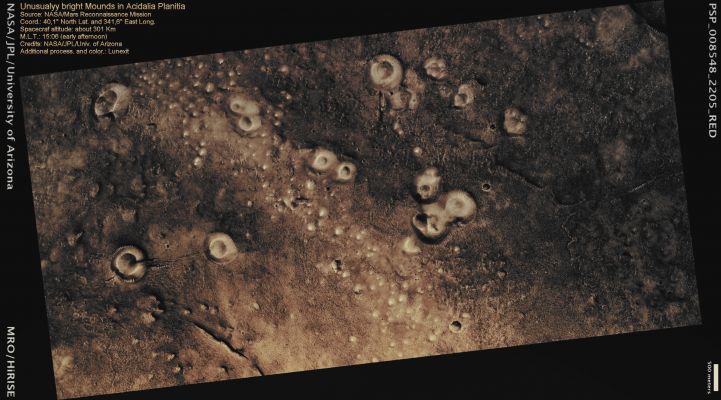
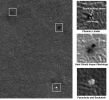
Mounds in Acidalia Planitia (Enhanced Absolute Natural Colors; credits for the additional process. and color.: Dr Paolo C. Fienga - Lunexit Team)
Caption NASA:"This image shows bright mounds scattered throughout a rather flat, dark landscape. These mounds range approximately between 20 and 500 meters (yards) in diameter.

The largest among them show central crater-like depressions which give them an appearance similar to terrestrial volcanoes. The origin of these mounds is still unclear. The most widely accepted hypotheses involve extrusion of underlying fluid-like materials (lava, wet/icy sediments) through weak points in the surface. 
Similar mounds have been observed elsewhere in the Northern Lowlands (the Northern Lowlands encompass a vast region of Mars younger than the rest of the Planet, as shown by lower number of impact craters, and well below its average altitude). Mounds such as the ones shown in this image may hold important clues for scientist to decipher the history of the Northern Lowlands: an old ocean basin? 
The site of continental-scale volcanism? 
Detailed analysis of HiRISE and other complementary datasets will help solve this mystery".
Parole chiave: Mars from orbit - Acidalia Planitia

Mounds in Acidalia Planitia (Enhanced Absolute Natural Colors; credits for the additional process. and color.: Dr Paolo C. Fienga - Lunexit Team)

Caption NASA:"This image shows bright mounds scattered throughout a rather flat, dark landscape. These mounds range approximately between 20 and 500 meters (yards) in diameter.

The largest among them show central crater-like depressions which give them an appearance similar to terrestrial volcanoes. The origin of these mounds is still unclear. The most widely accepted hypotheses involve extrusion of underlying fluid-like materials (lava, wet/icy sediments) through weak points in the surface.
Similar mounds have been observed elsewhere in the Northern Lowlands (the Northern Lowlands encompass a vast region of Mars younger than the rest of the Planet, as shown by lower number of impact craters, and well below its average altitude). Mounds such as the ones shown in this image may hold important clues for scientist to decipher the history of the Northern Lowlands: an old ocean basin?
The site of continental-scale volcanism?
Detailed analysis of HiRISE and other complementary datasets will help solve this mystery".

PSP_008508_1870_RED_abrowse.jpg PSP_008523_2060_RED_abrowse-01.jpg PSP_008548_2205_RED_abrowse.jpg PSP_008585_2915_.jpg PSP_008591_2485_cut_a.jpg
Informazioni sul file
Nome del file:PSP_008548_2205_RED_abrowse.jpg
Nome album:MareKromium / Mars Reconnaissance Orbiter (MRO)
Valutazione (2 voti):55555(Mostra dettagli)
Parole chiave:Mars / from / orbit / - / Acidalia / Planitia
Copyright:NASA/JPL/Univ. of Arizona e Dr Paolo C. Fienga - Lunar Explorer Italia per l'additional process. e la colorizzazione
Dimensione del file:1342 KiB
Data di inserimento:Ott 18, 2011
Dimensioni:4100 x 2274 pixels
Visualizzato:160 volte
URL:https://www.lunexit.it/gallery/displayimage.php?pid=30005
Preferiti:Aggiungi ai preferiti


Powered by Coppermine Photo Gallery