Inizio Registrati Login

Elenco album Ultimi arrivi Ultimi commenti Più viste Più votate Preferiti Cerca

Inizio > SOLAR SYSTEM > Mercury
Ritorna alla pagina delle miniature FILE 66/248 Torna all'inizio Guarda foto precedente Guarda foto successiva Salta alla fine
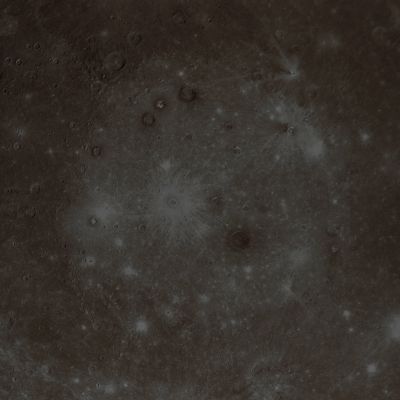
Caloris Basin (Absolute Natural Colors; credits for the additional process. and color.: Dr Paolo C. Fienga - Lunexit Team)
This view is a mosaic of multiple MDIS images and shows the Caloris Basin in its entirety. The Caloris Basin was discovered in 1974 from Mariner 10 images, but when Mariner 10 flew-by Mercury, only the Eastern half of the Basin was in daylight. During MESSENGER's first Mercury flyby, the Spacecraft was able to acquire High-Resolution images of the entire Basin, revealing the full extent of this Great Basin for the first time.

Geologists use the term "Basin" to refer to an impact crater that is larger than about 300 Km (186,3 miles) in diameter and often displays multiple Concentric Rings. Caloris has one Main Topographic Ring (1550-Km diameter). Patterns of concentric structures both inside and outside the Main Ring have been mapped and interpreted as evidence for additional Rings. 
Caloris is one of the largest Impact Basins in the Solar System, and MESSENGER's orbital observations will provide much more data for this impressive geologic feature, including high-resolution color and low-Sun images for discerning morphology. This mosaic was obtained when the Sun was high overhead. Such lighting conditions emphasize brightness differences among the Surface Materials, with little shadowing to provide a sense of the texture and topography. 
The interior of the Basin has been filled with lighter-hued Plains, which in turn have been modified by Impact Craters. These Craters range from small bright dots to larger Craters with bright Rays. Some of the larger Craters exhibit dark Rims. The dark Rims suggest that dark material underlies the Interior Plains in some places and was exposed through the formation of those Impact Craters.

Date Acquired: January, 14th, 2008
Instrument: Narrow Angle Camera (NAC) of the Mercury Dual Imaging System (MDIS)
Scale: Caloris Basin is roughly 1550 Km in diameter (about 962,55 miles)
Parole chiave: Mercury's Fly-by

Caloris Basin (Absolute Natural Colors; credits for the additional process. and color.: Dr Paolo C. Fienga - Lunexit Team)

This view is a mosaic of multiple MDIS images and shows the Caloris Basin in its entirety. The Caloris Basin was discovered in 1974 from Mariner 10 images, but when Mariner 10 flew-by Mercury, only the Eastern half of the Basin was in daylight. During MESSENGER's first Mercury flyby, the Spacecraft was able to acquire High-Resolution images of the entire Basin, revealing the full extent of this Great Basin for the first time.

Geologists use the term "Basin" to refer to an impact crater that is larger than about 300 Km (186,3 miles) in diameter and often displays multiple Concentric Rings. Caloris has one Main Topographic Ring (1550-Km diameter). Patterns of concentric structures both inside and outside the Main Ring have been mapped and interpreted as evidence for additional Rings.
Caloris is one of the largest Impact Basins in the Solar System, and MESSENGER's orbital observations will provide much more data for this impressive geologic feature, including high-resolution color and low-Sun images for discerning morphology. This mosaic was obtained when the Sun was high overhead. Such lighting conditions emphasize brightness differences among the Surface Materials, with little shadowing to provide a sense of the texture and topography.
The interior of the Basin has been filled with lighter-hued Plains, which in turn have been modified by Impact Craters. These Craters range from small bright dots to larger Craters with bright Rays. Some of the larger Craters exhibit dark Rims. The dark Rims suggest that dark material underlies the Interior Plains in some places and was exposed through the formation of those Impact Craters.

Date Acquired: January, 14th, 2008
Instrument: Narrow Angle Camera (NAC) of the Mercury Dual Imaging System (MDIS)
Scale: Caloris Basin is roughly 1550 Km in diameter (about 962,55 miles)

ZY-Mercury-PIA13840-PCF-LXTT.jpg ZZ-Craters-Mercury-Secondary_Craters_Field-PIA14379.jpg ZZ-Mercury-Caloris_Basin-PIA13675-PCF-LXTT-3.jpg ZZ-Mercury-Caloris_Basin.jpg ZZ-Mercury-Caloris_Montes-546192main_messenger_orbit_image20110517_1_full_full.jpg
Informazioni sul file
Nome del file:ZZ-Mercury-Caloris_Basin-PIA13675-PCF-LXTT-3.jpg
Nome album:MareKromium / Mercury
Valutazione (5 voti):55555(Mostra dettagli)
Parole chiave:Mercury's / Fly-by
Copyright:NASA/Johns Hopkins University Applied Physics Laboratory/Carnegie Institution of Washington and Paolo C. Fienga/Lunexit Team per il process. addizionale e la colorizzazione
Dimensione del file:1702 KiB
Data di inserimento:Gen 23, 2011
Dimensioni:3400 x 3400 pixels
Visualizzato:129 volte
URL:https://www.lunexit.it/gallery/displayimage.php?pid=28194
Preferiti:Aggiungi ai preferiti


Powered by Coppermine Photo Gallery