Inizio Registrati Login

Elenco album Ultimi arrivi Ultimi commenti Più viste Più votate Preferiti Cerca

Inizio > SOLAR SYSTEM > The Sun: just a star, like many others...
Ritorna alla pagina delle miniature FILE 40/143 Torna all'inizio Guarda foto precedente Guarda foto successiva Salta alla fine
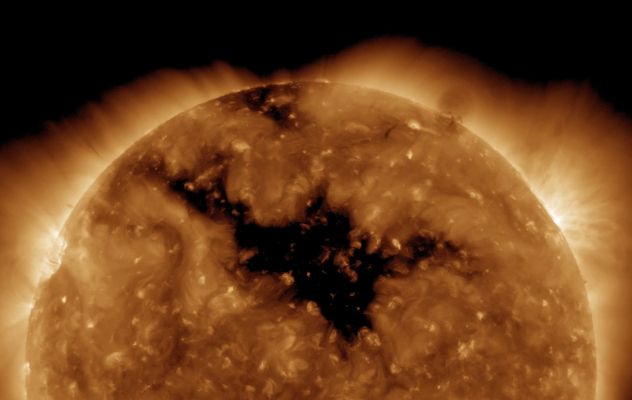
Deep Coronal Holes
Caption NASA:"This ominous, dark shape sprawling across the face of the Sun is a Coronal Hole -- a low density region extending above the Surface where the Solar Magnetic Field opens freely into interplanetary space. 
Studied extensively from space since the 1960s in UltraViolet and X-Ray Light, Coronal Holes are known to be the source of the high-speed Solar Wind (such as atoms and electrons which flow outward along the open Magnetic Field lines). During periods of low activity, Coronal Holes typically cover regions just above the Sun's Poles. 
But this extensive Coronal Hole dominated the Sun's Northern Hemisphere earlier this week, captured here in Extreme UV Light by cameras onboard the Solar Dynamics Observatory. The solar wind streaming from this Coronal Hole triggered auroral displays on Earth".
Parole chiave: From Space Pictures

Deep Coronal Holes

Caption NASA:"This ominous, dark shape sprawling across the face of the Sun is a Coronal Hole -- a low density region extending above the Surface where the Solar Magnetic Field opens freely into interplanetary space.
Studied extensively from space since the 1960s in UltraViolet and X-Ray Light, Coronal Holes are known to be the source of the high-speed Solar Wind (such as atoms and electrons which flow outward along the open Magnetic Field lines). During periods of low activity, Coronal Holes typically cover regions just above the Sun's Poles.
But this extensive Coronal Hole dominated the Sun's Northern Hemisphere earlier this week, captured here in Extreme UV Light by cameras onboard the Solar Dynamics Observatory. The solar wind streaming from this Coronal Hole triggered auroral displays on Earth".

Solar_Corona.jpg Solar_Corona_vangorp_big.jpg Solar_Corona~0.jpg Solar_Eclipse-2010.jpg Solar_Eclipse-Tse2008_200_mo1_big.jpg
Informazioni sul file
Nome del file:Solar_Corona~0.jpg
Nome album:MareKromium / The Sun: just a star, like many others...
Valutazione (5 voti):55555(Mostra dettagli)
Parole chiave:From / Space / Pictures
Copyright:NASA/Goddard/SDO-AIA Team
Dimensione del file:339 KiB
Data di inserimento:Ago 29, 2010
Dimensioni:1800 x 1139 pixels
Visualizzato:110 volte
URL:https://www.lunexit.it/gallery/displayimage.php?pid=27432
Preferiti:Aggiungi ai preferiti

Commento 1 a 8 di 8
Pagina: 1

Anakin   [Nov 29, 2012 at 01:43 PM]
Hanno scoperto un Buco Nero supergigante. Le sue dimensioni sono 11 volte maggiori dell'orbita di Nettuno. la sua sigla è NGC 1277. Ma una cosa non ho capito: sono dei buchi o sono stelle di massa enorme? Cioè se io gli vado incontro, atterrò con un astronave o ci passo dentro ed esco da una ltra parte?
MareKromium   [Nov 29, 2012 at 03:13 PM]
Astronomers have discovered what may be the most massive black hole ever known in a small galaxy (known as NGC 1277) which lies about 250 million light-years from Earth, scientists say.

The supermassive black hole has a mass equivalent to 17 billion suns and is located, as we said, inside the galaxy NGC 1277 in the constellation of Perseus. It makes up about 14 percent of its host galaxy's mass, compared with the 0.1 percent a normal black hole would represent, scientists said.

"This is a really oddball galaxy," said study team member Karl Gebhardt of the University of Texas at Austin in a statement. "It's almost all black hole. This could be the first object in a new class of galaxy-black hole systems."

The giant black hole is about 11 times as wide as the orbit of Neptune around our Sun, researchers said. The mass is so far above normal that the scientists took a year to double-check and submit their research paper for publication, according to the study's lead author, Remco van den Bosch.

"The first time I calculated it, I thought I must have done something wrong. We tried it again with the same instrument, then a different instrument," van den Bosch, an astronomer at Germany's Max Planck Institute for Astronomy, told SPACE.com. "Then I thought, 'Maybe something else is happening".

Per Anakin: la tua domanda, al momento, non ha risposta. Però è bello pensare a quello che accadrebbe se ci addentrassimo all'interno di un Buco Nero... Abbraccio Circolare! paolo

P.S.: L'anomalia di questo specifico Buco Nero è che va (SEMBRA che vada) a coprire, in termini di estensione, l'intera Galassia alla quale accede (NGC, ossìa New General Catalog Object n. 1277). Non so, ma vista la notizia così, da Astrofisico, mi viene da pensare ad un errore di valutazione da parte degli Amici Texani. Però io, come ovvio, non ho le loro grandi conoscenze ed i loro (ritengo notevolissimi ed assai significativi) dati, e quindi può anche darsi che abbiano visto giusto. certo è che un Buco Nero grande quasi quanto la Galassia che lo "ospita", è un paradosso. Un incredibile ed affascinante paradosso.
Anakin   [Nov 29, 2012 at 03:34 PM]
ma è un buco o un corpo di materia tangibile?
AndreaGG   [Nov 29, 2012 at 06:58 PM]
MK mi corregga se sbaglio... Attualmente la teoria più convincente è che un buco nero nasca dal collasso gravitazionale di una stella massiva... Altra cosa sono i buchi neri al centro delle galassie, dove non è certo che il progenitore sia una stella, comunque sono concentrazioni di materia in uno spazio molto "ristretto". Questi sono per altro mooolto più grandi rispetto ai primi buchi neri citati. Consiglio una ricerca sul sito astronomia.com dove se ne spiega la natura in diversi articoli...
paolocf1963   [Nov 29, 2012 at 07:09 PM]
Se Vi va, Vi racconto quello che penso, dopo aver studiato, con Passione e Fatica, la Materia...
AndreaGG   [Nov 30, 2012 at 06:18 AM]
A me interessa molto il tuo punto di vista! ;)
Anakin   [Nov 30, 2012 at 06:53 AM]
Sì Paolo, grazie!
pierluigi   [Nov 30, 2012 at 08:23 AM]
Ciao a tutti ragazzi, quella dei buchi neri e' una storia che mi ha sempre affascinato, ma che non ho mai capito, grazie Paolo.

Commento 1 a 8 di 8
Pagina: 1


Powered by Coppermine Photo Gallery