Inizio Registrati Login

Elenco album Ultimi arrivi Ultimi commenti Più viste Più votate Preferiti Cerca

Inizio > MARS > Mars Reconnaissance Orbiter (MRO)
Ritorna alla pagina delle miniature FILE 53/2237 Torna all'inizio Guarda foto precedente Guarda foto successiva Salta alla fine
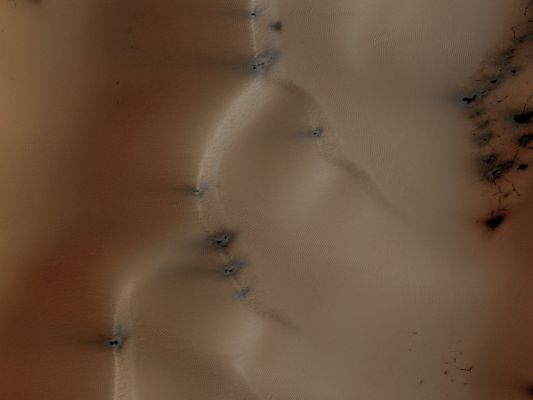
Dunes in Richardson Crater (EDM - Natural Colors; credits for the additional process. and color.: Dr Paolo C. Fienga - Lunexit Team)
This observation from NASA's Mars Reconnaissance Orbiter (MRO) is a view of the Sand Dunefield in Richardson Crater, still partually covered with seasonal frost.

This EDM is a close-up view of defrosting patterns on the Dunes. The frost is a combination of frozen CO2 and some water ice that covers the Dunes in the Winter and Spring. As the seasonal frost sublimes away, odd features such as spots, fans, and streaks form.
Small dark streaks on the dune slip-face slopes may be where recent avalanches of sand, or perhaps wind, has moved the dark sand underlying the frost, or where frost has been removed to expose the sand. Alternatively, the dark streaks may be patches of coarse-grained ice that are clear enough so that the dark material below the ice is visible. 
The slip-faces indicate the general direction of sand transport.

It has been hypothesized that the Dark Spots and Fans may be "geysers" or "cold gas jets" that form when sublimation processes trap gas at the bottom of the ice. The gas is released through cracks in the ice, entraining dust from below the ice and scattering it onto the Surface to form the Dark Spots and Fans.
Parole chiave: Mars from orbit - Craters - Richardson Crater

Dunes in Richardson Crater (EDM - Natural Colors; credits for the additional process. and color.: Dr Paolo C. Fienga - Lunexit Team)

This observation from NASA's Mars Reconnaissance Orbiter (MRO) is a view of the Sand Dunefield in Richardson Crater, still partually covered with seasonal frost.

This EDM is a close-up view of defrosting patterns on the Dunes. The frost is a combination of frozen CO2 and some water ice that covers the Dunes in the Winter and Spring. As the seasonal frost sublimes away, odd features such as spots, fans, and streaks form.
Small dark streaks on the dune slip-face slopes may be where recent avalanches of sand, or perhaps wind, has moved the dark sand underlying the frost, or where frost has been removed to expose the sand. Alternatively, the dark streaks may be patches of coarse-grained ice that are clear enough so that the dark material below the ice is visible.
The slip-faces indicate the general direction of sand transport.

It has been hypothesized that the Dark Spots and Fans may be "geysers" or "cold gas jets" that form when sublimation processes trap gas at the bottom of the ice. The gas is released through cracks in the ice, entraining dust from below the ice and scattering it onto the Surface to form the Dark Spots and Fans.

Deimos-PIA02699.jpg Deuteronilus_Mensae-PIA12996.jpg Dunes-PIA13268-PCF-LXTT.jpg Dunes_and_DD_Tracks-PIA13538-EB-LXTT-001.jpg Dunes_and_DD_Tracks-PIA13538-PCF-LXTT-000.jpg
Informazioni sul file
Nome del file:Dunes-PIA13268-PCF-LXTT.jpg
Nome album:MareKromium / Mars Reconnaissance Orbiter (MRO)
Valutazione (5 voti):55555(Mostra dettagli)
Parole chiave:Mars / from / orbit / - / Craters / - / Richardson / Crater
Copyright:NASA/JPL-Caltech/Univ. of Arizona and Paolo C. Fienga/Lunexit Team per l'additional process. e la colorizzazione
Dimensione del file:716 KiB
Data di inserimento:Lug 15, 2010
Dimensioni:2560 x 1920 pixels
Visualizzato:57 volte
URL:https://www.lunexit.it/gallery/displayimage.php?pid=27111
Preferiti:Aggiungi ai preferiti


Powered by Coppermine Photo Gallery