Inizio Registrati Login

Elenco album Ultimi arrivi Ultimi commenti Più viste Più votate Preferiti Cerca

Inizio > MARS > Mars Reconnaissance Orbiter (MRO)
Ritorna alla pagina delle miniature FILE 2235/2237 Torna all'inizio Guarda foto precedente Guarda foto successiva Salta alla fine
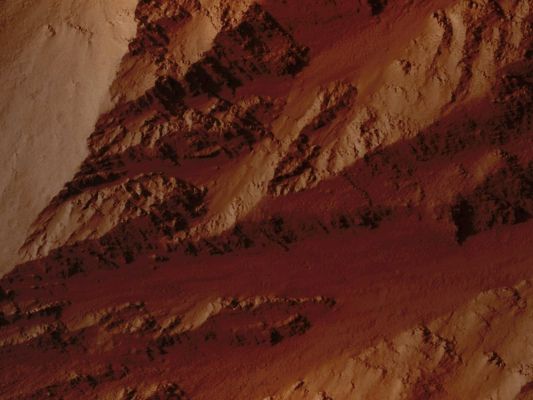
Olympus' Edge (Extremely Enhanced Absolute Natural Colors; credits for the additional process. and color.: Dr Paolo C. Fienga - Lunexit Team)
This image covers the Northern Edge of the largest Volcano of the Solar System: Olympus Mons. 

The margin of Olympus Mons is defined by a massive Cliff which is several kilometers tall. At this location, the Cliff is nearly 7 Km (about 23.000 feet) tall. 
The Cliff exposes the guts of the volcano, revealing interbedded hard and soft layers. The hard layers are Lava and the soft layers may be Dust (from large Dust Storms) or Volcanic Ash. 

The High Resolution Imaging Science Experiment (HiRISE) camera on NASA's Mars Reconnaissance Orbiter recorded this image on March 2, 2010.
Most scientists think the the Cliffs formed by Landslides. This collapse is driven by the weight of the huge volcano exceeding the strength of the rocks it is built of. 

This image covers a swath of ground about 1 Km (such as approx. two-thirds of a mile) wide. It is a portion of HiRISE observation ESP_016886_2030, which is centered at 22,95° North Lat. and 224,76° East Long. The season on Mars is Northern-Hemisphere Spring. 
Other image products from this observation are available at http://hirise.lpl.arizona.edu/ESP_016886_2030.
Parole chiave: Mars from orbit - Volcanoes - Olympus Mons

Olympus' Edge (Extremely Enhanced Absolute Natural Colors; credits for the additional process. and color.: Dr Paolo C. Fienga - Lunexit Team)

This image covers the Northern Edge of the largest Volcano of the Solar System: Olympus Mons.

The margin of Olympus Mons is defined by a massive Cliff which is several kilometers tall. At this location, the Cliff is nearly 7 Km (about 23.000 feet) tall.
The Cliff exposes the guts of the volcano, revealing interbedded hard and soft layers. The hard layers are Lava and the soft layers may be Dust (from large Dust Storms) or Volcanic Ash.

The High Resolution Imaging Science Experiment (HiRISE) camera on NASA's Mars Reconnaissance Orbiter recorded this image on March 2, 2010.
Most scientists think the the Cliffs formed by Landslides. This collapse is driven by the weight of the huge volcano exceeding the strength of the rocks it is built of.

This image covers a swath of ground about 1 Km (such as approx. two-thirds of a mile) wide. It is a portion of HiRISE observation ESP_016886_2030, which is centered at 22,95° North Lat. and 224,76° East Long. The season on Mars is Northern-Hemisphere Spring.
Other image products from this observation are available at http://hirise.lpl.arizona.edu/ESP_016886_2030.

Volcanoes-Arsia_Mons-PIA13540-1.jpg Volcanoes-Arsia_Mons-PIA13540-2.jpg Volcanoes-Olympus_Mons-PIA12992.jpg Weather-PIA10672.gif Yardangs-Medusae_Fossae-TRA_000828_1805_IRB-04-PCF-LXTT.jpg
Informazioni sul file
Nome del file:Volcanoes-Olympus_Mons-PIA12992.jpg
Nome album:MareKromium / Mars Reconnaissance Orbiter (MRO)
Valutazione (3 voti):55555(Mostra dettagli)
Parole chiave:Mars / from / orbit / - / Volcanoes / - / Olympus / Mons
Copyright:NASA/JPL-Caltech/Univ. of Arizona and Paolo C. Fienga/Lunexit Team per l'additional process. e la colorizzazione
Dimensione del file:193 KiB
Data di inserimento:Mag 11, 2010
Dimensioni:1333 x 1000 pixels
Visualizzato:57 volte
URL:https://www.lunexit.it/gallery/displayimage.php?pid=26737
Preferiti:Aggiungi ai preferiti


Powered by Coppermine Photo Gallery