


|

|

|

|


| Inizio > MARS > Mars Reconnaissance Orbiter (MRO) |
 |
FILE 353/2236 |  |
 |
 |
 |
|
|||
|
 |
||||||||
|
||||||||
|


| Informazioni sul file | |
| Nome del file: | ESP_016036_1370_RED_abrowse-00.jpg |
| Nome album: | MareKromium / Mars Reconnaissance Orbiter (MRO) |
| Valutazione (6 voti): |  (Mostra dettagli) (Mostra dettagli) |
| Parole chiave: | Mars / from / orbit / - / Dunes / - / Noachis / Terra / Region |
| Copyright: | NASA/JPL/Univ. of Arizona e Paolo C. Fienga/Lunexit Team per il processing addizionale e la colorizzazione |
| Dimensione del file: | 1891 KiB |
| Data di inserimento: | Gen 16, 2010 |
| Dimensioni: | 5293 x 2048 pixels |
| Visualizzato: | 66 volte |
| URL: | https://www.lunexit.it/gallery/displayimage.php?pid=26120 |
| Preferiti: | Aggiungi ai preferiti |
Commento 1 a 2 di 2 Pagina: 1 |
|
|||
|
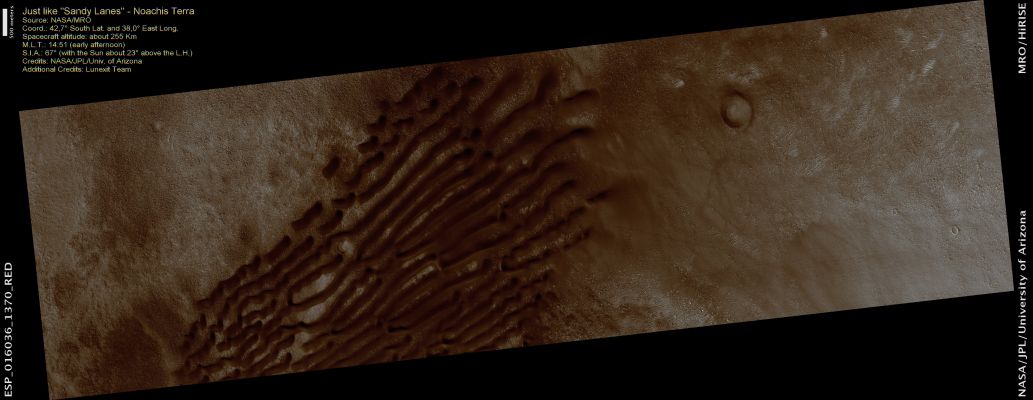
Questa, invece, è proprio bella e, penso, corretta. - PCF
|
|
|||
|
si riesce anche a capire, dalla geometria delle dune la direzione del vento che le ha generate....dal basso-destra all'alto-sinistra (non uso coordinate perchè non avrebbe senso...)..inoltre si possono notare differenti morfologie..ad esempio le dune più piccole possono essere classificate grossomodo "Barcane", la cui forma ricorda una falce di Luna le cui punte sono dirette sottovento; le dune invece estese sono campi detti "Dune trasversali" la cui assiemetria marcata tra il lato sottovento e il lato controvento ne svelano indirettamente la direzione dominante delle correnti d'aria che le hanno generate.Interessante notare che tra i campi di dune compaiono qua e la increspature di superficie molto piccole, orientate perpendicolarmente ad essi e che secondo me potrebbero essersi generate sott'acqua o comunque in una fase precedente alla formazione delle dune più grandi che, peraltro sono costitutite da un materiale probabilmente differente sia per granulometria sia per natura petrografica.
|
Commento 1 a 2 di 2 Pagina: 1 |

