Inizio Registrati Login

Elenco album Ultimi arrivi Ultimi commenti Più viste Più votate Preferiti Cerca

Inizio > SOLAR SYSTEM > Venus
Ritorna alla pagina delle miniature FILE 18/126 Torna all'inizio Guarda foto precedente Guarda foto successiva Salta alla fine
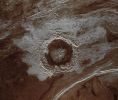
Barton Crater (possible Natural Colors; credits: Dr Paolo C. Fienga - Lunexit Team)
During orbits 404 through 414 on 19-20 September 1990, the Magellan Probe imaged a Peak-Ring Crater that is about 50 Km in diameter located at Latitude 27,4° North and Longitude 337,5° East. The name "Barton" has been proposed by the Magellan Science Team for this Crater, after Clara Barton, founder of the Red Cross; however, the name is tentative pending approval by the International Astronomical Union.

Barton is just at the diameter size that Venus Impact Craters appear to begin to possess Peak-Rings instead of a single Central Peak or Central Peak complex like does about 75% of the craters with diameters between about 50 and 15 Km. 

The floor of the Crater is flat and radar-dark, indicating possible infilling by volcanic deposits sometime following the impact event. Barton's Central Peak Ring is discontinuous and appears to have been disrupted or separated during or following the cratering process. The extremely blocky crater deposits (ejecta) surrounding Barton appear to be most extensive on the South-West to South-East (lower left to right) side of it.
Parole chiave: Venus from orbit - Craters - Barton Crater

Barton Crater (possible Natural Colors; credits: Dr Paolo C. Fienga - Lunexit Team)

During orbits 404 through 414 on 19-20 September 1990, the Magellan Probe imaged a Peak-Ring Crater that is about 50 Km in diameter located at Latitude 27,4° North and Longitude 337,5° East. The name "Barton" has been proposed by the Magellan Science Team for this Crater, after Clara Barton, founder of the Red Cross; however, the name is tentative pending approval by the International Astronomical Union.

Barton is just at the diameter size that Venus Impact Craters appear to begin to possess Peak-Rings instead of a single Central Peak or Central Peak complex like does about 75% of the craters with diameters between about 50 and 15 Km.

The floor of the Crater is flat and radar-dark, indicating possible infilling by volcanic deposits sometime following the impact event. Barton's Central Peak Ring is discontinuous and appears to have been disrupted or separated during or following the cratering process. The extremely blocky crater deposits (ejecta) surrounding Barton appear to be most extensive on the South-West to South-East (lower left to right) side of it.

Craters-Balch_Crater-0.jpg Craters-Balch_Crater-1.jpg Craters-Barton_Crater-PIA00463.jpg Craters-Dickinson_Crater-PIA00479.jpg Craters-Fossey_Crater-PCF-LXTT-00.jpg
Informazioni sul file
Nome del file:Craters-Barton_Crater-PIA00463.jpg
Nome album:MareKromium / Venus
Valutazione (2 voti):55555(Mostra dettagli)
Parole chiave:Venus / from / orbit / - / Craters / - / Barton / Crater
Copyright:NASA/JPL - Magellan Probe Project e Paolo C. Fienga/Lunexit Team per l'additional process. e la colorizzazione
Dimensione del file:434 KiB
Data di inserimento:Gen 11, 2010
Dimensioni:1620 x 1620 pixels
Visualizzato:55 volte
URL:https://www.lunexit.it/gallery/displayimage.php?pid=26088
Preferiti:Aggiungi ai preferiti


Powered by Coppermine Photo Gallery