Inizio Registrati Login

Elenco album Ultimi arrivi Ultimi commenti Più viste Più votate Preferiti Cerca

Inizio > MARS > Mars Reconnaissance Orbiter (MRO)
Ritorna alla pagina delle miniature FILE 218/2237 Torna all'inizio Guarda foto precedente Guarda foto successiva Salta alla fine
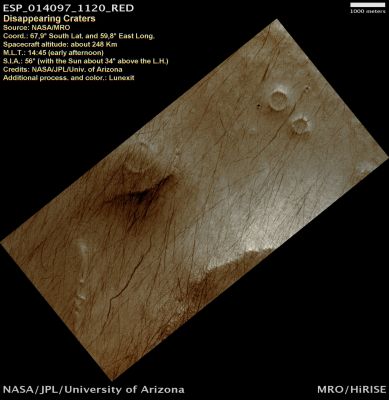
Disappearing Craters (Natural Colors; credits: Lunar Explorer Italia)
Impact Craters that form at High Latitudes often disappear faster than those that form in Equatorial Regions. The craters in this image are only barely detectable. 

Over time, craters in ice, particularly large craters, "relax". 
Their depth-to-diameter ratio decreases as the bowl of the crater gets shallower with time. The craters slowly appear softer and smoother, fading into the surrounding landscape, until they remain only as circular patterns on flat ground, before they eventually disappear altogether. The larger the crater, the faster it will relax.

The reason for the crater degradation is partly due to in-filling by snow or dust and slumping off of the crater walls, and also partly from processes that produce the patterned ground you see in this HiRISE image. But the primary reason for the shallowing is because the ground at High Latitudes on Mars is ice-rich, and ice is not very strong. At warmer temperatures found in the Inner Solar System, ice generally flows more easily than rock, so ice cannot support the structure of the crater as well as rock. The crater relaxes as the ice begins to flow back to a level surface.

All of the processes listed above have likely acted on these craters, and recently, they have also been swept by Dust Devils, which left dark streaks in their wake.
Parole chiave: Mars from orbit - DD Tracks and Buried Craters

Disappearing Craters (Natural Colors; credits: Lunar Explorer Italia)

Impact Craters that form at High Latitudes often disappear faster than those that form in Equatorial Regions. The craters in this image are only barely detectable.

Over time, craters in ice, particularly large craters, "relax".
Their depth-to-diameter ratio decreases as the bowl of the crater gets shallower with time. The craters slowly appear softer and smoother, fading into the surrounding landscape, until they remain only as circular patterns on flat ground, before they eventually disappear altogether. The larger the crater, the faster it will relax.

The reason for the crater degradation is partly due to in-filling by snow or dust and slumping off of the crater walls, and also partly from processes that produce the patterned ground you see in this HiRISE image. But the primary reason for the shallowing is because the ground at High Latitudes on Mars is ice-rich, and ice is not very strong. At warmer temperatures found in the Inner Solar System, ice generally flows more easily than rock, so ice cannot support the structure of the crater as well as rock. The crater relaxes as the ice begins to flow back to a level surface.

All of the processes listed above have likely acted on these craters, and recently, they have also been swept by Dust Devils, which left dark streaks in their wake.

ESP_014083_0945_RED_abrowse-01.jpg ESP_014083_0945_RED_abrowse-02.jpg ESP_014097_1120_RED_abrowse.jpg ESP_014100_1600_RED_abrowse.jpg ESP_014103_2485-ESP_014393_2485.jpg
Informazioni sul file
Nome del file:ESP_014097_1120_RED_abrowse.jpg
Nome album:MareKromium / Mars Reconnaissance Orbiter (MRO)
Valutazione (6 voti):55555(Mostra dettagli)
Parole chiave:Mars / from / orbit / - / DD / Tracks / and / Buried / Craters
Copyright:NASA/JPL/Univ. of Arizona e Lunar Explorer Italia per il processing addizionale e la colorizzazione
Dimensione del file:453 KiB
Data di inserimento:Ott 15, 2009
Dimensioni:2048 x 2103 pixels
Visualizzato:60 volte
URL:https://www.lunexit.it/gallery/displayimage.php?pid=25510
Preferiti:Aggiungi ai preferiti


Powered by Coppermine Photo Gallery